Plan maintenance, resolve issues, and document actions in a traceable manner: EcholoN helps companies map their maintenance processes within a configurable software platform.
As CMMS and maintenance software, EcholoN integrates equipment information, maintenance procedures, work orders, and feedback into a single process. The specific data, steps, and roles involved are tailored to your facility structure and maintenance strategy.
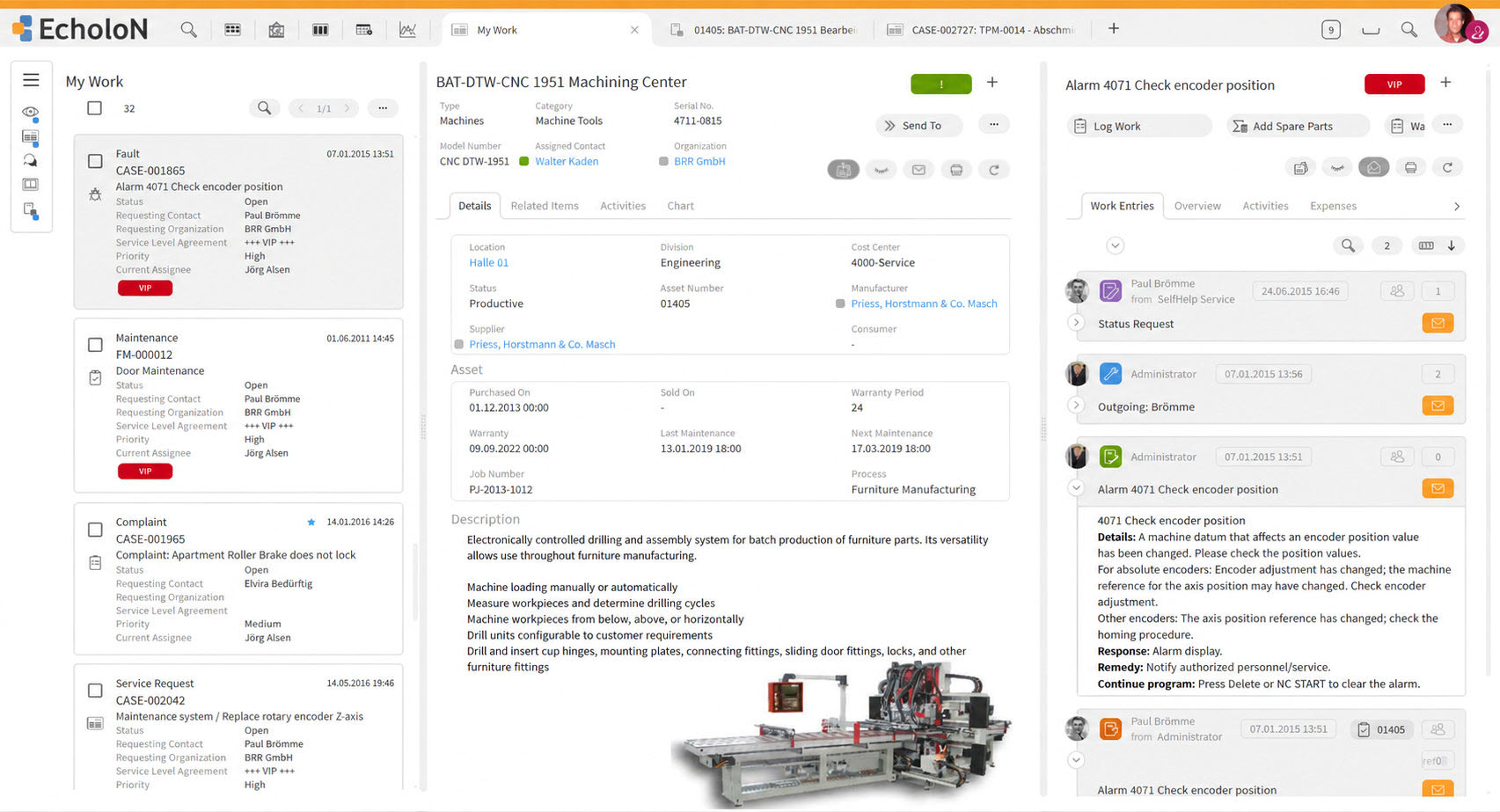
Manage Maintenance, Malfunctions, and Work Orders in a Single Process
A maintenance order requires more than just a schedule. Employees need to know which piece of equipment is affected, what needs to be done, who is responsible for the work, and how the results will be documented. EcholoN can map out maintenance and inspection plans, malfunction reports, and work orders along with their associated process steps.
Depending on the configuration and data model, the following can be taken into account, for example:
- Equipment, assets, or affected components,
- Reason and description of the work,
- Date, priority, and responsibility,
- Required inspection steps or work instructions,
- Feedback, results, and further processing.
Materials, spare parts, bills of materials, and assemblies can be linked to equipment and processes as needed. The associated data can be imported from upstream systems, such as an ERP system, and mapped within EcholoN. The specific objects and relationships required depend on your plant and process structure.
This allows you to trace the maintenance history based on the associated plant information. It supports daily work order processing and can serve as a basis for future analyses.
A Possible Workflow: From the Condition Report to the Documented Work Order
The EcholoN software revolutionises the perspective on maintenance and operation through its innovative approaches in the area of maintenance management. Companies that rely on efficient and automated management of their service processes in particular rely on EcholoN. With its modular architecture, the software offers flexible customisation without the need for costly programming.
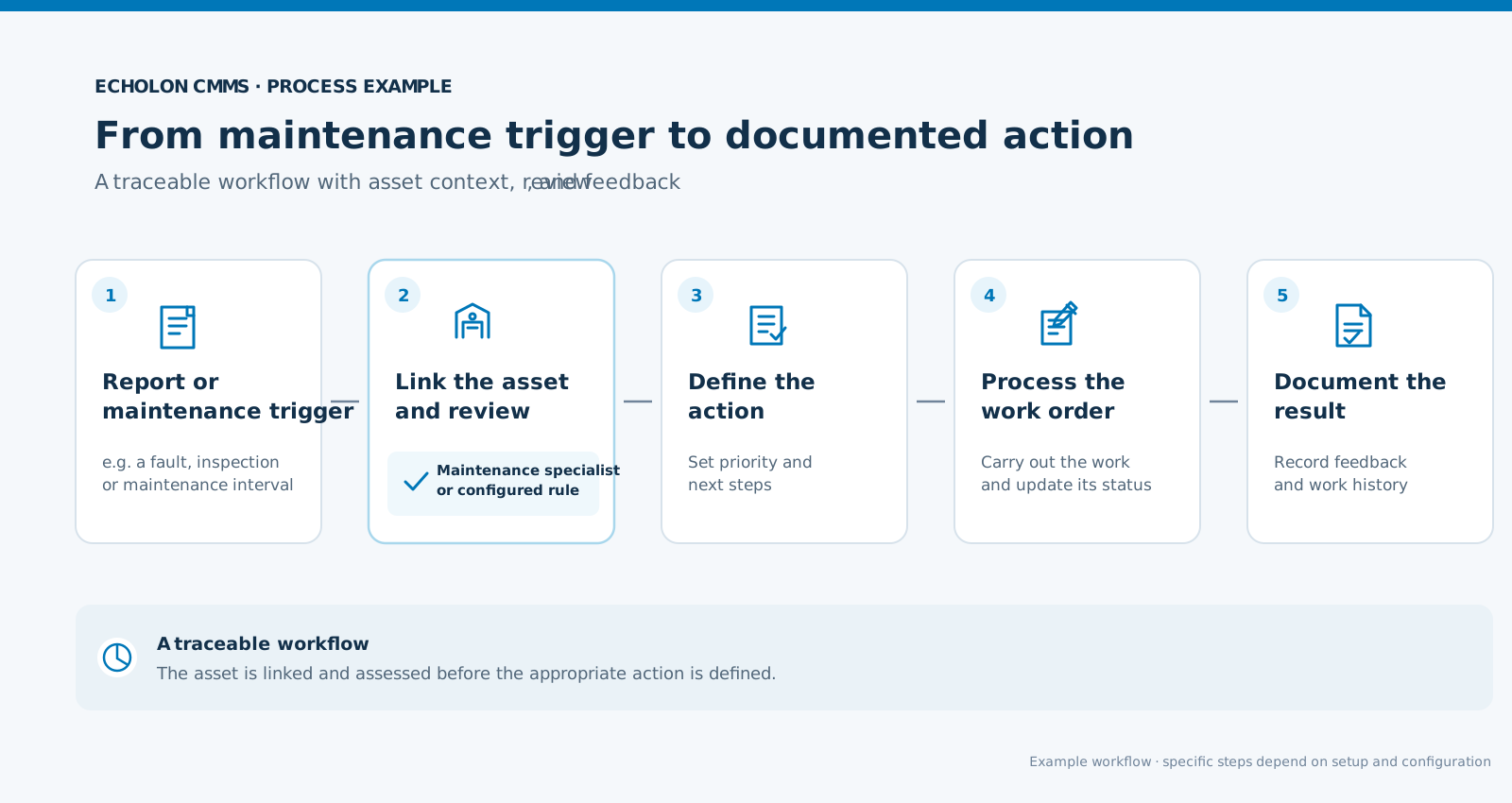
The following workflow is an example. The specific triggers, approvals, and responsibilities are configured for each individual process.
- A report or status update is received. It is assigned to a piece of equipment or a component.
- A responsible person reviews the issue. Equipment information and the documented history may be taken into account during this review.
- A decision is made regarding the action to be taken. Depending on the rule, this may be followed by a review, approval, or direct processing.
- A work order is created or processed further. The scope, responsibility, and required information depend on the process.
- The work is reported back. The result and relevant information are documented and assigned to the incident or the asset.
For defined statuses or events, configured rules can trigger follow-up processes. This requires a suitable data source, assignment, and process configuration. The workflow does not mean that every sensor message automatically generates a maintenance order.
Scheduled Maintenance and Maintenance Based on Condition Data
EcholoN supports maintenance triggers at fixed intervals with a defined lead time, as well as—depending on the use case—based on counter or usage limits. This can result in individual tasks on a one-to-one basis. For recurring bulk inspections, such as VDE electrical inspections, batch tasks can also be generated.
In condition-based maintenance, measured values or condition information are also factored into the decision-making process. Depending on the connection and the configured rule, detected limit violations, changes in condition, or events can trigger a notification, inspection, or further action.
Learn more about preventive maintenance.
Predictive Maintenance with EcholoN
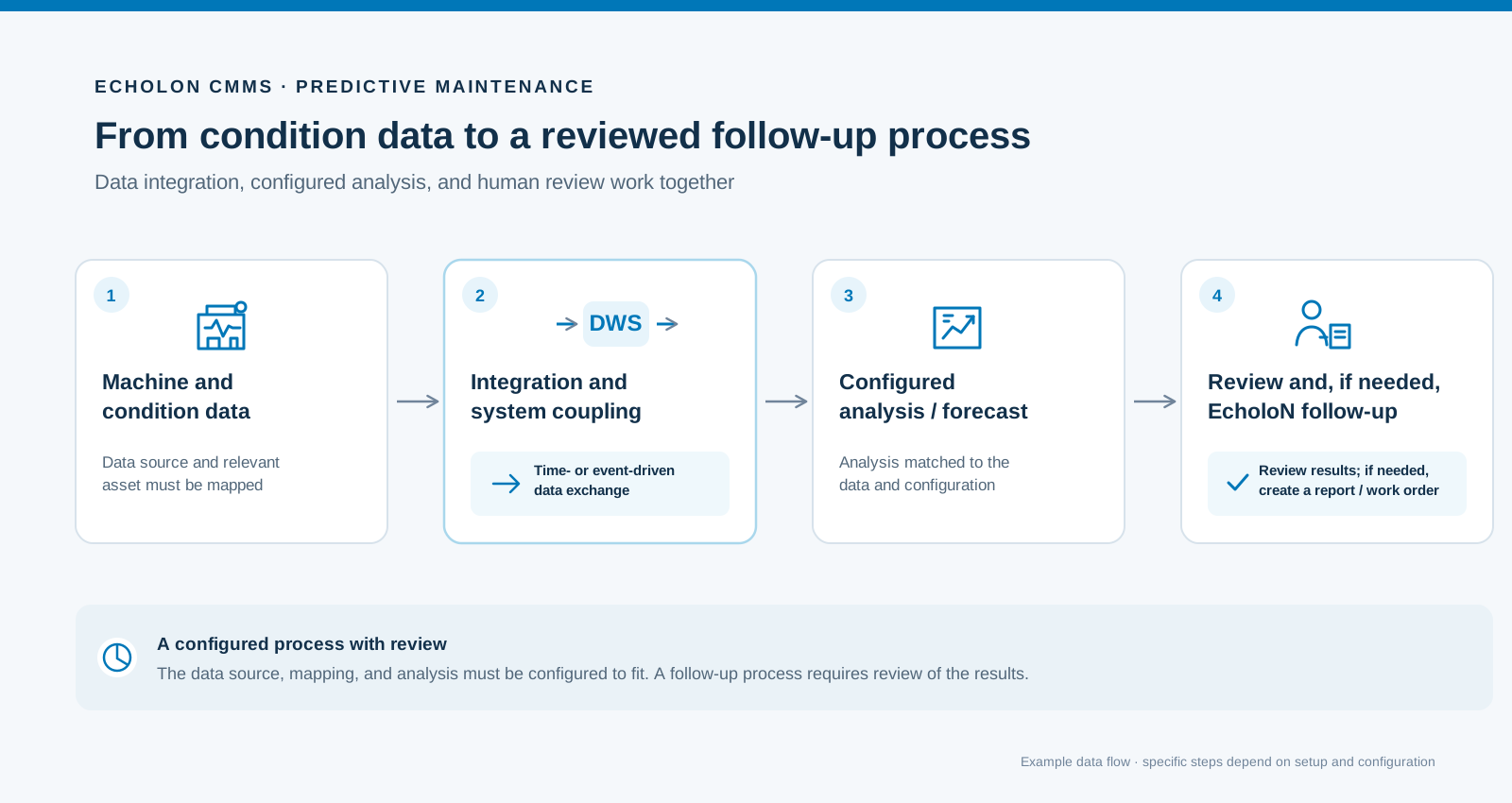
Predictive maintenance analyzes machine, sensor, or condition data to deduce probable future states or potential maintenance needs. Once properly configured, EcholoN can analyze such data to generate predictive maintenance forecasts.
To do this, the data sources, data model, and forecasting logic must be tailored to the specific use case. The forecast is therefore not an automatically available standard function that delivers immediately reliable results for every system without a suitable database and configuration. AI analyses can be used supplementarily for the evaluation. Forecast or analysis results can then be further processed in EcholoN.
Three tasks must be distinguished here:
- Data integration: Import condition and machine data from the designated sources and assign them appropriately.
- Analysis and forecasting: Evaluate data according to the configured logic; methods and prerequisites depend on the specific use case.
- Maintenance process: Review and prioritize results and - if the specified conditions are met - convert them into notifications, work orders, or further actions.
The EcholoN Data Workflow System (DWS) can make data from the designated sources available in EcholoN. Based on this data, predictive and analytical logic can be implemented via EcholoN Reporting or AI analyses. DWS provides data integration and system interfacing; the evaluation and its business logic depend on the specific use case.
Learn more about Predictive Maintenance: Definition, Application, and Prerequisites.
Data Sources and System Integration
Maintenance processes may require information from ERP, production, IoT, and other line-of-business systems. The DWS can integrate and transform data from various sources. The EcholoN documentation lists, among other things, databases, web services, and industrial and manufacturing systems via M2M/MQTT. Depending on the source and configuration, data exchange can be time- or event-driven.
Whether an interface is suitable for a specific sensor or data stream—and at what frequency data is transmitted—must be technically verified. General real-time processing of all IoT data is therefore not guaranteed.
Before integration, the following should be clarified:
- Which system is the primary source for asset and master data?
- How are assets and components uniquely assigned across systems?
- Which measured values or events are relevant for maintenance?
- How frequently and via which interface should data be transmitted?
- What data quality and history are required for analysis?
- Which conditions may automatically trigger follow-up processes, and where is human verification required?
Workflows for Responsibilities and Follow-Up Tasks
With the EcholoN Workflow Engine, process steps, roles, and rules can be configured to suit the specific workflow. In maintenance, for example, a workflow can specify who reviews a work order, when approval is required, and how completed work is documented.
The workflow configuration determines what happens automatically and which decisions employees make. This ensures that triggers, responsibilities, and handoffs within the process remain traceable.
Mobile Processing in the Respective Operational Model
Technicians can process work orders and relevant information on the go and report back on their work on-site. The EcholoN Mobile Solution supports both online and offline processing. Which order information and process steps are available is configured according to the user’s role and the maintenance process.
Learn more about EcholoN Field Service Management and the EcholoN Software Clients.
Reports and Key Metrics for Maintenance Management
Documented work orders, tasks, and status updates can be analyzed in various dashboards. Depending on the data set and maintenance objectives, these may include, for example, equipment availability, MTTR, MTBF, OEE in production, PM compliance, the ratio of preventive to reactive measures, maintenance costs per piece of equipment, unplanned outages, first-time fix rate, and overdue work orders.
In addition, SLA metrics, resolution times, and service-level reports can be combined with maintenance data. This allows facility management, technical operations, and the service desk to be analyzed together in joint evaluations. The specific definition of metrics and the data required for them are agreed upon during the project. EcholoN offers reporting and analysis functions for this purpose.
Preparing for the Implementation of a CMMS Solution
A CMMS implementation begins with the specific maintenance process and the data required for it. To ensure a solid start, the following points in particular should be clarified:
- Which assets and equipment should be mapped first?
- Which maintenance, inspection, and trouble-shooting processes are relevant?
- What data, documents, and feedback are required for a work order?
- What intervals or condition-based events are intended to trigger work orders?
- Which systems provide equipment, sensor, or material information?
- Which roles review, approve, process, and close work orders?
- Which reports or analyses should be generated from the documented work orders?
This allows for a realistic determination of the scope of data, interfaces, configuration, and implementation sequence. EcholoN can be demonstrated based on these requirements.
Frequently Asked Questions About CMMS and Maintenance Software
What maintenance processes can be managed with EcholoN?
EcholoN supports the planning and processing of maintenance tasks, inspections, malfunctions, and work orders. Maintenance tasks can be triggered at fixed intervals with lead time or—depending on the use case—based on counter readings and usage limits. Individual operations can be created for single inspections, while batch operations can be used for mass inspections.
Can EcholoN process condition and IoT data?
Yes. Condition and IoT data can be integrated into EcholoN processes via appropriate, configured interfaces. The supported data source, transmission frequency, and follow-up action depend on the technical connection and configuration.
Can EcholoN calculate predictive maintenance forecasts?
EcholoN can calculate predictive maintenance forecasts after appropriate setup and based on suitable machine, sensor, or condition data. The data model and forecasting logic must be tailored to the specific use case. AI analyses can be used as a supplement; results can then be further processed within EcholoN processes.
What data should be available prior to implementation?
A clear plant and component structure, relevant maintenance rules, responsibilities, and available fault and maintenance histories are helpful. Materials, spare parts, bills of materials, and assemblies can be imported as needed from upstream systems such as the ERP and mapped in EcholoN Configuration Management. For condition-based or predictive methods, suitable measurement and condition data are also required.
CMMS Demo Based on Your Maintenance Process
Would you like to see how EcholoN can map out maintenance planning, work orders, condition data, and follow-up processes in your specific situation? In a demo, we can discuss the workflow based on your facilities, data sources, and areas of responsibility.