With EcholoN IT Service Management Software, you can integrate incidents, service requests, problems, changes, configuration items, service levels, and knowledge on a single platform.
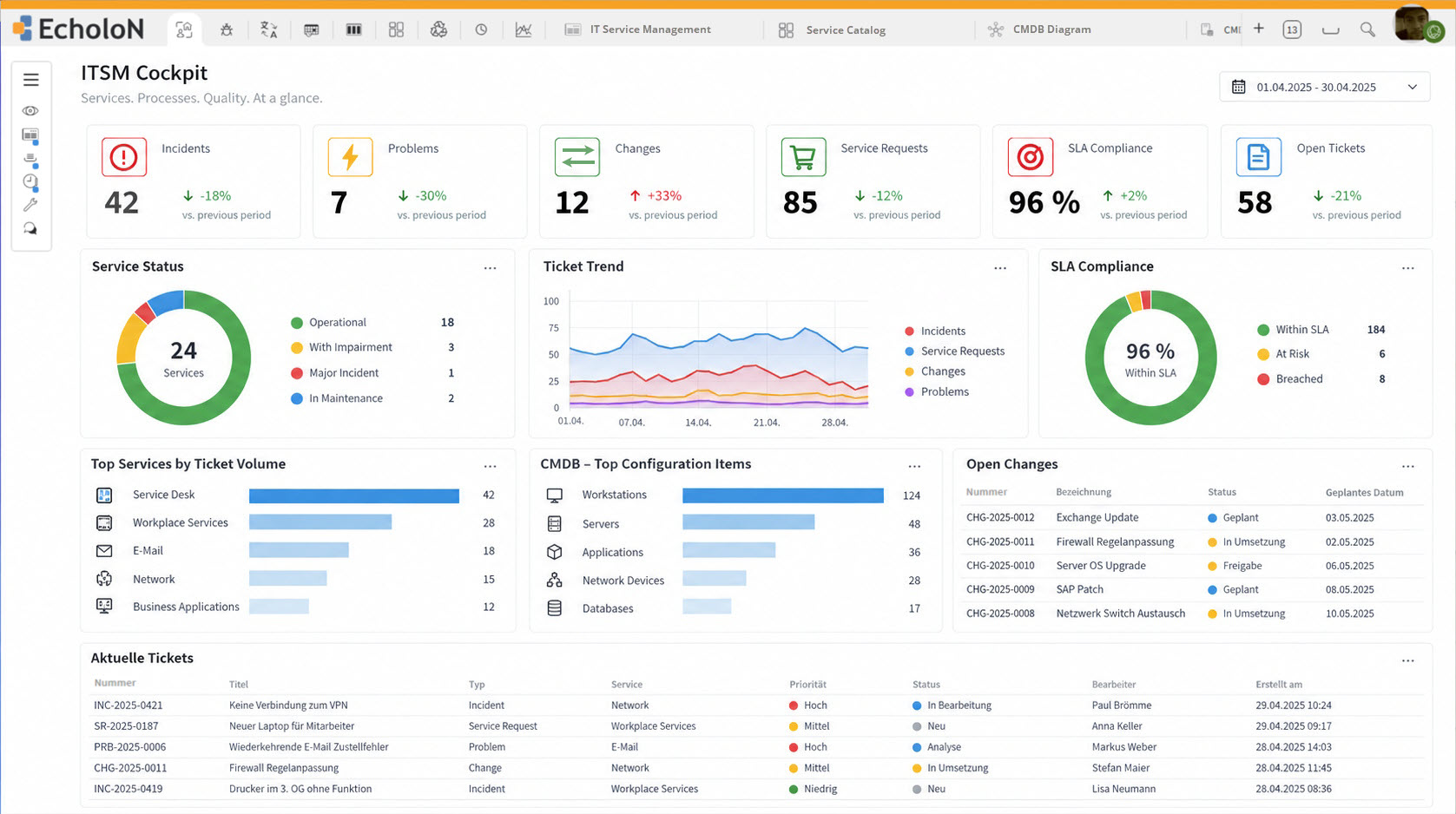
The difference from a traditional ticketing system: EcholoN doesn’t just look at individual tasks. Services, technical dependencies, responsibilities, SLAs, and follow-up processes are linked together and managed through configurable workflows.
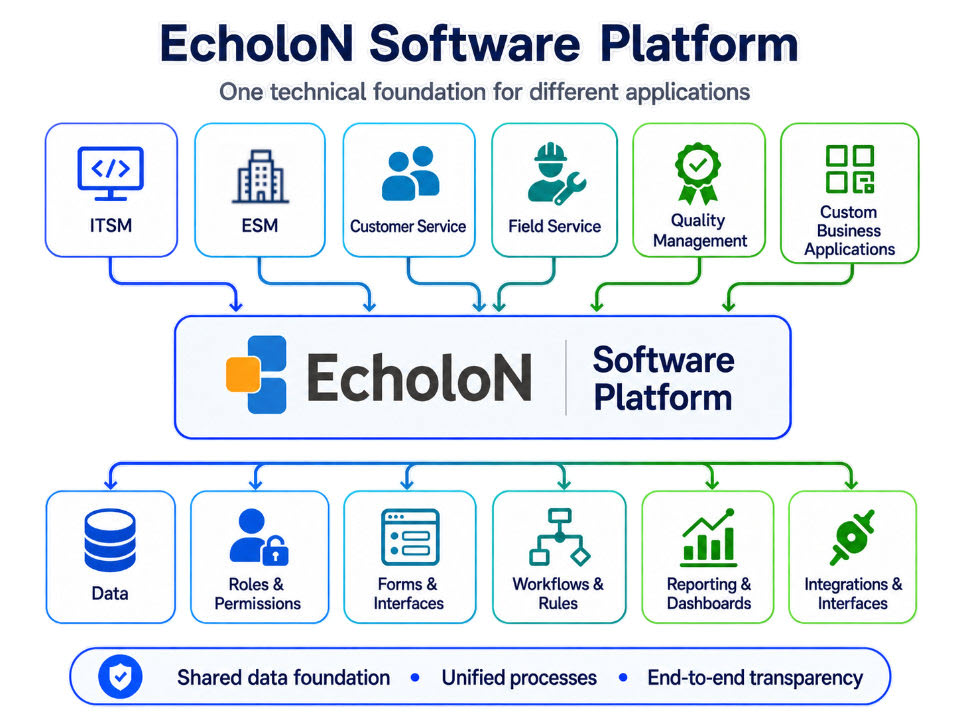
In doing so, EcholoN combines the advantages of customizable off-the-shelf software with a flexibly configurable platform. Processes, forms, roles, and data models can be tailored to your organization without having to build separate custom software for every requirement.
For IT organizations that go beyond simple ticket handling, want to integrate multiple ITSM processes, and wish to adapt their solution to existing organizational and system structures.
German manufacturer · Customizable off-the-shelf software · Workflow and data integration · ITIL-compliant
Why Choose EcholoN for IT Service Management?
An ITSM platform must do more than just map individual processes. It must align with the existing organization, infrastructure, and way of working.
EcholoN combines six key features to achieve this.
Connecting ITSM Processes
Incident, Service Request, Problem, Change Enablement, Service Level Management, Service Configuration Management, and Knowledge Management are seamlessly integrated on a single platform.
- This eliminates the need to re-enter information for each process or transfer it between isolated applications.
Flexibly Configure Processes
Forms, status models, roles, tasks, approvals, responsibilities, and escalation rules can be tailored to different services and organizational units.
- The integrated EcholoN Workflow Engine controls the resulting workflows.
Make services and technical dependencies transparent
The EcholoN CMDB links configuration items, applications, infrastructure, and IT services.
- This makes it possible, for example, to identify which components are affected by an incident or which services must be considered before a change is implemented.
Integrate existing systems and data
The EcholoN Data Workflow System supports the import, validation, transformation, and transfer of data.
- This enables existing information sources to be integrated into ITSM processes and migration and integration tasks to be implemented in a controlled manner.
Customizable off-the-shelf software instead of rigid process specifications
As off-the-shelf software, EcholoN is designed to adapt processes, forms, roles, and applications to different requirements.
- Configurations made within the intended EcholoN platform mechanisms remain part of the standard platform. Technical adjustments may be required for custom scripts or pro-code extensions as part of product updates.
Expand ITSM to Additional Service Areas Later
Companies can start with IT Service Management and later use the same platform for additional service processes.
- This allows ITSM to be expanded step by step toward Enterprise Service Management without having to introduce a separate process platform for every department.
Documented ITSM Projects with EcholoN
The following key figures are taken from published EcholoN reference reports and refer to the project timeline documented therein. They should not be interpreted as confirmed current figures for 2026.
HORNBACH: Replacement of the existing ticketing system
240 support staff and technicians · approximately 17,500 IT users supported
Project status according to the published reference report: 2016
HORNBACH directly replaced its previous ticketing system with EcholoN. According to the reference report, the implementation was completed in less than six months and included, among other things, data cleansing, migration, and self-service.
Aveniq: ITSM, Integration, and ISO Compliance
Approximately 2,500 portal users according to the reference report · ISO 20000 and ISO 27001 certifications in 2017
Aveniq uses EcholoN for ITIL-aligned service processes. The Data Workflow System is described in the reference project as a data hub and integration platform.
Hamburg Messe und Congress: Centralized Service Access
Approximately 99% of requests via EcholoN
Historical project data according to the published case study
The documented project status shows high utilization of the centralized service access and, consequently, the acceptance of the implemented service processes.
This is how EcholoN integrates Incident, Problem, Change, and CMDB
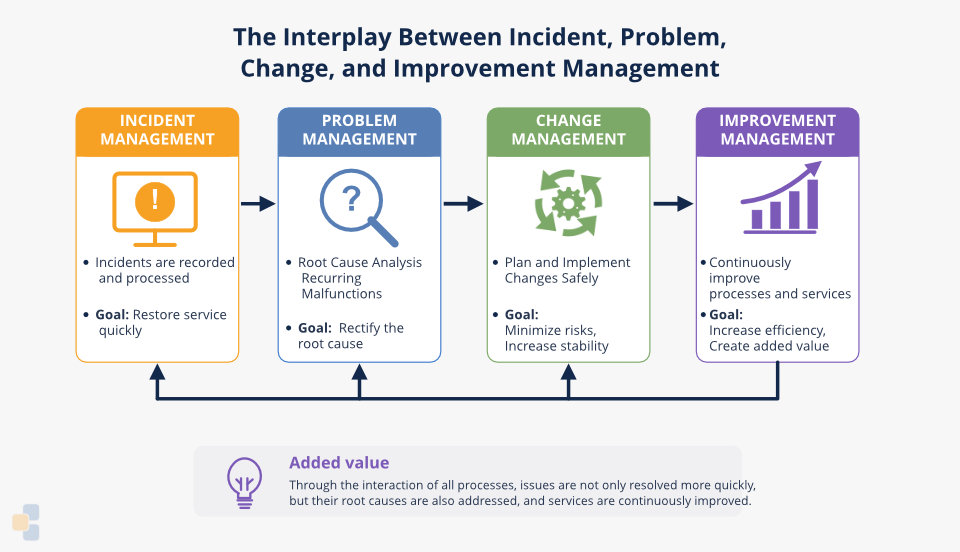
The added value of IT Service Management does not come from having as many individual modules as possible. What matters is how processes and information work together.
Example: A business-critical application repeatedly goes down
Several users report issues with the same application.
In Incident Management, the incidents are assigned to the affected service and the relevant configuration items. Priority, responsibility, and applicable service levels can be determined based on the stored information.
If the same issue occurs repeatedly, the incidents can be consolidated in Problem Management.
The responsible team investigates the cause and, if necessary, documents a workaround. This workaround can be applied directly to future incidents.
If a permanent fix requires a technical change, this results in a process in Change Enablement / Change Management.
Before implementation, the CMDB can be used to verify:
- which configuration items are affected,
- which services depend on them,
- which incidents and problems are associated with the change,
- which risks must be considered,
- and which tasks and approvals are required.
After the change is implemented, it remains clear which root cause was resolved and which processes were interconnected.
Incident → Problem → Change Enablement → Service Improvement
It is precisely these relationships that distinguish end-to-end IT service management from isolated ticket handling.
ITSM Practices with EcholoN
EcholoN supports key disciplines of IT service management. The scope and structure can be gradually adapted to the respective level of maturity.






Workflow Engine and Data Integration as Key Platform Components
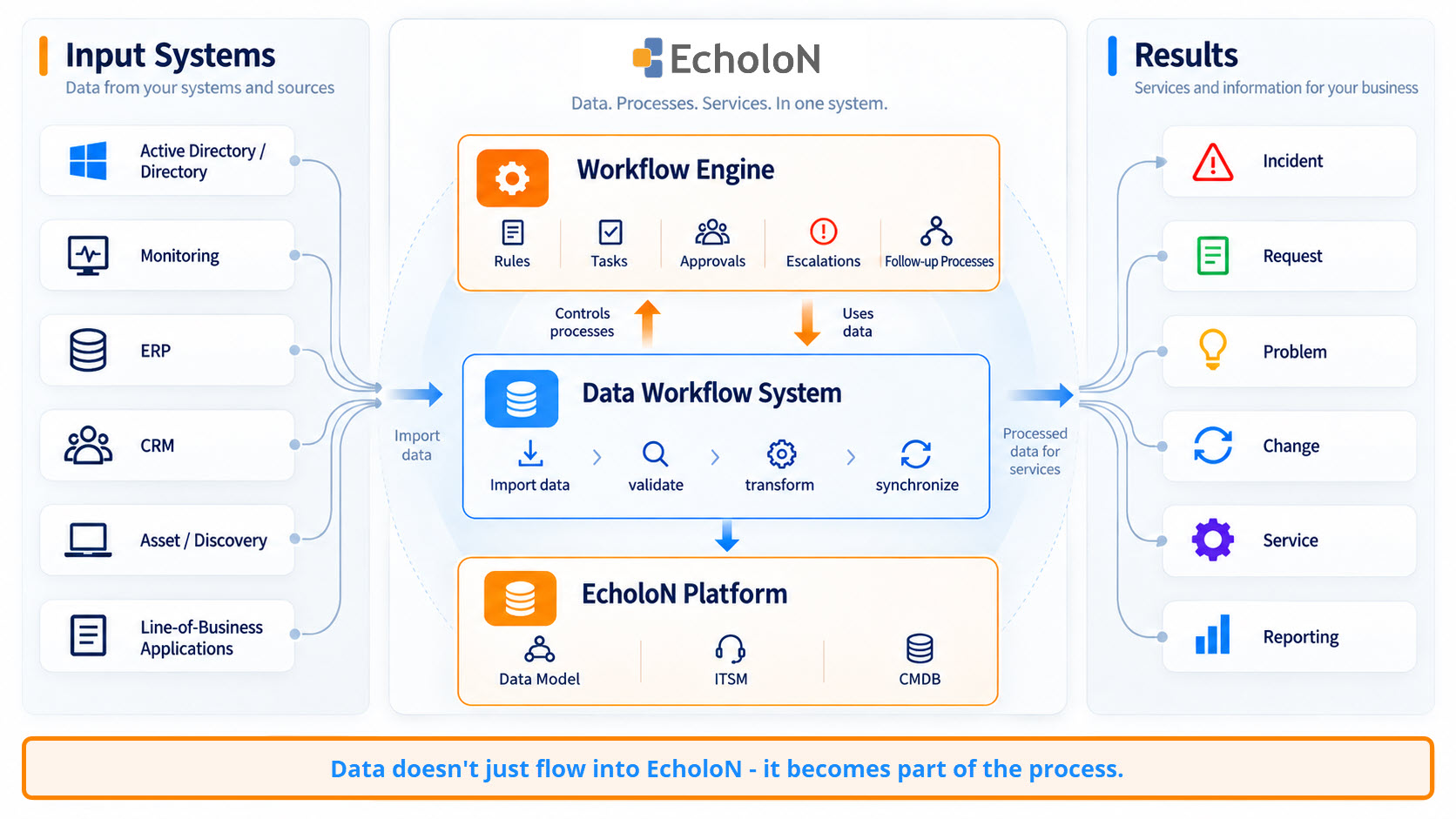
Many ITSM solutions can manage tickets, SLAs, and changes. Things get more challenging when processes deviate from standard templates or when information from multiple systems is required.
This is where the EcholoN platform comes in.
Not just documenting processes, but managing them
With the Workflow Engine, rules and process steps can be executed based on the actual data available.
Examples:
- Calculate priorities based on defined criteria
- Automatically determine the responsible team
- Initiate approval processes
- Assign tasks to different roles
- Trigger escalations before deadlines are missed
- Automatically change statuses
- Generate follow-up processes
- Use information from connected systems
This allows processes to be adapted to the organization, rather than forcing the organization to conform to a rigid standard workflow.
Incorporating data from existing systems into the process
ITSM rarely operates in isolation.
User data may come from directory services, technical information from monitoring or asset management systems, and business information from ERP or CRM applications.
The EcholoN Data Workflow System is designed to import, process, transform, and pass on such data.
This allows the existing system landscape to be integrated into ITSM processes without having to manually maintain all information twice.
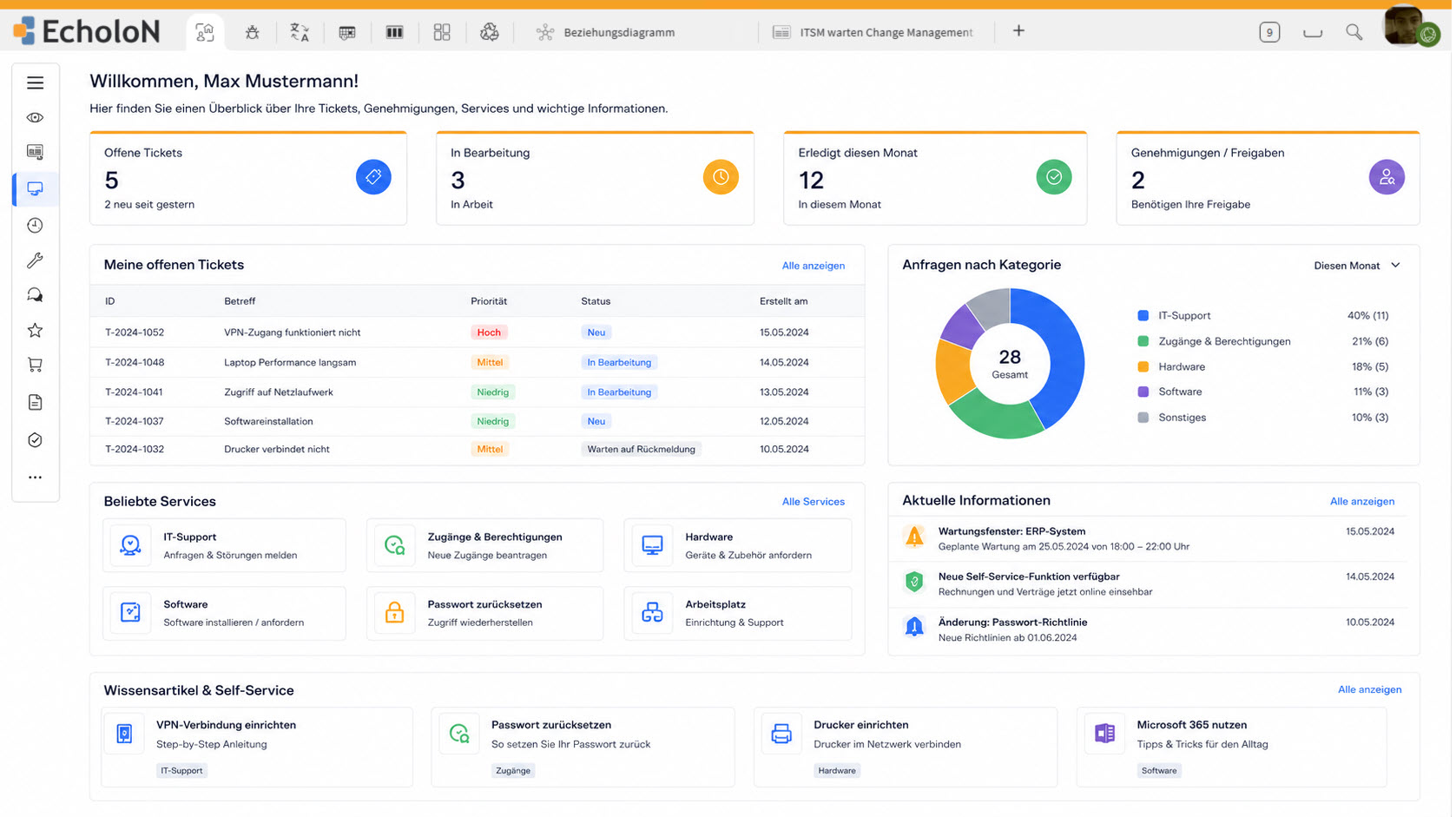
Self-Service, Service Levels, and Reporting on a Single Platform
Clearly Distinguishing Between Service Requests and Incidents
Through the EcholoN Self-Service Portal, users can both submit standardized service requests and report incidents.
Typical service requests include, for example:
- Setting up a user or workstation
- Requesting software access
- Changing permissions
- Ordering hardware
- Requesting a mobile device
A technical issue, on the other hand, is recorded as an incident and processed via the designated incident process.
This allows different types of requests to be recorded through a single point of access without mixing their ITSM process logic.
Monitoring Service Levels
EcholoN can link service levels to services, priorities, organizations, contracts, support hours, and responsible teams.
This makes it clear which cases are being processed on time and where escalation is necessary.
Driving Improvements Based on Data
With the EcholoN Reporting Tool, you can analyze, for example:
- Ticket volume
- Response and resolution times
- SLA compliance
- At-risk and escalated cases
- Recurring incidents
- Open problems and changes
- Team and workload metrics
- Use of self-service and knowledge base
This turns operational process data into the foundation for the continuous improvement of IT services.
Technical and Organizational Selection Criteria
When selecting ITSM software, the list of features is not the only deciding factor. It is also important to consider whether the solution can be integrated into the existing IT and organizational structure.
| Selection Criterion | EcholoN Approach |
|---|---|
| Deployment | Cloud or on-premises, depending on project and operational requirements |
| Customizability | Configurable standard software for company-specific processes and applications |
| Upgradeability | Shared, evolvable product base with project-specific customizations |
| Integration | Interfaces and data workflow system for data import, transformation, and synchronization |
| Processes | Workflow engine for rules, tasks, approvals, escalations, and follow-up processes |
| Organization | Role, organizational, and authorization models for different responsibility structures |
| Project Implementation | Vendor expertise, consulting, configuration, and implementation from a single source or in collaboration with qualified partners |
| Scaling | From IT Service Management to Enterprise Service Management on the same platform |
On-premises, Cloud/SaaS, Managed Service, or hybrid
EcholoN supports on-premises, Cloud/SaaS, Managed Service, and hybrid operating scenarios.
Which model is suitable depends, among other things, on the following requirements:
- Existing infrastructure
- Data storage
- Security requirements
- Required integrations
- Operational responsibility
- Internal IT resources
This allows the operational model to be selected to suit the initial technical and organizational situation.
Integrations
What matters is not only whether an interface exists, but also what data is required in which process.
Typical areas of integration include:
- Directory and user services
- Email and communication
- Monitoring
- Asset and discovery systems
- ERP and CRM
- Human resources and organizational systems
- Document management and line-of-business applications
The Data Workflow System can be used as an integration and transformation component in this context.
Customizations and Product Updates
Individual requirements can be implemented using the EcholoN platform’s built-in configuration and extension mechanisms.
A clear technical distinction applies here: Configurations within the standard mechanisms are part of the platform. For custom scripts or Pro-Code extensions, product updates may require additional customizations.
This creates a realistic foundation for long-term maintenance and further development.
Organizations and Permissions
Different organizations, customers, locations, teams, services, and roles can be mapped using appropriate structures and permissions.
Whether a specific tender or operational scenario imposes requirements for true technical multi-tenancy should be assessed separately.
Project and Support
With mIT solutions, software vendors, consulting, and project implementation are directly connected.
Analysis, design, implementation, integration, training, service, and software maintenance can thus be carried out within a shared product and project environment.
Customizable Standard ITSM Software Instead of a Rigid Tool
ITSM processes are not identical in every company.
Services, organizational structures, escalation paths, forms, approvals, and data sources vary.
EcholoN therefore relies on a configurable standard platform on which processes and applications can be implemented within a common framework.
This is particularly relevant for organizations that:
- do not want to completely discard existing processes,
- need to integrate different service areas,
- have specific data or workflow requirements,
- and wish to continue developing their platform over the long term.
This strikes a balance between rigid off-the-shelf software and fully customized in-house development.
From IT Service Management to Enterprise Service Management
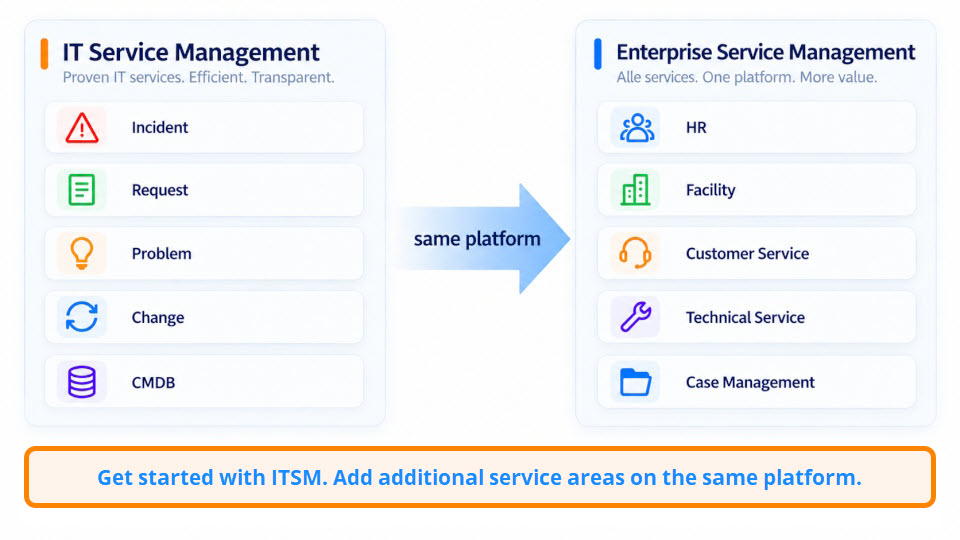
ITSM can serve as a starting point without permanently limiting the platform to IT.
The same basic mechanisms—processes, services, roles, workflows, escalations, data, and knowledge—are also needed in other areas of the organization.
Examples:
- HR Services
- Facility Management
- Customer Service
- Technical Support
- Internal Approval Processes
- Ordering and Approval Processes
- Custom Case Management
The strategic advantage does not lie in digitizing as many departments as possible right away.
IT can start with a clearly defined ITSM scenario without necessarily having to introduce a second platform for future service processes.
Learn more at Enterprise Service Management and Service Management with EcholoN.
Implementing ITSM in a Structured Way
An ITSM implementation does not have to begin with all practices at once.
A sensible approach is to focus on a clearly defined use case.
-
1. Analyze the initial situation
What services, processes, systems, data sources, and responsibilities are already in place?
-
2. Define the entry point
Possible starting points include, for example:
• Central service desk
• Incident management
• Service request management
• Self-service and service catalog
• SLA and escalation management
• Replacement of an existing ticketing system
-
3. Modeling Processes and Data
Roles, status models, services, forms, responsibilities, service levels, and required data are defined.
-
4. Integrate Systems and Migrate Data
Existing data sources and applications will be integrated in accordance with the target vision.
-
5. Measure adoption and expand it in a targeted manner
After launch, usage, turnaround times, service quality, and opportunities for improvement are evaluated.
Additional practices, services, or departments can then be added gradually.
A Brief Overview of ITSM, Service Desk, and ITIL
A ticket system records and tracks individual processes.
A service desk serves as the central operational point of contact for users and coordinates, among other things, incidents and service requests.
IT Service Management also addresses the planning, delivery, support, and continuous improvement of IT services.
ITIL provides proven practices for this purpose. These include, among others, Incident Management, Problem Management, Service Request Management, Change Enablement, and Service Configuration Management.
EcholoN helps companies adapt these ITSM practices to their own organization, services, and existing system landscape.
In-Depth Fundamentals:
Frequently Asked Questions About EcholoN ITSM Software
For which IT organizations is EcholoN suitable?
EcholoN is particularly well-suited for organizations that go beyond simple ticket processing, want to integrate multiple ITSM processes, and wish to adapt their software to existing organizational, workflow, and system structures.
Which ITSM practices does EcholoN support?
Possible areas of application include incident management, service request management, problem management, change enablement (or change management), service level management, service configuration management, and knowledge management.
These practices can be introduced gradually and adapted to the respective process model.
How does EcholoN differ from a traditional ticketing system?
A ticketing system focuses primarily on individual cases.
EcholoN additionally links these to IT services, service levels, configuration items, problems, changes, knowledge, data, and workflows. This makes the relationships between incidents, services, and infrastructure transparent.
How can existing systems be integrated?
Depending on the target system, existing interfaces, integration components, or project-specific connections can be used.
The EcholoN Data Workflow System also supports the import, validation, transformation, and transfer of data.
How do customizations affect product updates?
Configurations made within the intended EcholoN platform mechanisms remain part of the standard platform.
For custom scripts, integrations, or pro-code extensions, technical adjustments may be required during product updates. The specific effort involved depends on the particular extension scenario.
Can EcholoN be used for different organizations and authorization models?
Organizations, customers, locations, teams, services, roles, and permissions can be mapped in a structured manner.
If a specific project requires true technical multi-tenancy or a specific separation of data sets, this requirement should be evaluated separately as part of the solution assessment.
What operating models are possible?
EcholoN supports on-premises, cloud/SaaS, managed service, and hybrid operating scenarios.
The appropriate model depends, among other factors, on infrastructure, security requirements, integrations, data storage, and the desired level of operational responsibility.
Evaluate EcholoN ITSM Based on Your Requirements
ITSM software should not be evaluated solely based on a general list of features.
What matters most is how well it maps your actual services, processes, roles, technical dependencies, and existing systems.
In a customized EcholoN demo, for example, the following points can be evaluated using a specific scenario:
- Link incidents, services, and configuration items
- Automatically determine priorities and responsibilities
- Monitor service levels
- Link problem and change enablement
- Map custom workflows and approvals
- Integrate existing data sources
- Implementing self-service and service requests
- Providing reports and management information
- Implementing customizations within the platform
- Mapping the operating model and integration architecture
- Preparing for potential expansion into additional service areas
Don’t evaluate EcholoN based on an abstract feature list—evaluate it based on your actual ITSM processes.