With the EcholoN IT Change Management Software, you can capture, assess, approve, plan, and document changes to IT services, systems, and components in a seamless process.
Flexible workflows support managers in risk assessment, approval, and implementation. A change calendar, traceable process steps, and links to affected configuration items provide transparency regarding planned changes and their potential impact on IT operations.
- Record and classify changes in a structured manner
- Assess risks and impacts
- Manage approvals and CAB processes
- Plan and coordinate changes centrally
- Account for configuration items and dependencies
- Manage tasks and responsibilities via workflows
Managing IT changes in a structured way with EcholoN
Changes are a part of day-to-day IT operations: systems are updated, applications are modified, components are replaced, services are expanded, or technical issues are permanently resolved.
However, without a controlled process, changes can cause new disruptions, unplanned outages, or conflicts with other changes.
EcholoN therefore supports the entire IT change process—from central registration through evaluation and approval to implementation and final review.
Centralized Tracking of Change Requests
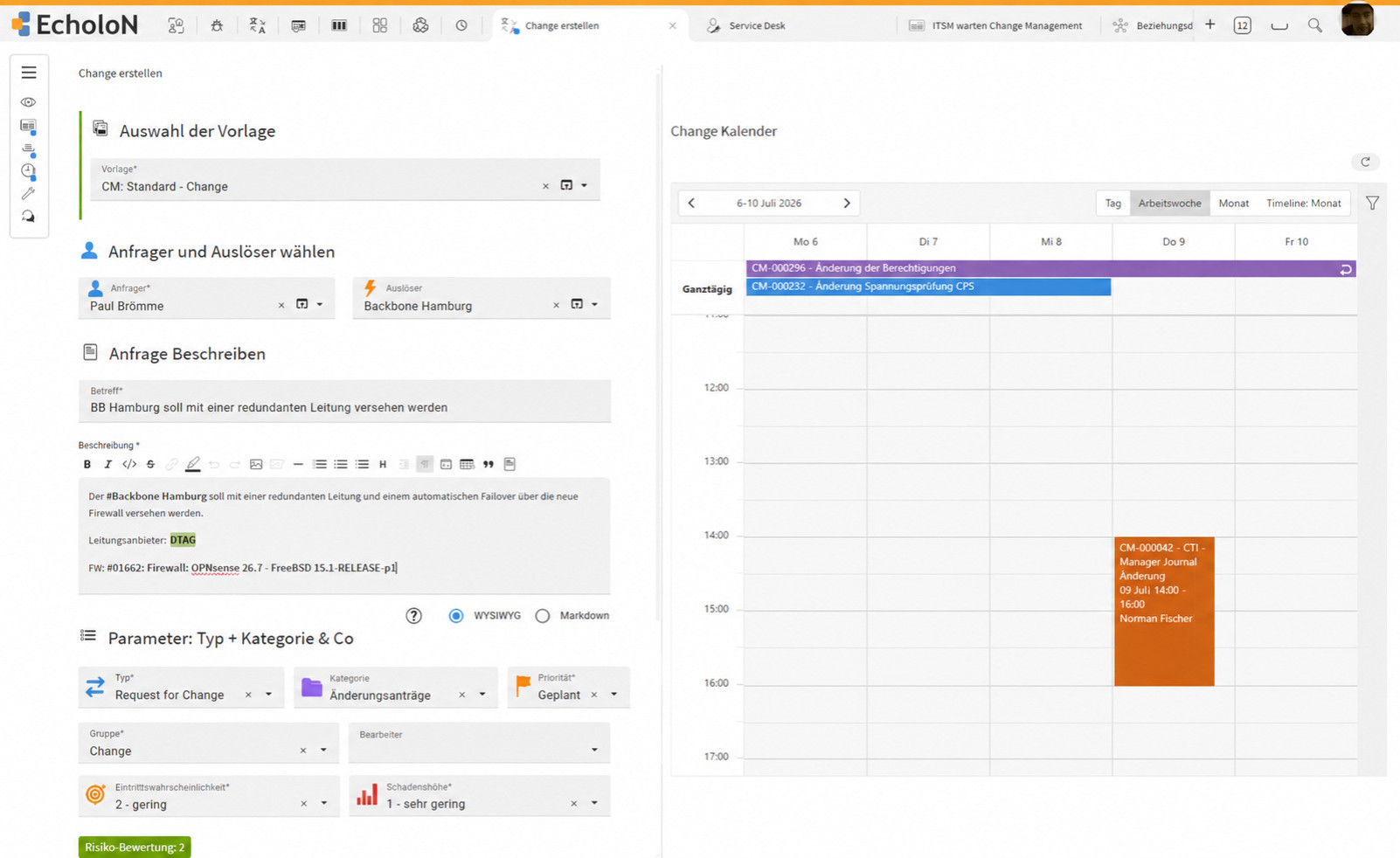
Planned changes are recorded in EcholoN in a structured manner as “Changes.” This ensures that relevant information is available in one central location and does not need to be coordinated via email, spreadsheets, or separate tools.
Depending on the process, factors such as affected services, systems, configuration items, deadlines, responsibilities, and other information relevant to the assessment can be taken into account.
Evaluate and Classify Changes
Not every change carries the same level of risk.
EcholoN helps classify changes based on defined criteria and assess potential impacts before implementation. This allows recurring and low-risk changes to be handled differently from complex or critical interventions in production systems.
Managing Approvals and CAB Processes
Depending on the change type, risk, and organizational process, responsible parties, business units, or a Change Advisory Board (CAB) can be involved in the review and approval process.
Decisions, processing statuses, and responsibilities are documented in a traceable manner within the change process.
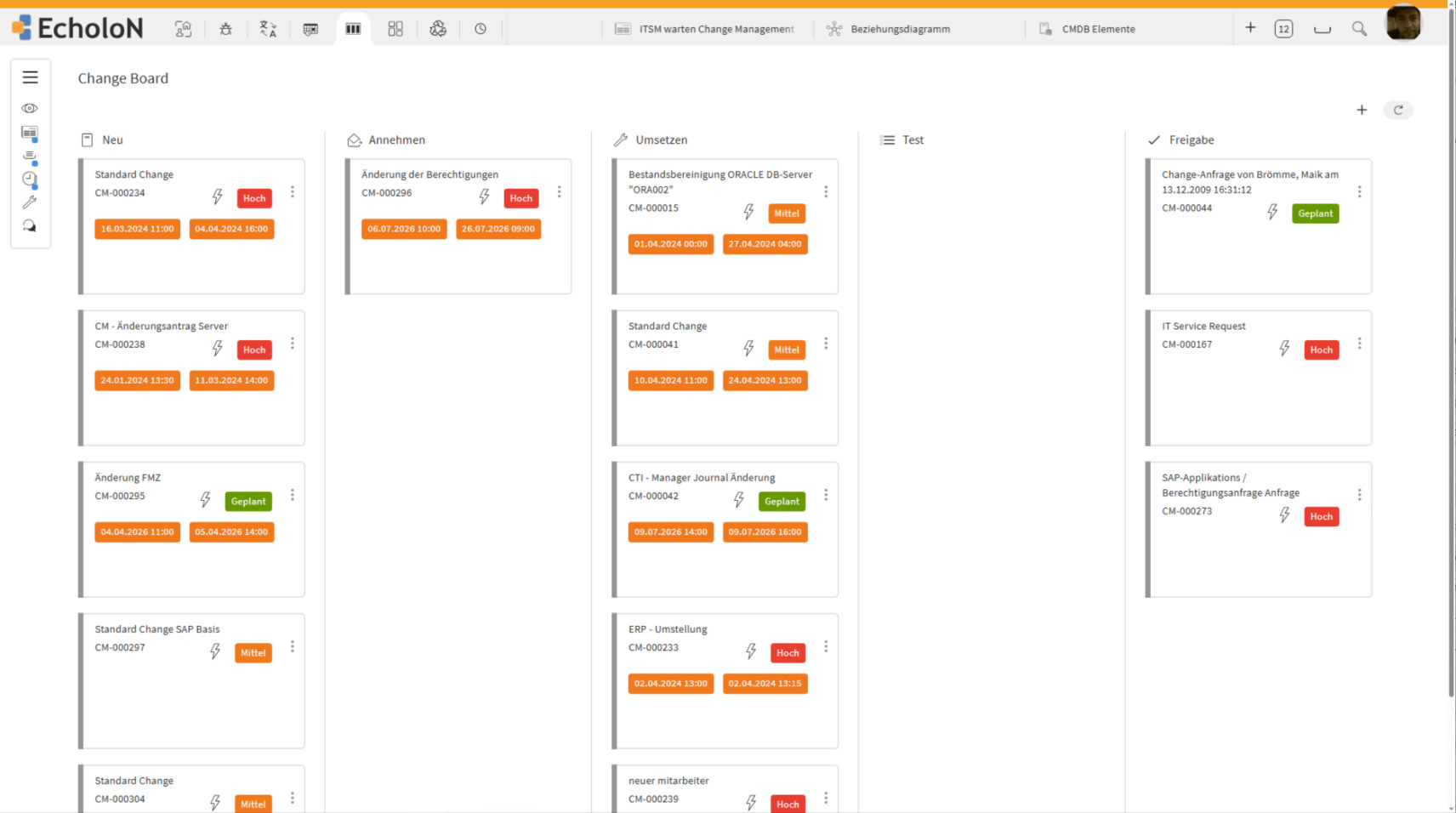
Coordinate Changes by Schedule
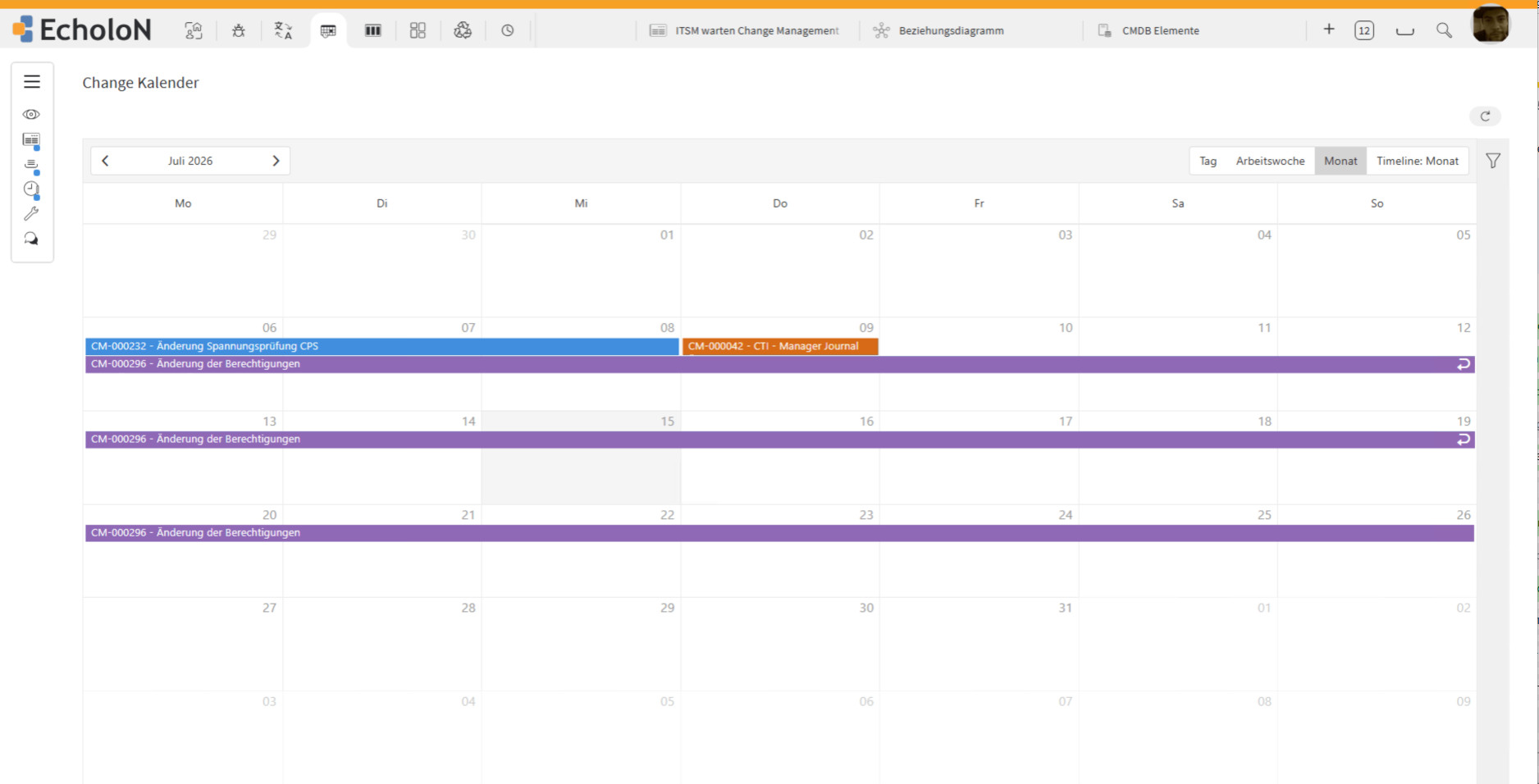
The Change Calendar provides those responsible with a centralized overview of upcoming changes.
This allows them to identify parallel activities, critical time periods, or potential overlaps early on and better coordinate changes.
Document Implementation and Review
The change remains traceable both during and after implementation.
Tasks, decisions, and results can be documented within the process. Upon completion, it is possible to verify whether the change was successfully implemented, whether any unexpected effects occurred, or whether further measures are required.
IT Change Management and Change Enablement with EcholoN
A structured change process establishes a clear workflow from the planned change through to the final evaluation.
EcholoN supports ITSM-oriented change management and change enablement with flexibly configurable processes, roles, and approvals.
-
1. Record the change
1The planned change is created centrally with the necessary information. For recurring processes, predefined templates and standardised procedures can be used.
-
2. Classify and evaluate
2The change is categorised and assessed in terms of risk, impact and the areas affected.
-
3. Check and approve
3Depending on the defined procedure, approval is granted by the relevant individuals, specialist departments or a Change Advisory Board.
-
4. The Change Plan
4Approved changes are scheduled and linked to the necessary tasks and responsibilities.
-
5. Prepare for implementation
5The necessary steps, tests, information and prerequisites are planned and assigned to the relevant individuals or teams.
-
6. Take the back-out into account
6Where necessary, documentation is drawn up prior to implementation setting out the measures that would enable a controlled return to a previous state should problems arise.
-
7. Implement the change
7The planned activities are being carried out. The current status of each task and any relevant decisions can be tracked in Change.
-
8. Carry out a change review
8Once the project has been completed, an assessment is carried out to determine whether the desired outcome has been achieved, whether any unexpected consequences have arisen, and whether further action is required.
This creates a seamless process from the change request to the documented implementation.
Assessing Risks and Impacts with CMDB and Configuration Items
A change often affects more than just the system being directly modified.
A server can host applications; applications can be part of business-critical services; and these services, in turn, can be used by different organizational units or customers.
This is precisely where the connection between change management and configuration management becomes important.
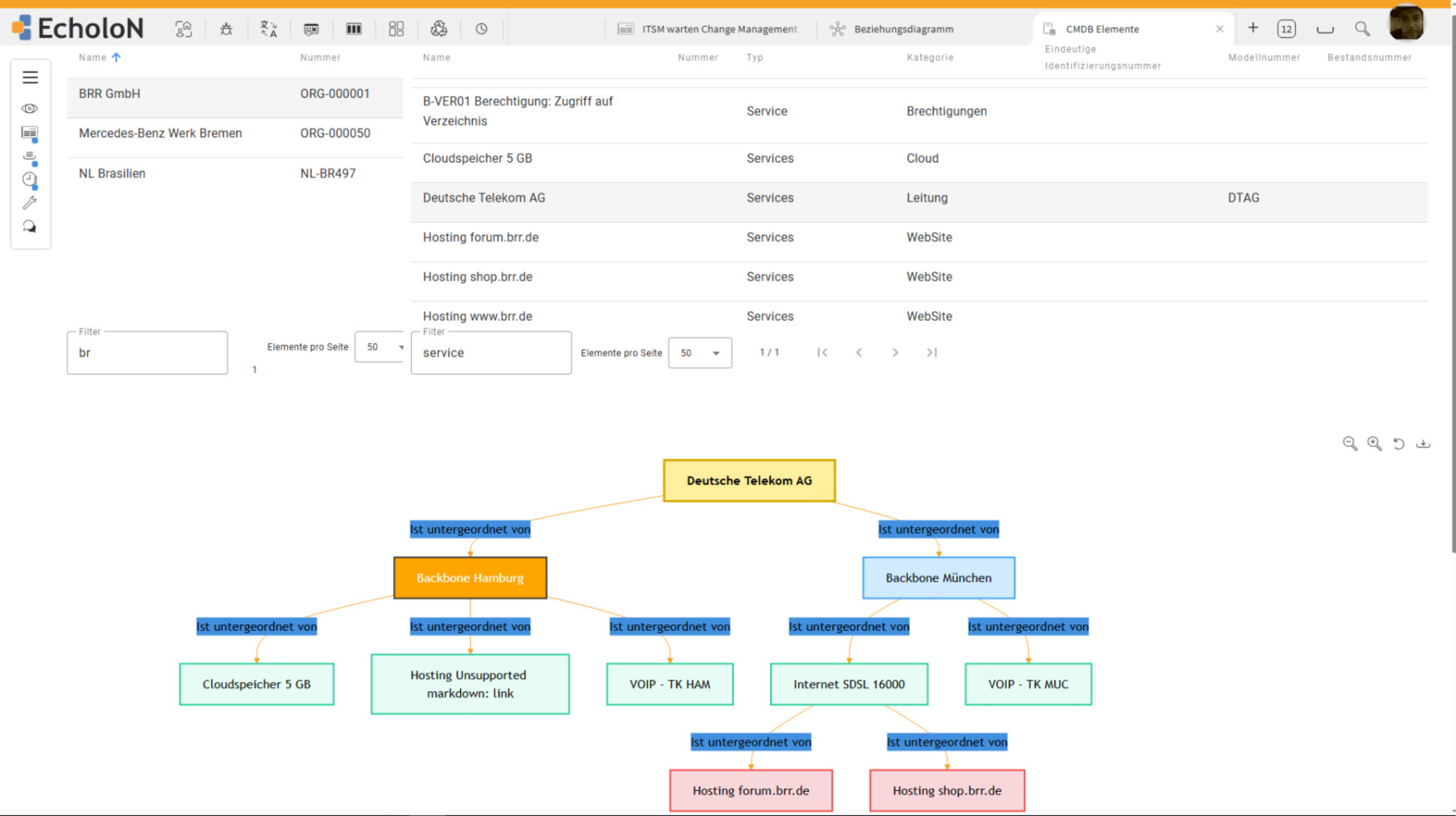
The EcholoN CMDB centrally manages configuration items and their relationships. This information can be incorporated into the assessment of a planned change.
This makes it easier to answer questions such as:
- Which IT service depends on the affected component?
- Which other systems are related to the configuration item?
- Which services or areas could be impacted by the change?
- Which stakeholders should be involved?
- Are there any other changes in the same technical environment?

The link between change, configuration items, and service relationships thus provides a more solid foundation for risk assessment and planning.
Instead of viewing a change in isolation, those responsible can take into account its potential impacts within the existing IT service structures.
Flexibly Automate Change Workflows and Approvals
Change processes vary depending on the organization, infrastructure, and risk.
While certain changes can go through a streamlined approval process, more complex changes require additional checks, involvement of business units, or approval levels.
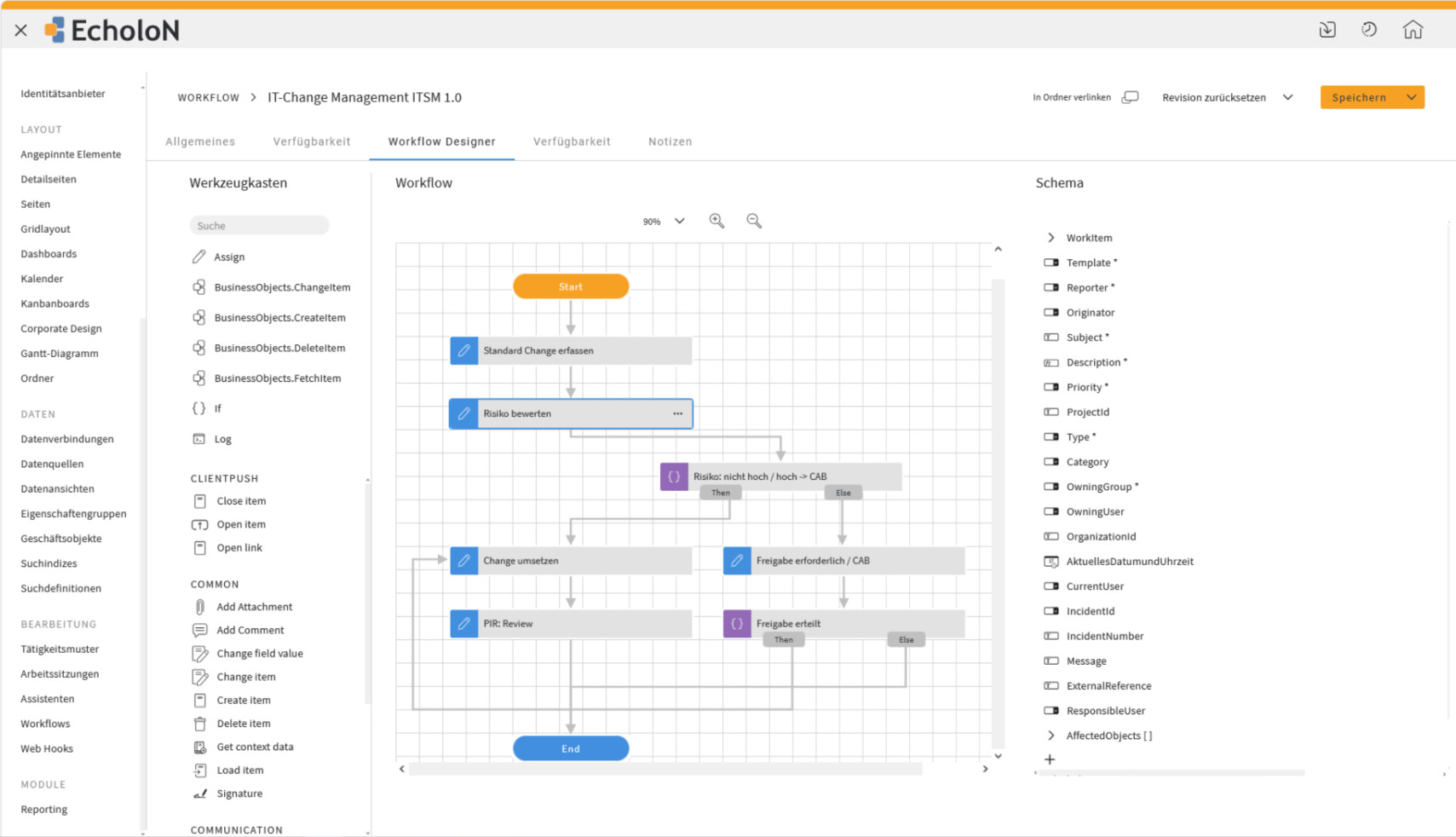
With the EcholoN Workflow Engine, such processes can be customized to meet your specific requirements.
Depending on the defined rules, for example:
- tasks can be created and assigned,
- approvals can be requested,
- roles and responsible parties can be involved,
- conditions and decision paths can be taken into account,
- deadlines can be monitored,
- notifications can be triggered,
- escalations can be initiated,
- and follow-up processes can be set in motion.
This ensures there is no rigid, one-size-fits-all process. Change workflows can be adapted to the organization, responsibilities, and risk classes.
From Risk to the Appropriate Approval
For example, a change can first be assessed and classified based on defined criteria.
If the risk is low, the defined process can proceed directly. In the case of higher risk, additional responsible parties, functional departments, or a CAB can be involved in the review.
Once approved, planning, implementation, and a final review follow as part of the same transparent process.
In this way, EcholoN combines standardized procedures with flexible workflow management.
Linking Incident, Problem, and Change Management
ITSM processes do not operate in isolation.
Incident Management initially focuses on restoring a disrupted service as quickly as possible.
If the underlying cause is subsequently investigated, this can lead to a case in Problem Management.
If a technical change is required to achieve a sustainable solution, this can in turn result in a change request.
EcholoN supports these interconnections within a unified service management environment:
Incident → Problem → Change → Configuration Item
This ensures that root causes, decisions, affected systems, and implemented changes remain linked.
Information does not need to be maintained independently in separate systems. At the same time, this provides better traceability from the original event through to the technical change.
You can find more information about the overall interaction of these processes in the IT Service Management section.
Benefits of EcholoN IT Change Management Software
Identify Risks Early
- Changes can be assessed before implementation, and affected systems, services, and configuration items can be included in the analysis.
Manage Approvals in a Traceable Manner
- Responsible parties, business units, and CAB processes can be integrated into the review and approval process within defined workflows.
Plan Changes in a Coordinated Manner
- Change calendars, deadlines, tasks, and responsibilities provide transparency regarding planned and ongoing changes.
Flexibly Adapt Processes
- The EcholoN Workflow Engine enables the implementation of both standardized and organization-specific change processes.
IT Change Management or Organizational Change Management?
The term “change management” is used to describe a variety of tasks.
IT Change Management, or Change Enablement, focuses on changes to IT services, applications, systems, and technical components. The goal is to evaluate, approve, plan, and implement changes in a controlled manner.
Organizational Change Management, on the other hand, deals specifically with how people, structures, and organizations are supported through change processes.
On this page, EcholoN supports the ITSM-oriented change process.
You can learn more about the organizational approach in the article What Is Change Management?.
For which organizations is EcholoN Change Management suitable?
EcholoN is suitable for companies and organizations that want to coordinate changes to their IT services and systems in a structured manner and document them in a traceable way.
A centralized change process becomes particularly relevant when:
- many systems and services are interdependent,
- different departments are involved in changes,
- approvals must be documented in a traceable manner,
- risks need to be systematically assessed prior to implementation,
- multiple changes are planned in parallel,
- incident, problem, and change management interact
- or existing standard processes need to be adapted to specific requirements.
EcholoN supports both clearly defined standard procedures and individually configured change processes.
Frequently Asked Questions About EcholoN Change Management Software
What is IT change management software?
IT change management software helps companies systematically capture, assess, approve, plan, implement, and document changes to IT services and technical systems.
It thus establishes a controlled process for planned changes within IT operations.
What is the difference between change management and change enablement?
Both terms are used in IT service management in connection with the management of changes.
Change enablement places particular emphasis on the goal of enabling successful changes while appropriately assessing and controlling risks.
EcholoN supports ITSM-oriented change processes with flexibly configurable workflows, roles, and approvals.
What role does the CMDB play in change management?
The CMDB provides information on configuration items and their relationships.
These relationships can help better assess the potential impact of a planned change on other systems, components, or services and take relevant dependencies into account even before implementation.
Does EcholoN support CABs and custom approval processes?
Approvals can be organized within the change process and managed via defined workflows.
Depending on the specific procedure, individual responsible parties, multiple approval levels, functional departments, or a Change Advisory Board can be involved in the review and decision-making process.
Plan Changes Carefully and Implement Them with EcholoN
The more complex IT landscapes and service relationships become, the more important it is not to view changes in isolation.
EcholoN integrates change management, workflow control, CMDB, and other ITSM processes within a single service management platform.
This allows you to capture changes in a structured manner, account for risks and dependencies, manage approvals, coordinate deadlines, and document results in a traceable way.
See for yourself in a personalized demo how your existing change processes can be mapped and automated with EcholoN.