

The Internet of Things (IoT) enables companies to digitally connect devices, machines, sensors, and systems, collect real-time status data, and automate processes in a targeted manner. This allows for better monitoring of equipment, earlier detection of malfunctions, and more efficient control of operational processes.
IoT describes the connection of physical objects to the Internet or internal networks, enabling them to send, receive, and make data analyzable. In industry, service, facility management, and maintenance, this creates the foundation for data-driven decisions, predictive maintenance, transparent processes, and new digital business models.

Author: Jochen Möller (CEO and CoFounder from EcholoN)
Creation: 07.01.2021, last change: 03.06.2026
Table of content
Definition: What is the Internet of Things (IoT)?
Basics of the IoT
What is the Industrial Internet of Things (IIoT)?
How exactly does the Internet of Things work?
Technology behind the IoT
Areas of application for the IoT
Edge computing in the IoT
Why IoT - how does the use of the Internet of Things benefit companies?
How does EcholoN support the IoT?
Internet of Things - IoT / IdD - Frequently asked questions – FAQs
Data is automatically synchronized, devices are coupled with other applications, users are networked - the number of devices that work “smart” through Internet access is growing. Users will find a lot of progress in this, as they can access the current status of their data from anywhere and benefit from networking with other devices and users. But industry and business are also convinced of the possibility and the resulting advantages of being able to network their devices and machines: The "Internet of Things" belongs to the new age of digital industry, also known as Industry 4.0. Read what it means exactly and how it works in the following post.
Definition: What is the Internet of Things (IoT)?
Defining the meaning of the ‘Internet of Things’ or ‘Internet of Things’ – IoT for short – is not that easy, as there are many different interpretations and explanations circulating. However, at least the basic assumption is the same everywhere: the term describes the intelligent networking of objects (things) via the Internet. These can be everyday devices as well as machines used in industry. By connecting to the Internet, these devices can communicate with each other, exchange data and perform tasks or work steps in a fully automated and coordinated manner.
But it is not only device-to-device communication that is made possible by the connection to the internet – many of the objects also provide an interface that human users can dial into from anywhere and thus control the device.
The aim of the IoT is to improve the way we work and live, for example by optimising and automating work processes or offering a more diverse user experience. Examples of IoT devices include fitness wristbands, smart home devices and applications, and machine-to-machine communication, or M2M for short.
Basics of the IoT
The fundamentals of the Internet of Things refer to the basic concepts and technologies required for the IoT to be built and function. The IoT consists of a large number of interconnected devices, sensors and actuators that can exchange data via the internet and interact with each other automatically. Various technologies such as sensor technology, wireless communication, cloud computing and data analysis are required to implement the IoT. Sensors collect physical or chemical information from the environment and transmit it via network connections. Wireless communication technologies enable devices to communicate with each other and exchange data in real time. The collected data is stored in the cloud, where it can be processed, analysed and used for various applications. The fundamentals of the IoT also include security and data protection, as the IoT potentially processes large amounts of personal data. Understanding these fundamentals is essential to realise the full potential of the IoT and develop innovative applications in areas such as smart homes, smart cities and Industry 4.0.
What is Industrial Internet of Things (IIoT)?
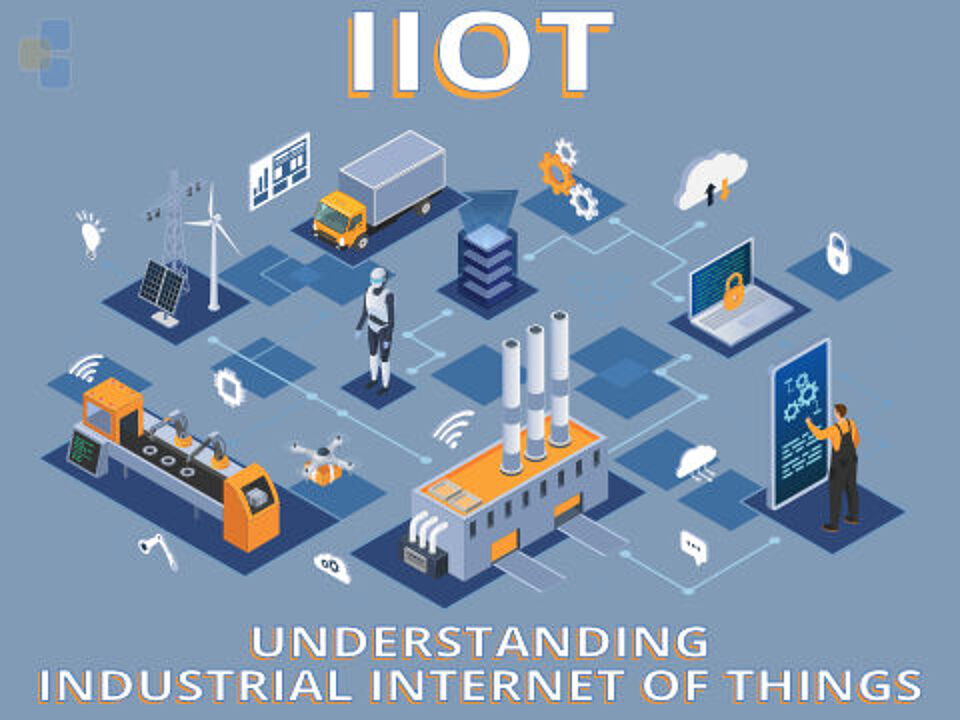
In the context of the Industrial IoT, a distinction is made between private and industrial applications. While private use includes the aforementioned fitness wristbands or smart homes, i.e. the consumer-oriented side, the industrial sector involves, among other things, machines and systems that are connected to each other. This form of the Internet of Things is called the ‘Industrial Internet of Things’, or IIoT for short.
The aim of the IIoT is to increase the efficiency and effectiveness of workflows, reduce costs and accelerate processes. This is based on the assumption that intelligent machines can react and work faster, more accurately and more cost-effectively than humans. If the IIoT is used and applied correctly, it can significantly increase a company's competitiveness and future viability. The IIoT can be used in a wide variety of areas: in manufacturing, logistics companies, agriculture and even in the medical sector.
When talking about IIoT, the term ‘Industry 4.0’ is often mentioned. This term describes a type of project that aims to gradually digitise the entire industry.
It sounds promising and, above all, promising for the future. So how exactly does the IIoT work?
How exactly does the Internet of Things work?
There are two main components in devices that enable them to integrate into the IoT: sensors and actuators. All "things" are equipped with sensors to collect data and transmit these to the common network. Actuators, in turn, are necessary to enable the device to carry out certain actions. So they process data such as an action command. The two types of sensors do not always have to be physically attached to the device; the surroundings of the device are often sufficient.
In addition, the respective devices in the network must be clearly identifiable so that the data obtained can be used and clearly assigned. This is done using an ID that the device receives when it is first installed. Only when the data from the sensors can be clearly identified and used can commands be sent back to the actuators. In order to continuously fix errors and close any security gaps, it is also important that the devices and their software are regularly maintained and updated. The users of the devices must also be managed. This includes their unique identification, their roles, access permissions and property rights.
The way in which the IoT works is based on a number of different technologies, such as cloud computing, artificial intelligence, machine learning and connectivity. The combination of these results in a so-called “smart device”, i.e. a clever part that can use the full functionality of the IoT. But what exactly do these smart devices and the IoT bring for companies?
Technology behind the IoT
The Internet of Things is based on a variety of technologies. These include sensors that collect data from the physical world and wireless networks that transmit this data. In addition, data analytics, machine learning and artificial intelligence are important components of the IoT. These technologies make it possible to collect and analyse large amounts of data and extract useful information from it. As a result, the IoT can be applied in various areas, such as industry, health and the smart home, and improve our everyday lives.
Sensors and actuators
Sensors and actuators play a crucial role in the Internet of Things (IoT). Sensors are devices that can detect physical or chemical parameters and convert them into electronic signals. These signals can provide information about temperature, humidity, movement or other environmental conditions. On the other hand, actuators are devices that respond to commands and can perform physical actions. Examples of actuators are motors, pumps or actuators that can initiate actions based on information from sensors. By integrating sensors and actuators into IoT devices, it becomes possible to connect physical objects and the natural environment with the digital world, enabling new applications and services. Sensors and actuators are thus indispensable components in the IoT ecosystem.
Networking technologies
IoT is a technology that enables devices to communicate with each other and exchange data. Networking technologies are the basic infrastructure of IoT. They include various wired and wireless communication protocols such as WLAN, Bluetooth, 5G and RFID. These technologies enable devices to be connected to each other and exchange information in real time. By networking devices, efficient processes can be implemented and data can be used for analysis and improvement.
Application areas of the IoT
The application areas of the IoT are manifold. In agriculture, the IoT can help maximise crop yields by inserting sensors into soils and plants to measure moisture levels and nutrient requirements. In healthcare, wearables and connected medical devices can monitor patient data in real time and help doctors make accurate diagnoses. In transport, IoT enables smart traffic management systems and connected vehicles that can optimise traffic flows and reduce accidents. In industry, IoT devices can be used to automate factory operations and improve efficiency. These are just a few examples of the many applications of IoT that can help improve daily life in different industries.
IoT in industry
The Internet of Things is also having a major impact on industry. By networking machines and devices, industrial processes can be optimised and made more efficient. With the help of sensors, data can be collected and analysed, leading to better monitoring and control of production. IoT also enables real-time communication between different systems, which leads to improved coordination and collaboration in industry. By integrating artificial intelligence, automated decisions can also be made, leading to further improvements in production and product quality.
Applications in everyday life
Internet of Things applications are now widespread in everyday life and offer numerous benefits. For example, smart home devices such as thermostats and lighting systems can be controlled via a mobile app, increasing comfort and energy efficiency. Wearable devices such as fitness trackers and smartwatches monitor health data and help improve fitness. In the area of mobility, the IoT enables vehicles to be connected, leading to more efficient traffic management and increased safety. In retail, IoT technologies are used to track inventory and offer personalised shopping experiences. These applications illustrate how the IoT is revolutionising and improving our everyday lives.
Edge Computing in IoT
Edge computing in the IoT refers to the paradigm in which data processing and analysis take place directly at "the edge of the network" (Edge) instead of sending it to remote cloud servers.
Introduction to Edge Computing
Edge computing refers to a technology where data processing and storage takes place as close as possible to the source of the data. Unlike traditional cloud computing architecture, data is not processed in a central data centre, but directly to "the edge of the network", in so-called "edge devices". This reduces latency because the data does not have to be sent over long distances to a central data centre and back. Edge computing thus enables real-time processing of data and fast reactions to events.
Advantages and use of edge computing in the IoT
A major advantage is that data can be processed in real time without the need to connect to the central cloud server. This reduces latency and enables fast response. In addition, edge computing can reduce data transmission costs, as only relevant and pre-processed data is sent to cloud systems. This is especially important in environments with limited bandwidth or high data volumes. Distributing data processing to edge devices also enables increased security, as sensitive data does not necessarily have to be transmitted to an external network.

Why IoT – how does the use of the Internet of Things benefit companies?
If companies decide to use IoT within their production or logistics, the opportunity arises to offer completely new services or business models. This can result in higher customer satisfaction, more demand and more customers. But not only the product range is renewed, the use of (I)IoT can also significantly increase efficiency, effectiveness and productivity. This includes the energy efficiency that results from the optimized use of machines and devices.
In addition, IoT enables a company to manage and evaluate large amounts of data. It thus enables the current state to be represented and, if necessary, optimized. This also enables the company to take advantage of the opportunity to optimize products and services in order to ultimately ensure higher customer satisfaction and more customers.
The bottom line is that companies that jump on the bandwagon of digitization and use the possibilities of the Internet of Things are, and above all, will remain more promising and competitive. We at EcholoN are happy to help you jump on this train. We are at your side with advice and action on all questions relating to inventory analysis and the implementation of the IoT. Please contact us without obligation.
How does EcholoN support IoT?
The Internet of Things only reaches its full potential when data is processed meaningfully, forwarded automatically and integrated into existing IT structures. This is precisely where EcholoN offers significant added value as an IoT platform – through a powerful combination of data integration, workflow automation and asset management.
Seamless integration with the EcholoN Data Workflow System
The EcholoN Data Workflow System is the central platform for connecting and controlling IoT data sources. Sensor values, status messages or device information from networked systems are automatically recorded, transformed and transferred to the right processes in real time. Whether temperature data, runtime metrics or system errors: all information flows into the EcholoN platform in a structured manner – without any manual intermediate steps.
The integrated workflow engine ensures that defined processes are triggered automatically: e.g. a maintenance message when a threshold value is exceeded or an escalation when a device is down. This turns ‘data’ into concrete ‘action’.
IoT-supported asset management with EAM, CMDB & CMMS
IoT integration is particularly effective in the context of enterprise asset management (EAM). In manufacturing and industrial IoT, the platform enables predictive monitoring and predictive maintenance. EcholoN EAM manages smart devices, systems and machines as digital assets – including their lifecycle, location, history and status data.
These IoT components are logically linked in the Configuration Management Database (CMDB). This enables complete transparency across the IT and OT infrastructure – from the system landscape with IoT devices to individual sensors.
This is complemented by the Computerised Maintenance Management System (CMMS), which precisely schedules and documents maintenance tasks and links them to live data from IoT sensors. Predictive maintenance thus becomes a reality.
Conclusion: With EcholoN, IoT is not only technically connected, but also holistically integrated into IT and service processes – from data acquisition to operational implementation. Companies benefit from greater efficiency, transparency and automation in digital asset and service management.
Internet of Things - IoT / IdD - Frequently Asked Questions - FAQs
What is the Internet of Things (IoT)?
The Internet of Things refers to the connection of devices that are not normally connected to the internet to collect, share and analyse data. It enables direct communication between physical and virtual objects and plays a major role in the deployment of IoT applications in various industries.
What are the applications of the Internet of Things?
The Internet of Things has applications in many areas such as automated industry, connected cars, smart cities, deployment of IoT sensors and many more.
What does connected cars mean?
Connected cars refer to vehicles that are connected to the internet and can collect sensor data. This data can be used for various IoT applications in the automotive industry, including remote maintenance and improving vehicle performance.
What business models are enabled by the Internet of Things?
The Internet of Things enables companies to develop new business models in which devices and data play a central role. Examples include the business model of connected devices with the internet, the provision of IoT solutions and the development of automation systems in various industries.
How can IoT applications be used in industry?
IoT applications are widely used in industrial automation. By connecting devices and machines, companies can monitor processes, collect and analyse data to improve efficiency and reduce human intervention.
How does the Internet of Things help in the development of smart cities?
The Internet of Things plays an important role in the development of smart cities. By connecting devices and infrastructure, cities can collect and analyse data to support efficiency and sustainability initiatives, optimise transport and improve the quality of life for residents.
What are IoT sensors?
IoT sensors are devices that are able to collect and share data from their environment. They play an important role in providing information for IoT applications and enable interaction between physical and virtual objects.
How do connected cars work?
Connected smart cars are equipped with sensors and an interface that enable them to communicate with the internet. This allows them to collect, transmit and analyse data. This data is used to optimise vehicle performance, detect faults and simplify maintenance.
What role does the Internet of Things play in the automotive industry?
The Internet of Things plays a crucial role in the automotive industry. It enables the development of connected cars that can communicate with the internet and other vehicles. This enables new features such as driver assistance systems, telematics and infotainment that improve the driving experience and increase safety.
What are the benefits of IoT solutions for businesses?
IoT solutions offer a variety of benefits to businesses. They enable more efficient data collection and analysis, improve customer communication, streamline operations, support remote maintenance and offer new business opportunities.
Also interesting:
- Blog article: The MQTT protocol in IoT – Message Queuing Telemetry Transport
- Blog article: Introduction to Industry 4.0
- Blog article: What is M2M? – Machine to Machine communication
- Blog article: What is predictive maintenance?
- Blog article: RFID, smart equipment, IoT and IoS