
Knowledge management - Knowledge database - Wiki & Co


Author: Sandra Effenberger
created on: 27.10.2021, last change: 16.01.2026
Table of content
Why is knowledge management becoming increasingly important, and what advantages do knowledge management tools offer companies?
What is knowledge management?
What advantages does knowledge management software offer?
Why is knowledge management important in companies?
How do companies benefit from knowledge management?
How can knowledge management be successfully implemented?
How does EcholoN support knowledge management in companies?
Frequently asked questions – FAQs – Knowledge management – Knowledge database
Summary
Modern knowledge management strategies bundle information in structured knowledge databases in order to preserve and pass on knowledge internally and make it accessible to customer service and employees. The article explains how knowledge management software and wikis serve as tools for creating, updating and searching for entries in the knowledge database. Through integration with CRM, help desk and mobile apps for iOS and Android, relevant information can be found quickly and made available to users as self-service.
The focus is on practical aspects: building a knowledge database, creating manuals, FAQs and structured articles, as well as authorisation and configuration options. Such knowledge management tools simplify processes and reduce time expenditure by consolidating data from different departments, promoting knowledge transfer and increasing productivity by reducing repetitive queries in customer support. The implementation of knowledge base software also supports process management, facilitates the creation and maintenance of content, and makes important information easily and quickly accessible to both customers and internal users.
Why is knowledge management becoming increasingly important, and what advantages do knowledge management tools offer companies?
In an increasingly networked digital world, knowledge management has long been a critical factor for success. Customers want quick and competent information when they contact customer service. Employees need all the relevant data they need to do their jobs in a timely and prompt manner, and strategic and operational decisions also require the right information at the right time.
Below, you will learn how knowledge management tools work, what the terms service knowledge management system (SKMS) and knowledge base mean, and how your company can optimise processes and improve support and customer service with knowledge management software.
What is knowledge management?
Definition of knowledge management
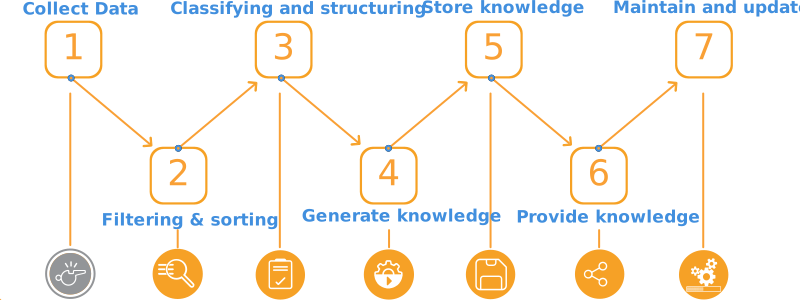
Knowledge management refers to the process of identifying, collecting, organising, storing and sharing knowledge within an organisation. It encompasses the centralised management of information and knowledge to ensure the effective use and utilisation of existing knowledge.
Objectives of knowledge management
The objectives of knowledge management are diverse. They include increasing innovative strength, making more efficient use of existing knowledge and creating a competitive advantage for the company.
Advantages of knowledge management in companies
Knowledge management offers a number of advantages for companies. It enables better use of existing resources, promotes knowledge transfer within the company and supports continuous knowledge development. Through well-functioning knowledge management, companies can increase their innovative strength and improve their competitiveness.
Definition: What is knowledge management software?
In order to manage services optimally and efficiently, it is crucial to organise the knowledge within the company in such a way that all employees involved receive all the necessary information at all times. Knowledge management software plays a central role in this. It allows both documents (e.g. work and procedural instructions, guidelines, documentation, parts lists, etc.) and information from any other sources (e.g. chat messages, email correspondence, telephone notes, visit logs) to be stored, archived and used in digital form.
Such knowledge management tools were originally introduced as part of ITIL (IT Infrastructure Library) as ‘service knowledge management systems’ (SKMS) with the aim of centrally providing data, information and knowledge required by an IT organisation. An essential element of SKMS is the so-called knowledge base (KNB), a dynamic database in which all information is stored.
Today, knowledge management tools are used not only in IT, but also in other areas of companies, such as human resources management, customer service, quality management and emergency management. Here, too, it is important to manage knowledge efficiently and make it available in order to secure and accelerate processes and increase the overall service level.
However, modern knowledge management software with integrated knowledge databases offers much more than just the ability to integrate documents manually. Rather, modern, powerful SKMS are characterised by the fact that they grow dynamically, for example by automatically documenting and archiving successful solutions. For example, a fault that has been reported via a ticket system and resolved by customer service can be transferred to the knowledge database software so that it is displayed to the clerk or even the customer themselves in the event of a similar case.
‘Information only becomes knowledge in the hands of someone who knows what to do with it.’ Peter Drucker

What are the advantages of knowledge management software?
The most important advantage of all knowledge management tools is certainly that the professional and experiential knowledge in the company is thus centrally stored and decentrally available. In its simplest form, this is often done via an intranet or a company wiki, although an integrated SKMS is much more flexible and, above all, more reliable in comparison. Because while intranets and wikis have to be maintained mainly manually - with the risk that information is only stored incompletely or not updated regularly - integrated knowledge management software does more.
Modern knowledge management tools are not isolated solutions, but are integrated into business processes. This means that they can not only be fed manually with data, information and knowledge like an intranet, but also generate new knowledge from stored workflows that are run through several times a day, which is then stored directly and made available. This enables even decentralised companies to make direct use of new knowledge from the sales force, customer service or order processing, thereby continuously improving their customer service.
Why is knowledge management important in business?
The value of knowledge in companies
Knowledge is a valuable resource for companies. It enables employees to perform their tasks effectively and develop innovative solutions. Therefore, it is important to recognise, organise and share this knowledge to get the maximum benefit from it.
The role of management in knowledge management
Management plays a crucial role in knowledge management. It is responsible for ensuring that the tools and methods of knowledge management are used correctly and for promoting the transfer of knowledge within the company. The Chief Information Officer (CIO) often plays an important role in implementing knowledge management.
Knowledge management tools and methods
There are a variety of tools and methods that can be used for knowledge management. From explicit knowledge stored in documents and databases to tacit knowledge that exists in the minds of employees, there are many approaches to systematically capture and use knowledge in an organisation. Knowledge databases and wikis are two examples of tools that can help organise and share knowledge.

How do companies benefit from knowledge management?
Companies of all sizes benefit in different ways from modern knowledge management software:
- Customer enquiries can be answered more quickly and in a targeted manner.
- Complaints are recorded in a structured manner and solutions are documented centrally.
- Less need for internal coordination due to unclear data or information.
- Fewer costs for avoidable duplicate or blind work due to missing or incomplete information.
- Customer and employee satisfaction increases.
- Cross-departmental processes require less manual coordination, as all parties involved can use all necessary information at any time.
Increasing innovative power through knowledge management
By making the best use of their existing knowledge, companies can increase their innovative power. Through the exchange of ideas and experiences, new approaches to solutions can be developed and better products or services created.
More efficient use of existing knowledge
Effective knowledge management enables companies to use their existing knowledge more efficiently. By accessing existing information and experience, they can save time and resources and make better decisions.
Knowledge management as a competitive advantage
Companies with effective knowledge management can use this as a competitive advantage. By making efficient use of existing knowledge, they can be more agile and innovative than their competitors, thereby increasing customer satisfaction.
How can knowledge management be implemented successfully?
The role of employees in knowledge management
Employees play a crucial role in knowledge management. They are the knowledge carriers and should be actively involved in knowledge sharing. Companies should create a culture that promotes continuous knowledge sharing and networking.
Continuous knowledge sharing and networking
Continuous knowledge sharing and networking among employees are crucial for successful knowledge management. By sharing knowledge and experiences, new ideas can be generated that contribute to the further development of the company.
The importance of tacit knowledge
Implicit knowledge, which exists in the minds of employees, is just as valuable as explicit knowledge. Companies should create mechanisms to identify and use this tacit knowledge to improve their performance.
How does EcholoN support knowledge management in the company?
The central element of EcholoN is the integrated, multidimensional knowledge database, which is available in all editions. Even in the affordable Express Edition for small and medium-sized businesses, it is linked to a ticket system that enables quick recording of faults, enquiries or other messages from customers or employees. All the information required for processing is clearly listed here, such as the person making the enquiry, the process or possible solutions.
Once the enquiry has been processed and the ticket closed, the experience gained is transferred directly to the knowledge database and is immediately available to other employees in the system. In this way, many simple problems and customer requirements can be solved. For more complex problems involving different areas, solutions can be determined in a structured manner and documented seamlessly.
Additional modules allow EcholoN to be expanded with further SKMS functionalities, making it a tailor-made software solution for companies from a wide range of industries and sectors. This is possible because EcholoN offers its own workflow engine, which can be used to model and automate any business process. In addition, any internal and external data sources can be seamlessly and consistently integrated into the knowledge process via the Data Workflow System.
Because all workflows are also connected to the integrated knowledge base, the company's knowledge database grows with each work step completed and expands to include process-relevant information. This can be used in the daily work environment to process customer enquiries via email or telephone more quickly, for example. Excerpts from the knowledge base can also be prepared directly for customers, suppliers or other stakeholders, for example in the form of web-based FAQs in self-service. This allows frequently asked questions or problems to be clarified more quickly and without delay, while more complicated issues can still be resolved through direct contact via chatbots, telephone or video conference.
A key advantage of EcholoN as an SKMS is its high degree of flexibility: the software has a modular structure and can be expanded at any time during operation to integrate new functionalities. Of course, the existing knowledge stored in the knowledge database can still be accessed. In this way, knowledge management can be rolled out gradually within the company and used in more and more areas of the business.
Frequently asked questions – FAQs – Knowledge management – Knowledge database
What is knowledge management?
Knowledge management refers to the process of identifying, capturing, storing, distributing and utilising knowledge within an organisation to improve efficiency and productivity.
Why is knowledge management important?
Knowledge management is important because companies can benefit from the effective use of knowledge. By accessing relevant knowledge, companies can promote innovation, empower employees and increase productivity.
What types of tools are used in knowledge management?
There are a variety of tools for knowledge management, including knowledge management software, knowledge databases, collaboration tools, content management systems and many more. These tools help to capture, organise and distribute knowledge.
How can companies manage their internal knowledge efficiently?
Companies can manage their internal knowledge efficiently by using knowledge management tools, setting clear knowledge goals, codifying knowledge, promoting knowledge transfer, and creating a culture of knowledge sharing.
What methods of knowledge management are there?
There are various methods of knowledge management, such as capturing successful prior knowledge, codifying knowledge in documents, transferring knowledge through training and mentoring, promoting collaboration, and using digital tools.
How can companies successfully implement knowledge management?
Companies can successfully implement knowledge management by establishing a clear strategy and responsibilities for knowledge management, taking the needs of their employees into account, coordinating knowledge across departments, and establishing effective communication channels.
Are there standards for knowledge management?
Yes, there are standards for knowledge management, such as ISO 30401:2018, which defines guidelines and requirements for knowledge management in organisations.
What are the advantages of good knowledge management?
Good knowledge management can lead to improved productivity, greater innovation, better decision-making, faster knowledge transfer and more effective collaboration.
What is a knowledge base?
A knowledge base is a structured collection that provides detailed information in a clear format and appropriate formatting. Knowledge bases form the basis for providing cross-company knowledge to all stakeholders: users, customers, support teams, or for quickly and easily training new employees.
What criteria are important when choosing knowledge base software?
When choosing the right knowledge base, the type of information plays a major role: make sure that the solution supports images and videos and that the knowledge base remains relevant to your processes. Some companies prefer open source options, but it is also important that the interface is easily accessible and simple to use so that your company's knowledge base is used on a daily basis.
Also interesting:
EcholoN - Knowledge Base Practical use of the knowledge base
Helpdesk software with knowledge base
Service Desk Software
- Blog article: What is an FAQ and what does it mean?
- Blog article: What is self-service?
- Blog article: Three pillars of service: ticket system - helpdesk software and service desk
- Blog article: SPOC - The key to a successful single point of contact
- Blog article: Digitisation of documents and processes