

Author: Ralph Bockisch
created on: 09.09.2025, last change: 27.10.2025
Table of content
Clarification of terms: route planning vs. route planning
Digital route planning: more than just route optimisation
Risks with unclear demarcation
Best practice from the field: How holistic planning with FSM works
Why EcholoN can do more than classic route optimisation tools
Conclusion: Think strategically about route planning - with EcholoN as a process platform
Frequently asked questions about route optimisation in field service
Why precise route planning makes all the difference in field service
In field service, a few minutes can often make the difference between a satisfied and a frustrated customer. That's why route optimisation alone is not enough. If you only focus on the shortest routes, you quickly lose sight of the big picture – such as availability, SLA requirements or necessary qualifications.
Route planning and tour planning have different objectives. Only when both are clearly separated and correctly combined can field service be managed efficiently. Modern systems for digital tour planning help to optimally schedule service technicians, conserve resources and intelligently manage service processes.
EcholoN offers a platform that combines planning, real-time data and escalation management in a single system. This results in more than just route optimisation with fewer kilometres – it creates a consistent, dynamic planning process for the entire field service, regardless of the industry.
Definition of terms: route planning vs. itinerary planning
The terms route planning and itinerary planning are often used synonymously in everyday language, but they pursue very different goals. Anyone who wants to manage field service processes efficiently should be aware of the difference. Only a clear distinction can create the basis for precise and economical deployment management.
- Tour planning involves the strategic distribution of orders to available resources. It answers questions such as:
• Which field service employees take on which assignments?
• What qualifications are required?
• How can customer requirements and SLAs be optimally taken into account?
Tour planning is therefore scheduling-oriented and takes into account not only geographical factors but also time, technical and personnel factors.
- Route planning, on the other hand, focuses on the optimal route and best travel time between specified stops. The aim is to calculate the fastest or shortest route – usually with the help of map services, traffic or weather data.
In practice, this means that route planning is part of route planning, but only part of it. Without strategic resource allocation, each route remains an isolated case – and resources are not used systematically.
For efficient field service planning, it is therefore not enough to simply plan optimised routes. A higher-level strategy is needed that takes all planning parameters into account – from availability and qualifications to SLA compliance.
Digital route planning: more than just route optimisation
Anyone who plans routes wants to work efficiently – but digital route planning goes far beyond simple route calculation. While route planning merely determines the shortest distance between locations, route planning takes into account all relevant factors of a field service assignment: time slots, technician availability, qualifications, priorities and SLA requirements.
Field service processes can only be truly optimised when these parameters are considered together. This is exactly where EcholoN comes in: the solution combines route planning with real-time data, automated rules and escalation logic. The result is a dynamic planning system that responds to deviations, allocates resources intelligently and ensures SLAs are met.
Traditional tools stop at the route – EcholoN, on the other hand, thinks further: from order to feedback. This makes technician scheduling a strategic task rather than an operational burden.
How EcholoN makes a difference in practice: functions, goals, benefits
In the reality of field service, it quickly becomes clear how crucial it is to think of tour and route planning not in isolation, but in an integrated and process-oriented way. Modern FSM solutions such as EcholoN help companies close this gap – with measurable benefits.
Functions
EcholoN brings planning, scheduling and real-time control together on a single platform. The software allows you to:
- Assign orders dynamically based on the availability, qualifications and location of technicians
- Calculate routes automatically, taking into account current traffic and weather data
- Define escalation scenarios when assignments are at risk or SLA deadlines are in danger of being exceeded
- Reschedule customer appointments flexibly without having to make manual adjustments
Goals
The goal is to holistically manage your field service processes – with a clear focus on:
- Time savings through automated processes
- Cost reduction through targeted use of resources
- Customer satisfaction through reliable and transparent communication
Benefits
The practical benefits are evident in many areas:
- Fewer empty kilometres because tours are optimally planned
- Greater adherence to deadlines because escalations are identified and planned for at an early stage
- Less stress for dispatchers because the software thinks ahead
- Higher productivity because field service employees have more time for the actual service
EcholoN combines planning and operational implementation in one system – transforming pure route optimisation into strategic field service management with foresight.

Risks with unclear demarcation
When tour and route planning are mixed together, avoidable errors with noticeable consequences arise:
What can happen:
- Technicians take detours or duplicate routes – higher costs, lower efficiency
- SLAs are not met – contractual penalties and dissatisfied customers
- Assignments do not match qualifications – mistakes on site
- Changes must be made manually – time lost in scheduling
The result: Resources are wasted, customers are disappointed – and processes become less controllable.
The solution: A clear separation of tour and route planning. With EcholoN, you can combine planning, real-time data and escalation management in one system – for smooth processes without surprises.
Technician scheduling reimagined: sensibly linking real time and rules
In classic resource planning, the focus is often on processing orders quickly. But true route optimisation in the field begins where data is intelligently linked: Who is available? Who has the necessary qualifications? Where are there time-critical service windows?
Digital systems such as EcholoN go exactly one step further. They not only assign assignments geographically, but also take individual requirements into account – automatically, rule-based and adaptable in real time. This results in planning that is prepared for exceptions instead of relying on manual reactions.
Even in the event of short-term changes or unexpected events, dispatchers retain an overview. Escalation logic takes effect automatically and routes are adjusted dynamically. Technicians receive all information on their mobile devices – including tasks, checklists and feedback options.
Would you like to know how responsive your current technician planning is?
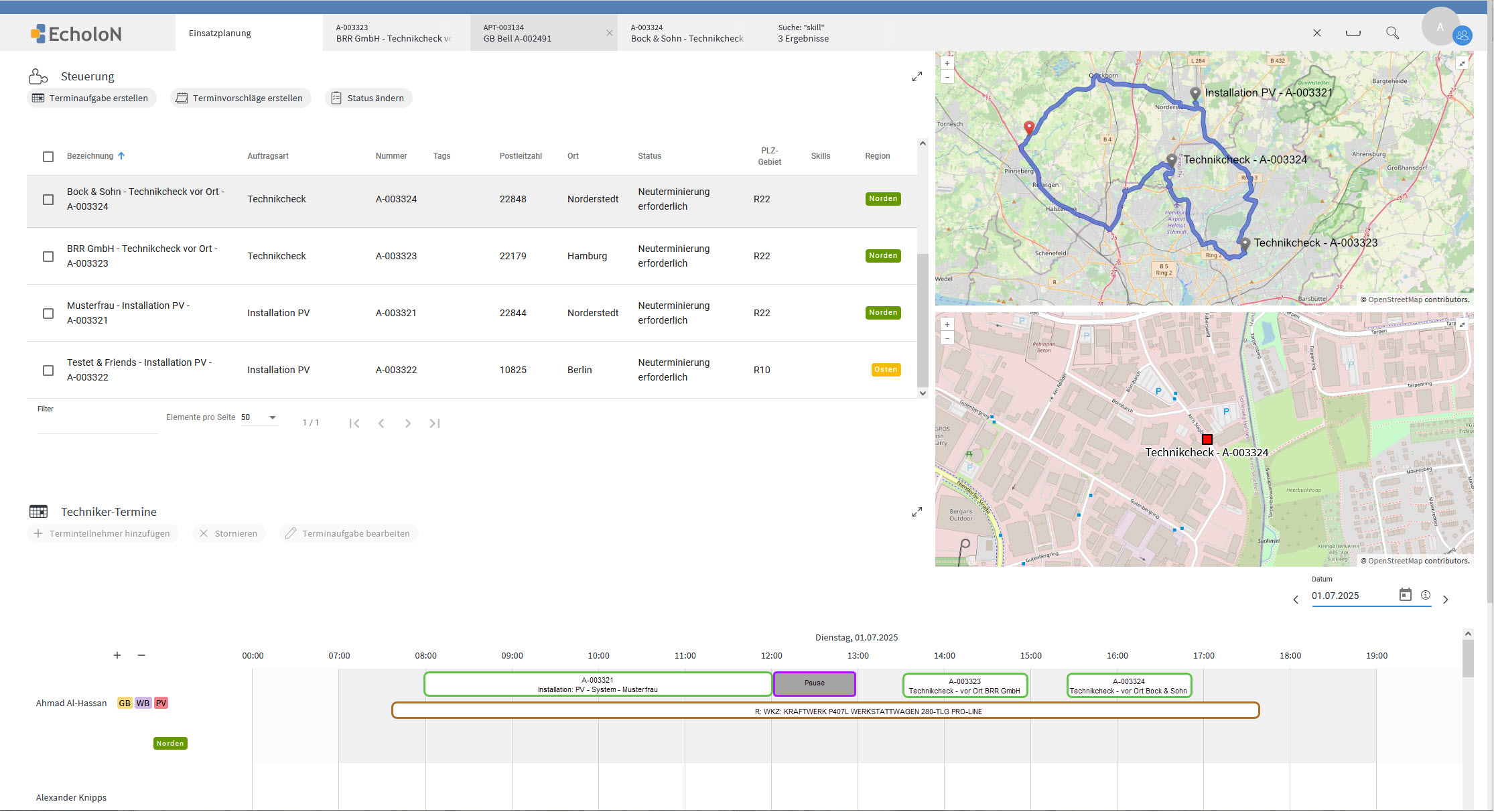
Best practice from the field: How to achieve holistic planning with FSM
Successful field service planning means more than just setting start and end points. Companies that really have their processes under control rely on field service management systems that respond flexibly to real-time information – and turn planning into ongoing optimisation.
What works in practice?
- Tours and routes are planned together instead of being optimised in isolation
- Availability, qualifications and priorities are automatically incorporated into scheduling
- In the event of short-term changes, rule-based escalation management takes effect
- Technicians receive all relevant information on their mobile devices, including customer data and checklists
- Planning remains transparent – for scheduling, technology and customers
Example from the application:
A service provider with over 40 technicians reduces the time needed to assign jobs by 27% thanks to EcholoN – thanks to automated route planning and dynamic adjustments in the event of delays. Customers benefit from better planning and greater adherence to deadlines.
The key: processes do not run side by side, but are integrated via a platform that involves all participants.
Why EcholoN can do more than traditional route optimisation tools
Many software solutions focus solely on route optimisation, i.e. the distance from A to B. EcholoN, on the other hand, combines operational planning with strategic process intelligence – from resource-accurate deployment planning to automatic escalation in the event of bottlenecks. The integration of planning, real-time data and customer communication results in holistic control that goes far beyond mere route calculation.
From optimised route planning in the field to IT service: how EcholoN connects processes
Efficient field service planning does not end with the shortest route – it begins with strategic route planning that optimally combines resources, qualifications and customer requirements. Those who rely solely on classic route optimisation are leaving valuable potential untapped.
EcholoN offers much more than pure route optimisation. The platform combines field service management with intelligent workflows, real-time control and escalation logic – creating transparency, reliability and efficiency throughout the entire service process.
At the same time, you benefit from modular software that goes beyond field service management. Depending on your needs, you can integrate additional solutions such as:
- Ticket system for structured process recording
- Helpdesk and Service Desk to centrally manage enquiries
- Customer service to improve communication and satisfaction
- IT Service Management for process handling according to ITIL and ITSM standards
- Quality management to ensure responsiveness and compliance
Everything from a single source – and fully integrable. This allows you to create a platform that grows with your requirements – without media breaks or unnecessary additional tools.
Conclusion: Think strategically about route planning – with EcholoN as your process platform
The clear distinction between route planning and itinerary planning is more than just a difference in terminology – it is crucial for efficiency and controllability in field service. Those who focus solely on route optimisation risk idle time, SLA violations and overworked teams.
Digital route planning with EcholoN goes beyond route optimisation. The solution combines resource planning, real-time data, rules and escalations in one system – for greater control, better utilisation and more satisfied customers. Companies that plan holistically today not only secure operational advantages, but also create a stable basis for further growth.
Would you like to strategically develop your field service processes?
Let's work together to identify potential areas for improvement in your planning – with no obligation and tailored to your individual requirements.
Frequently asked questions about route optimisation in field service
What is the difference between route planning and route scheduling?
Route planning and route scheduling are essential concepts in field service that are often confused with each other. Tour planning involves the strategic allocation of tasks to field service technicians and determining the optimal sequence of these tasks. This involves factors such as priority, availability and required resources. Routine tools such as the EcholoN Enterprise Service Management Suite offer invaluable assistance with their customisable planning management tools. Route planning, on the other hand, focuses on the physical aspects of travel, such as optimising the route and minimising travel time. While specialised tools such as EcholoN help to bring together all aspects of tour and route planning, it is clear that a clear distinction and combination of both approaches ensures the most effective field service.
What are the risks of unclear differentiation between tour and route planning?
Unclear distinctions between tour and route planning can entail numerous risks. These include inefficient use of resources, increased operating costs and possible non-compliance with service level agreements (SLAs). This often leads to dissatisfied customers and a poorer service experience. A lack of planning reliability can also lead to delays and an overworked field service crew. It is therefore crucial to establish clear strategic route planning in order to minimise these risks. Software solutions such as EcholoN can help to harmonise planning processes by integrating real-time information and escalation management systems, enabling more efficient use of resources.
How can holistic planning in field service management be achieved?
Holistic planning in field service management is achieved by integrating consolidated planning and analysis tools that offer real-time data and comprehensive reporting functions. The EcholoN Enterprise Service Management Suite exemplifies this by offering the ability to control all service and process steps via a central platform. This not only ensures optimal user efficiency, but also improves technician scheduling through automated workflows and real-time updates. The use of such solutions leads to an improvement in process quality and overall efficiency in the field. It is recommended that companies plan for ongoing auditing of their FSM processes to ensure continuous optimisation with solutions such as EcholoN.
What are the advantages of route optimisation in field service with EcholoN?
Route optimisation in field service with EcholoN offers numerous advantages, including increased efficiency, more cost-effective processes and improved customer satisfaction. EcholoN enables companies to design flexible resource planning that responds to the individual capacities and skills of technicians. The seamless integration of real-time data supports rapid decision-making and significantly reduces response times. In addition, linked planning management processes promote overall organisation and planning, enabling technicians to work more productively. Overall, the EcholoN solution enhances the intelligent use of resources, thereby significantly improving the services provided by external technicians.
How do I plan a route?
Efficient route planning begins with the collection of relevant data such as customer locations, time slots and technician availability. A digital system such as EcholoN helps to link this information, automatically create optimal routes and flexibly incorporate short-term changes. This saves time, avoids detours and increases service quality.
What types of route planning are there?
There are manual, automated, dynamic and strategic route planning systems. While simple systems usually only take geographical data into account, EcholoN combines all relevant factors: real-time information, qualifications, customer priorities and resource utilisation – for integrated and scalable field service management.
What needs to be considered when planning routes?
Complete deployment data, plannable time slots, current availability and compliance with SLAs are essential. Systems such as EcholoN ensure that this information is centrally controlled and continuously updated. This allows resources to be better utilised, idle times to be reduced and service promises to be reliably met.
You may also find this interesting:
- EcholoN FSM – Field Service Management Software
- Customer service, customer support and after-sales service
- CMMS - Maintenance software for reliable processes
- Blog article: Difference between maintenance, inspection, servicing and repair
- Blog article: Efficient scheduling - resource planning Technician scheduling