
EcholoN is the technical foundation for digital line-of-business applications and business processes. Data, roles, forms, workflows, clients, modules, and integrations are seamlessly integrated within a common system architecture.
Companies can get started with proven features and process templates and then customize applications to fit their own workflows, data structures, and organizational requirements.
The EcholoN software platform also serves as the technical foundation of the Enterprise Application Framework. The overview of the EcholoN solutions for digital business processes illustrates which specific business and service processes can be implemented using this platform.
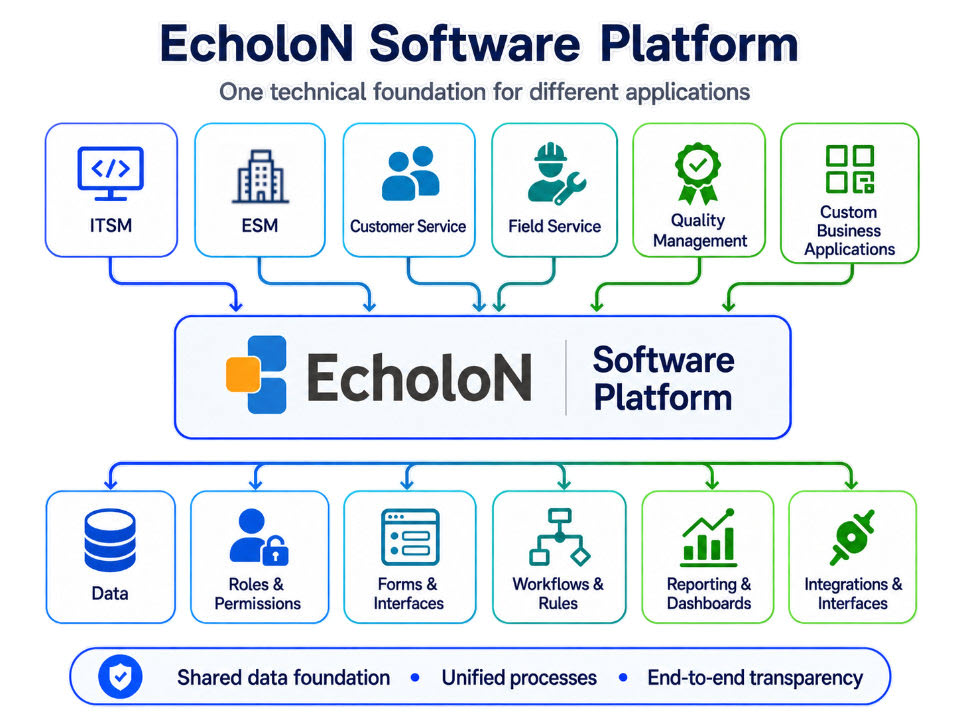
Technical Foundation for Applications, Data, and Processes
Digital business applications consist of more than just a single workflow. They require data, users and roles, forms, tasks, rules, documentation, reports, and often connections to other enterprise systems.
EcholoN brings these technical building blocks together in a unified environment.
Depending on the application, you can, among other things:
- Manage users, roles, and permissions
- Map organizational and client structures
- Centrally provide data and information structures
- Configure forms and user interfaces
- Control tasks and workflows
- Automate deadlines, follow-ups, and escalations
- Record processing steps and documentation in a traceable manner
- Reuse process and application templates
- Integrate external applications and data sources
- Provide reports and dashboards
- and maintain custom configurations so they can be updated.
This creates a common technical foundation for different applications without having to introduce another isolated software system for every new business process.
Shared data. Shared functions. Different applications.


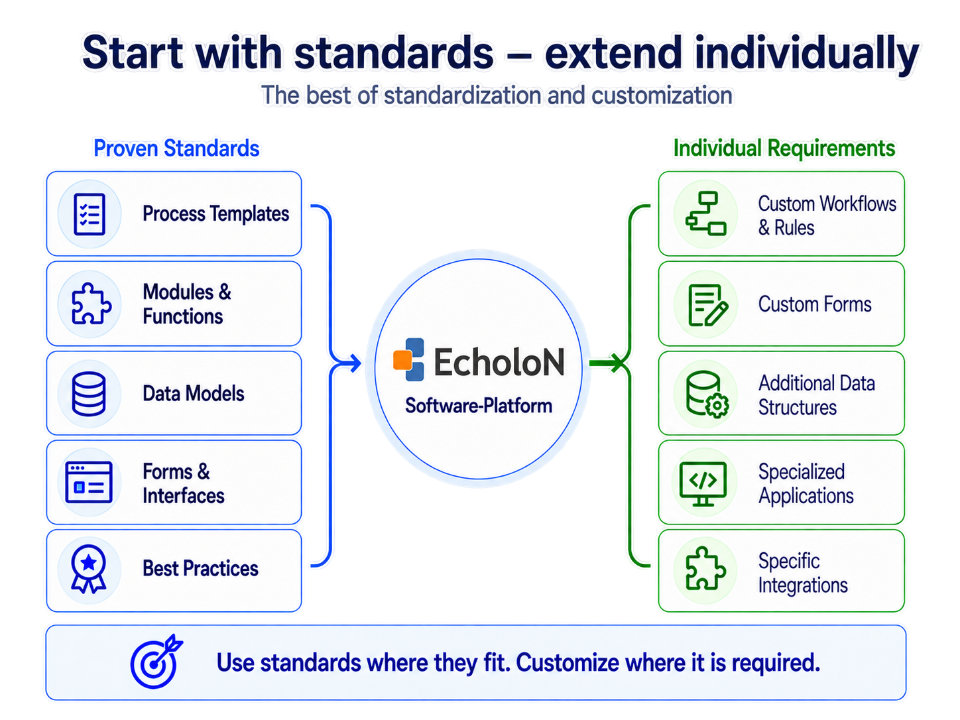
Start with Standard Features - Expand with Customization
EcholoN combines proven standard features with customizable configuration.
This means companies don’t have to develop every process from scratch. Existing features, data models, and process templates can be used as a starting point and adapted to the specific needs of each organization.
Depending on the edition and application, the following can be, for example:
- Screens and forms
- Roles and permissions
- Views and worklists
- Data structures
- Rules and decision tables
- Process steps
- Workflows
- and integrations
configured and extended.
Use standards where they make sense
Tried-and-true functions and process models create a robust foundation and reduce the effort required for recurring requirements.
Customize where your own workflows are critical
Company-specific processes and line-of-business applications can be implemented and further developed within the same architecture.
In this way, EcholoN combines standardized software components with the flexibility needed for individual business processes.
Workflow and Process Automation with EcholoN
A key technical component is the EcholoN Workflow Engine.
It connects data, forms, users, tasks, rules, and integrated systems to create controllable digital workflows.
For example, workflows can:
- automatically generate tasks,
- determine responsibilities,
- involve users or teams,
- request approvals and decisions,
- provide forms based on the process status,
- verify and supplement data,
- monitor deadlines,
- trigger reminders and escalations,
- initiate follow-up processes,
- transfer information to other systems
- and document process steps in a traceable manner.
This supports both clearly defined workflows and flexible, case-specific, and long-running processes.
Graphical tools allow workflows and the associated forms to be customized to meet specific requirements.
Explore the Workflow Engine and process automation with EcholoN

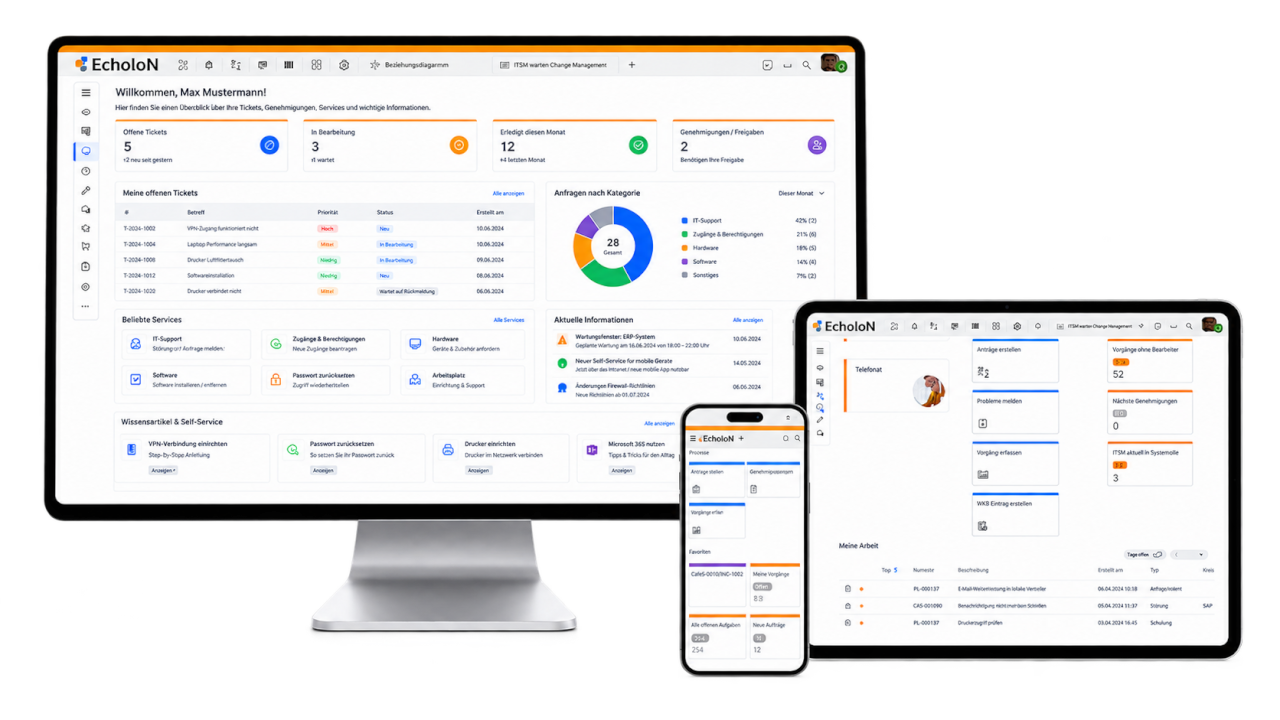
EcholoN Clients for Different Roles and Work Situations
Not every user works with the same tasks, devices, or requirements. EcholoN therefore provides a variety of access and user interface options.
Depending on the infrastructure and area of application, Windows, web, and mobile applications can be used and combined with one another.
For example:
- Administrative staff can use extensive task lists and specialized functions,
- managers can access relevant information and reports,
- external users can be integrated via web-based interfaces,
- mobile employees can edit information directly within their respective work scenarios,
- and different roles can access the functions they need.
Interfaces, forms, and available functions can be customized to suit the user’s role and area of responsibility.
View EcholoN clients for desktop, web, and mobile applications
The EcholoN system foundation can be expanded with additional modules and technical components.
This allows for the addition of features such as portal access, data integration, reporting, communication, or connections to existing enterprise systems.
Self-Service Portal
The EcholoN Self-Service Portal provides employees, customers, and partners with centralized digital access to inquiries, knowledge, forms, services, and status information.
Inputs from the portal can be directly linked to the underlying processes, roles, and workflows.
Users not only receive information but can also independently initiate and track complete digital processes.
View the Self-Service Portal with EcholoN
Data Workflow System
The EcholoN Data Workflow System (DWS) supports the integration and automated processing of data from various sources.
Data can be extracted, transformed, validated, and exchanged between different applications. This allows existing data sets to be integrated into end-to-end digital workflows and reduces duplicate data maintenance.
View data integration with the EcholoN DWS
Reporting and Analysis
With the EcholoN Reporting and Analysis Tool, data from applications and processes can be used for operational and strategic evaluations.
This includes, among other things, reports, KPIs, dashboards, and custom analyses.
View Reporting and Analysis with EcholoN
Additional Modules and Add-ons
Additional components are available to address various technical requirements, communication channels, and integration scenarios.
Data, CMDB, and Asset Management
Digital processes require a reliable and structured information base.
EcholoN can centrally manage information about organizations, contacts, systems, devices, assets, services, contracts, and other objects, and establish relationships between them.
Configuration Management Database
The EcholoN CMDB maps configuration items and their relationships in a structured manner.
Systems, components, services, and other objects can be linked together and utilized within the relevant processes.
This ensures that information is not isolated in a database but can be directly linked to processes, changes, and workflows.
View EcholoN CMDB and Configuration Items
IT Asset Management
With EcholoN’s IT Asset Management, assets and associated information can be managed in a structured manner and linked to other processes.
For example, lifecycle information, locations, contracts, costs, maintenance, or other relevant data can be assigned to an asset.
View IT Asset Management with EcholoN
Data is thus not only stored but becomes an integral part of the respective application and process control.

Integrations and Interfaces
Business processes rarely end within a single application.
ERP, CRM, monitoring, directory, communication, and other line-of-business systems provide data or need to be accessed as part of a business process.
EcholoN therefore supports connectivity to existing system landscapes via interfaces, connectors, web services, and APIs.
Depending on the integration scenario, it is possible, for example, to:
- import and synchronize data,
- reuse existing master data,
- process events from third-party systems,
- transfer information to other applications,
- or trigger actions across systems.
For more extensive data flows and transformations, the EcholoN Data Workflow System for data integration is available.
For SAP environments, EcholoN also offers its own SAP connection via the SAP Connector.
Additional connectors and integration components are summarized in the overview of EcholoN modules and add-ons.
This allows existing applications to remain part of a seamless digital process instead of creating additional data silos.
Deployment and Operations Models
Technical deployment and operations must align with the existing infrastructure, IT strategy, and organizational requirements.
EcholoN therefore supports various deployment and operations models.
On-Premises
- EcholoN can be operated within the organization’s own infrastructure. This allows companies to retain control over their local system environment and integrate the application into existing internal infrastructures.
Cloud and SaaS
- Alternatively, EcholoN can be deployed in the cloud and used as a SaaS solution. This reduces the effort required for maintaining in-house infrastructure and technical application operations.
Managed Service
- With a managed service, technical operations can be outsourced, allowing the organization to focus on using and further developing its applications and processes.
Hybrid Models
- Combinations of on-premises and cloud-based components are also possible. For example, core applications can be run within the organization’s own infrastructure, while other components are delivered via the cloud.
The most suitable deployment model depends on the infrastructure, security requirements, operational strategy, and application scenario.
Further decision-making criteria are explained in the technical article On-Premises or Cloud – What Companies Should Consider When Choosing Software.
Proven Process and Application Templates
EcholoN provides more than just technical features for customization.
Proven process and application templates are already available for established areas of application. They provide a structured starting point and can be adapted to suit your organization’s needs.
Incident Management
Record, assess, process, and document disruptions and incidents in a structured manner.
View Incident Management with EcholoN
Problem Management
Investigate recurring issues, analyze root causes, and document known problems in a traceable manner.
View Problem Management with EcholoN
Change Management
Record, evaluate, approve, plan, and implement changes in a structured and traceable manner.
View Change Management with EcholoN
Configuration Management
Document configuration items, relationships, and changes in a structured manner and make them available for use in other processes.
View Configuration Management with EcholoN
Service Level Management
Manage and monitor service level agreements, target times, and other performance metrics in a structured manner.
View Service Level Management with EcholoN
Companies can thus build upon existing process models and further develop them to suit their own organization.
EcholoN Editions – Feature Sets Tailored to Your Needs
Not every organization requires the same feature set or the same level of customization.
That’s why EcholoN is available in different editions. Depending on the edition, the options range from standardized entry-level scenarios to comprehensive, customized application and process design.
The overview of EcholoN editions compares features, processes, and available configuration levels.
For particularly extensive requirements regarding custom application design and the flexible configuration of complex business processes, the EcholoN Enterprise Edition is available for comprehensive use of the Enterprise Application Framework.
What solutions can be implemented on this technical foundation?
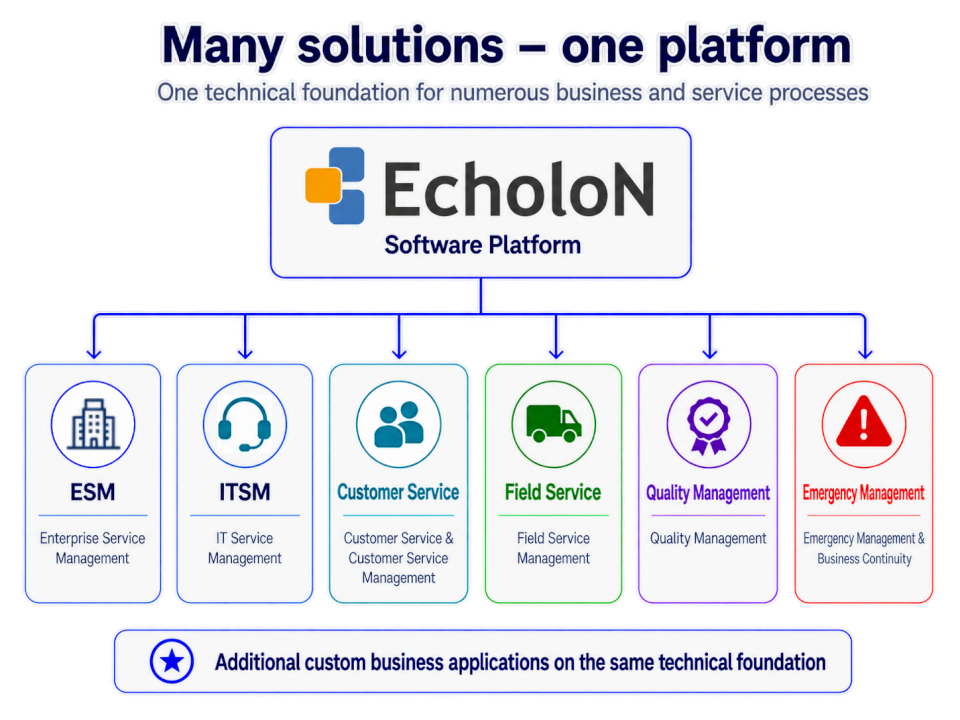
The software provides the technical components. Various line-of-business and service applications can be built on top of this foundation.
The following examples illustrate key areas of application. For a complete overview, see the section EcholoN Solutions for Digital Business Processes.
Enterprise Service Management
With Enterprise Service Management (ESM), service management principles can be extended beyond IT to other business units. Services, requests, tasks, and workflows can be organized using shared structures.
View Enterprise Service Management with EcholoN
IT Service Management
IT Service Management (ITSM) supports the structured organization and management of IT services and the associated processes.
Existing process templates, the CMDB, workflows, and other technical components are integrated within a shared environment.
View IT Service Management with EcholoN
Customer Service and Customer Service Management
With EcholoN for customer service, customer support, and after-sales service, customer inquiries, service orders, and other customer-related processes can be processed and documented in a structured manner.
View Customer Service with EcholoN
Field Service Management
Field Service Management with EcholoN connects back-office operations, dispatch planning, and mobile service processes.
Information on orders, assets, and service calls can thus be utilized throughout a unified workflow.
View Field Service Management with EcholoN
Quality Management
The EcholoN Quality Management Software provides structured support for quality, inspection, documentation, and improvement processes.
View Quality Management with EcholoN
Emergency Management
The EcholoN Emergency Management Software supports defined and traceable workflows for emergency and business continuity processes.
View Emergency Management with EcholoN
These application areas are examples of solutions built on the same technical foundation.
You can find additional specialized applications and customized business processes bundled in the central solutions section.
Get to Know EcholoN Software in Your Own Application Scenario
The components, processes, and integrations required depend on your existing workflows, requirements, and system landscape.
A personalized demonstration can show how EcholoN connects data, workflows, roles, user interfaces, and existing systems for a specific application scenario.
Frequently Asked Questions About the EcholoN Software
What is the EcholoN software platform?
EcholoN is a modular technical foundation for implementing digital business, service, and operational processes. Among other things, it connects data, users, roles, forms, workflows, documentation, reports, and integrations within a single system environment.
What is the difference between EcholoN Software and EcholoN Solutions?
EcholoN Software describes the technical foundation, including its components and functions.
EcholoN Solutions, on the other hand, illustrate which specific business processes and application areas can be implemented with it - for example, Enterprise Service Management, IT Service Management, Customer Service, Field Service Management, or Quality Management.
Can existing processes be customized?
Yes. Depending on the edition and application, forms, roles, views, data structures, rules, and workflows - among other elements - can be adapted to an organization’s requirements.
EcholoN combines existing standard functions and process templates with defined options for company-specific configurations.
Can custom business applications be implemented with EcholoN?
Yes. The shared technical architecture enables the implementation of individual business processes in addition to existing applications and process templates.
The EcholoN Enterprise Edition is specifically designed for particularly extensive custom application and process design.
Are customizations retained during EcholoN updates?
Yes. A key advantage of EcholoN is the combination of adaptable standard software and the ability to receive ongoing updates. Companies can adapt processes, forms, data structures, roles, rules, and workflows to their own requirements without having to develop custom software that is completely decoupled from the standard.
The configuration and extension options are an integral part of the EcholoN architecture. This allows custom applications and company-specific processes to be implemented and further developed on a standardized software foundation that remains updateable.
In this way, EcholoN combines the advantages of established standard software with the flexibility to meet individual requirements: Standardized in its technical foundation, customized in its application, and capable of being updated as the platform evolves.
Can EcholoN be connected to existing systems?
Yes. Depending on the specific system and application scenario, existing applications and data sources can be integrated via interfaces, APIs, web services, connectors, or the EcholoN Data Workflow System.
Can EcholoN be operated in the cloud and on-premises?
Yes. EcholoN supports various deployment and operating models and can thus be adapted to a company’s existing IT infrastructure and operating strategy. Options include on-premises, cloud or SaaS, managed service, and hybrid scenarios.
This allows companies to run EcholoN within their own infrastructure, use it as a cloud-based solution, or combine on-premises and cloud-based components. The appropriate operating model depends on the specific requirements for infrastructure, security, administration, and operations.
On-Premises or Cloud - Decision Criteria for Enterprise Software










 Vivantes: Stephanie Koch - Service Center Personnel
...I have not been there for so long ;) What I can say is very positive: I am very satisfied with the implementation, the feedback and the direct contact - Stephanie Koch - Service Center Personnel
 Telekommunikation Lindau: Uwe Knöpfle - Head of data center
... KundenTreff, Munich / 24.10.2018 here, there were valuable insights into the possibilities, for example the project management with EcholoN - Uwe Knöpfle - Head of data center
 Bezirk Schwaben: Markus Rinkenburger - IT service
....Superb, how on the part of our small wishes, for example. Changes, was received - Markus Rinkenburger - IT service
 Stadtverwaltung Worms: Michael Lewandowsky - Internal service
...just run an update during the lunch break, that's a really cool thing - Michael Lewandowsky - Internal service