With the EcholoN Enterprise Service Management Software, you can integrate services and business processes from IT and other departments onto a single platform.
Requests, services, forms, tasks, approvals, knowledge, and service levels can be managed in a structured manner and linked through cross-departmental workflows.
EcholoN goes beyond a traditional ESM suite: Standard functions can be utilized, processes and data structures can be configured without custom software development, and more complex requirements can be expanded as needed - even to include your own specialized applications and software components.
This allows Enterprise Service Management to grow with your company’s needs - from individual service processes to a unified platform for digital service and business processes.

What is Enterprise Service Management Software?
Enterprise Service Management—ESM for short—applies service management principles and structured service delivery to various areas of the enterprise.
While service management is often established in IT, ESM can also be used to organize, for example, HR requests, facility services, customer service processes, technical services, approvals, or administrative business processes.
Typical ESM platforms provide functions such as service catalogs, self-service, workflows, roles and permissions, service levels, knowledge, integrations, and reporting.
A key feature of an ESM platform is that different business units can use shared technical mechanisms without having to employ identical processes.
The individual services remain distinct in terms of their business functions. Nevertheless, cross-functional workflows, data, and responsibilities can still be linked together.
For a detailed technical overview, see the article What Is Enterprise Service Management?.
ESM and ITSM: What’s the Difference?
IT Service Management and Enterprise Service Management are not opposites.
IT Service Management (ITSM) focuses on the planning, delivery, support, and further development of IT services.
Enterprise Service Management (ESM) applies the same service management principles to additional internal or external services and enables cross-functional processes.
| IT Service Management | Enterprise Service Management |
|---|---|
| Focus on IT services | IT and other enterprise services |
| ITSM processes and practices | Service and business processes across multiple departments |
| IT service catalog | Cross-departmental service offerings |
| IT-specific responsibilities | Additional service owners and departmental managers |
| IT processes within the service organization | Cross-functional processes spanning multiple departments and systems |
An existing ITSM can therefore serve as a useful starting point for Enterprise Service Management.
For more information on IT-specific processes, see IT Service Management Software with EcholoN.
Why Companies Use Enterprise Service Management

Many companies already have powerful specialized systems.
The problem often arises between these systems, departments, and areas of responsibility.
For example, a request begins via email. The required information is stored in an HR, ERP, or CRM system. Approval is granted through yet another communication channel. Then another department must take action.
For the requester, it often remains unclear where the process is in the pipeline and who is currently responsible.
Typical consequences include:
- manual handoffs
- media breaks
- different intake channels
- duplicate data entry
- lack of status information
- difficult-to-trace responsibilities
- long turnaround times
Enterprise Service Management creates a unified service and process framework to address these issues.
EcholoN can capture requests in a structured manner, assign responsibilities, manage tasks and approvals, monitor service levels, and integrate existing systems into a seamless process.
When Enterprise Service Management Makes Sense
ESM becomes particularly relevant when processes regularly involve multiple teams, roles, or systems.
Typical signs include recurring requests via shared inboxes, frequent manual hand-offs, multiple forms for comparable processes, a lack of transparency regarding processing status, recurring approvals, or service requests that cannot be clearly assigned to a single system.
ESM does not need to replace existing line-of-business systems.
For example, an HR system can continue to serve as the primary source of employee master data, while EcholoN manages the associated request, approval, or onboarding process.
ESM can thus be used as a connecting service and process layer between business units and existing systems.
Enterprise Services on a Shared EcholoN Platform

Different departments require different processes.
However, they do not necessarily require different technical foundations.
With EcholoN, various service areas can use shared platform mechanisms for users, roles, forms, workflows, data, service levels, knowledge, integrations, and reports.
| Department | Typical Processes with EcholoN |
|---|---|
| IT | Incidents, service requests, changes, permissions, IT services |
| HR | Employee inquiries, onboarding, offboarding, internal requests |
| Facility Management | Fault reports, workspace services, building and equipment requests |
| Customer Service | Support requests, complaints, service cases, customer and device histories |
| Technical Service | Maintenance, Repairs, Service Orders, Field Service Calls |
| Administration | Approvals, Information Requests, Contract and Approval Processes |
| Other Departments | Custom case, service, and business processes |
The individual areas may have different screens, data, roles, and process logic.
At the same time, shared platform functions and cross-functional workflows can be utilized.
What Sets EcholoN Apart as an ESM Platform
Standard features for tickets, services, self-service, and workflows are now part of the basic scope of many service management systems.
What matters most, therefore, is the extent to which a platform can adapt to existing processes and evolve beyond traditional ESM use cases.
To achieve this, EcholoN combines multiple levels: utilizing standard features, configuring them with no-code, supplementing them with additional logic using low-code, and, if necessary, developing custom applications with pro-code.
Standard Features as a Foundation
EcholoN provides core functions for handling requests, cases, and services.
These include, among other things, service and case management, service catalogs, self-service, workflow control, roles and permissions, service levels, knowledge, reporting, and links to customers, users, products, devices, and other data objects.
Existing functions can be used as a starting point, rather than redeveloping basic service management mechanisms from scratch for each department.
No-Code: Configuring Processes, Workflows, and Interfaces
Many requirements can be implemented within the EcholoN platform through visual configuration.
These include, for example:
- Data structures
- Forms and screens
- Roles and permissions
- Status models
- Service offerings
- Rules and conditions
- Workflows
- Tasks
- Approvals
- Escalations and deadlines
With the EcholoN Workflow Engine, workflows, tasks, conditions, approvals, escalations, and other process steps can be configured graphically and linked together.
In this way, business processes can be adapted to the respective organization without having to develop a separate software component for every change.
Low-Code: Adding Additional Business Logic
If the visual configuration is insufficient, additional business logic can be added via scripts and expressions.
This allows, for example, the implementation of specific rules, calculations, or technical functions without having to develop a standalone software component for every requirement.
Low-Code extends the existing platform and workflow mechanisms where additional logic is required.
Pro-Code: Develop Your Own Business Applications
For requirements that go beyond standard functions, configuration, and additional business logic, the EcholoN Enterprise Edition offers more advanced capabilities.
Custom applications, modules, and software components can be implemented based on the existing platform.
This allows standard service management functions to be combined with custom business applications.
ESM is thus one area of application for the EcholoN platform - not its technical limit.
EcholoN can be used beyond traditional ESM scenarios as a technical foundation for custom business applications and digital business processes.
Integrating Existing Systems
Enterprise Service Management does not exist in isolation from the existing system landscape.
Using EcholoN’s integration and data functions, existing applications and data sources can be incorporated into processes.
Depending on the scenario, the following can be integrated, for example:
- REST/JSON interfaces
- GraphQL, SOAP web services
- SQL/ODBC databases
- LDAP or Active Directory
- SAP environments
- Other applications and data sources
For more information, see Data Integration with EcholoN.
This allows an existing line-of-business system to remain the primary source of its data, while EcholoN controls the overarching service or business process.
Select an Operating Model That Aligns with Your IT Strategy
Companies differ in terms of infrastructure, operations, and security requirements.
EcholoN supports various operating models.
Depending on the scenario, the platform can be deployed on-premises, as a cloud/SaaS solution, as a managed service, or in hybrid scenarios, among other options.
This allows companies to select an operating model that meets their specific infrastructure, security, and operational requirements.

Service management processes are crucial to ensure optimal service quality, which in turn contributes to customer loyalty. Through efficient service management, organisations can increase customer satisfaction and ensure service continuity, leading to long-term benefits.
In addition, effective service management processes offer the following benefits for an organisation:
Process optimisation
With clear, well-defined processes, organisations can adapt and improve their services to increase efficiency and effectiveness.
Cost control
Effective service management helps to reduce or eliminate unexpected costs by minimising service defects and failures and eliminating their causes.
Quality improvement
By continuously evaluating and improving service processes, organisations can raise their service standards and achieve higher customer satisfaction.
Risk minimisation
By systematically controlling and monitoring service processes, companies can identify risks and develop customised risk mitigation strategies.
Better supplier management
Service management can help improve relationships with suppliers by clearly defining who does what and who is responsible for what.
Improved compliance
Service management processes can help companies meet legal and contractual requirements by ensuring that services are delivered in a standardised, repeatable way.
Service management as the key to customer satisfaction
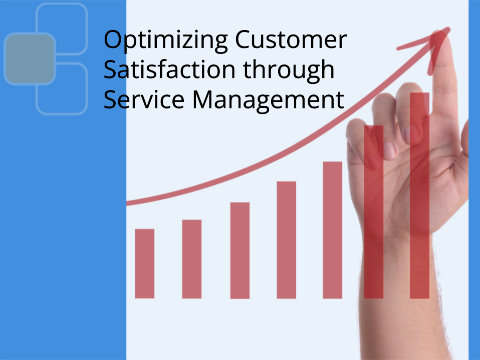
A functioning service management system plays a key role in meeting your customers' expectations – and often even exceeding them. It ensures that service processes run reliably, transparently and in line with actual requirements.
Respond faster, provide more targeted help
Structured processes, automated routines and clearly defined service levels enable requests to be processed more quickly. This not only increases response times, but also improves the quality of the response.
Automate recurring tasks
Standard processes such as scheduling appointments, approving materials, or escalation management processes can be automatically controlled via the workflow engine. This reduces processing times and takes the strain off your team – without compromising service quality.
Use information in a targeted manner
The central recording of feedback, incidents and order data provides a reliable basis for decision-making. This helps to identify bottlenecks at an early stage and make processes more customer-friendly.
Increase availability and transparency
Whether via self-service portals, status displays or automated notifications, customers – both internal and external – know where their request stands at all times. This creates trust and reduces queries.
Make quality visible
Good service management documents what has been done – and in what time. This creates measurable quality that also pays off in certifications, ratings and customer loyalty.
Control changes
Service management also includes the structured management of changes – whether to systems, processes or responsibilities. With the help of defined change processes, you can ensure that adjustments are implemented in a controlled manner without compromising service quality. Support is also available through the CIP process. Risks can be minimised, impacts planned in advance and all parties involved transparently integrated.
Evaluate data, improve services
Evaluations and reports on process times, case numbers or escalations reveal potential for development. Service management creates the basis for data-driven decisions and strategic optimisation.
With service management software such as EcholoN, you can keep track of all relevant key figures, control processes in a targeted manner and ensure that your services not only work, but also impress.
Enterprise Service Management and IT Service Management - What's the Difference?
Enterprise Service Management extends the principles of IT Service Management to other business units within the company. ITSM focuses on the structured delivery and improvement of IT services. ESM also creates a common service and process platform for IT, HR, customer service, facility management, and other business units.
ITSM can thus be an important component of a comprehensive ESM strategy.
Which frameworks and tools are suitable for service management?

Overview of common frameworks in service management
There are various frameworks such as ITIL, COBIT and ISO/IEC 20000 that support companies in introducing and optimising their service management. These frameworks offer proven methods and best practices for efficiently organising and continuously improving service processes.
ITIL
ITIL (Information Technology Infrastructure Library) is a comprehensive guide for the planning, provision and support of IT services in organisations. It offers proven best practices for IT service management in order to continuously improve the efficiency and quality of IT services. ITIL includes guidelines, processes, tools and roles to optimise the use of IT infrastructure.
ISO / IEC 20000
ISO/IEC 20000 is an internationally recognised standard for a Service Management System (SMS). It specifies requirements for the service provider for planning, setting up, implementing, operating, monitoring, reviewing, maintaining and improving an SMS. The requirements cover the design, transition, delivery and improvement of services to fulfil the agreed service requirements.
COBIT
COBIT (Control Objectives for Information and Related Technology) is a framework for the control and monitoring of information technology processes in organisations. It provides a set of best practices and guidelines to ensure that IT processes are efficient and secure. COBIT is often used to improve governance and compliance in IT systems.
CMMI-SVC
CMMI-SVC (CMMI for Services) is a framework that supports organisations in improving their service processes and optimising their services. It offers proven methods and best practices for service organisations to increase their efficiency and provide high-quality services. Organisations can use it to evaluate and improve their service performance.
FitSM
FitSM (Federated IT Service Management) is a standard for IT service management based on the needs of organisations with federated structures. It provides a framework for the management of IT services and supports the efficiency and quality of services, regardless of the size or scope of the organisation.
SIAM
SIAM (Service Integration and Management) is a framework developed to enable the effective integration of services from different suppliers. It provides best practices and processes to improve collaboration between different service providers and maximise overall performance. SIAM aims to reduce the complexity of service integration and ensure a consistent level of service.
In addition, organisations can integrate different frameworks, processes and standards into their service-oriented approach to meet different requirements.
Choosing the right service management tool
Choosing the right service management tool is critical to effective service delivery. Organisations can rely on powerful tools such as ServiceNow, BMC Remedy and EcholoN to automate, monitor and continuously improve their service processes.
Implementation of Enterprise Service Management
Implementing Enterprise Service Management (ESM) enables companies to integrate and optimise service processes across different departments. By managing services in a standardised way, companies can ensure efficient service delivery and a holistic view of their services.
How can service management be used across all industries?

Service management in different industries
Service management can be used in various industries such as healthcare, finance and IT to improve service quality and provide customer-centred services. Adapting service processes to the specific requirements of each industry enables companies to optimise their service delivery.
Field service management and service management processes
Field service management is an essential part of service management, especially in industries such as technology and manufacturing. By integrating service management processes, organisations can increase the efficiency of field service and ensure smooth service delivery in the field.
Company-wide service management optimisation
Companies can optimise service management across the enterprise by applying best practices from different industries and continuously improving service processes. The integration of ESM tools and the adaptation to industry-specific requirements enable companies to maximise service quality and increase customer satisfaction.
EcholoN as an Enterprise Service Management Platform
EcholoN combines core service processes with flexible process design. Tickets, service requests, assets, SLAs, knowledge, self-service, and custom workflows can be organized and linked together on a single platform.
The integrated workflow engine not only enables the automation of traditional service processes but also the digitization of custom workflows from various departments.
Key features at a glance:
- Ticket management and order control
Systematically record, prioritise and track service requests – both internal and external. - Service contracts and SLA monitoring
Manage service level agreements centrally and check compliance automatically. - Asset and device management
Link services to products, systems or components – including history and documentation. - Mobile access for field service teams
Service technicians document orders directly on site – paperless, structured and without wasting time. - Self-service portal with knowledge database
Take the pressure off your team and give customers the opportunity to find answers themselves – supported by AI-based suggestion logic. - Reporting and evaluation
Get meaningful KPIs and reports on performance, response times and process quality at any time. - Workflow engine
The integrated, flexible workflow engine automates processes and tasks. Standard templates for processes and workflows are an indispensable tool for fast action.
The modular concept of EcholoN
EcholoN covers various areas of service management. In addition to common functions such as ticket creation and service contract agreements, the framework also provides product and device information for all devices used in service operations. Employees can use the specifications to prepare for service calls by, for example, laying out replacement parts and drawing on knowledge from previous assignments. Many interfaces to well-known software and hardware are already integrated.
Manage and process service orders
The foundation for an optimal service offer is the precise planning and handling of all service assignments.
EcholoN provides the order management with all required information centrally. Thus, for example, open service orders and service assignments or order times and used material are always at a glance.
The service is supported in the handling and coordination practically and reliably.
Mobile service use
Support the work of your service technicians in the field with the mobile application from EcholoN. Be it order time recording, material consumption or a digital service report. Everything can be done on site and returned to the system. Thus, the time-consuming subsequent recording of paper-based service reports is completely eliminated.
The browser-based online application can be used on any device thanks to the latest technology. Offline as a native app for iOS, Android and Windows operating systems
Equipment and device information accessible by mobile device
Devices or products (assets) managed in EcholoN are easily and clearly available for mobile service processing (asset management).
Information such as important documents or reports on previous service calls can be stored in the device file.
Customer administration made easy
With EcholoN you manage all relevant customer data. Companies, contacts and tasks are created and assigned with one click.
Powerful self-service portal
The EcholoN self-service portal has an integrated knowledge database, which is continuously improved by machine learning AI (artificial intelligence), among other things. The intelligent tool helps the service provider and, above all, the customer, because on the one hand, specialist and experience knowledge can be made available centrally and decentrally in the company, and on the other hand, customer enquiries can be answered more quickly and in a targeted manner.
Your advantage with EcholoN
EcholoN provides clarity, reliability and a new level of quality in service management. Processes become transparent, communication more targeted – and customer loyalty measurably stronger. Whether in technical service, IT or customer management, EcholoN grows with your requirements and supports you in managing your services professionally.
Reasons for the EcholoN service management solution
Whether standard or individualized - your requirement is our benchmark
- Optimizing the control of maintenance, service and repair operations
- Increase customer satisfaction
- Faster response to requests
- Secure invoicing of all services
- Optimize the flow of information between the head office / dispatcher and customer service representatives
- Improve the recording and processing of customer-specific information
- Increase in sales by more satisfied customers
Frequently asked questions (FAQ)
What is Enterprise Service Management?
Enterprise Service Management (ESM) applies service management methods and structures to other areas of the organization. In addition to IT, areas such as HR, customer service, facility management, and technical services can be organized through shared processes, workflows, and service offerings.
What does a service management system include?
A service management system (SMS) brings together processes, roles, rules, and tools to deliver services in a controlled and standardized manner. It includes, among other things, ticket management, compliance with service-level agreements, resource management, and ongoing quality control.
What is a service management tool?
A service management tool is a software solution that supports companies in planning, managing, and analyzing their service processes. Such tools—such as EcholoN—enable structured workflows, centralized data storage, and the integration of customers, technicians, and partners.
What are the benefits of service management software?
Service management software simplifies processes, shortens response times, and improves service quality. Additional benefits include:
- An overview of all active and completed tickets
- Automated escalations and deadline tracking
- Reduced manual effort
- Traceability for internal and external customers
What is the difference between ESM and ITSM?
IT Service Management focuses on IT services and IT-related processes. Enterprise Service Management extends this approach to the entire organization and integrates additional departments into a common service and process structure.
What methods and standards exist in service management?
Common frameworks and standards in service management include:
- ITIL (IT Infrastructure Library) for IT service processes
- ISO/IEC 20000 as the international standard for service management systems
- COBIT, CMMI-SVC, FitSM, and SIAM for specific application areas and governance structures
Which areas can be managed with Enterprise Service Management?
Typical areas of application include IT, customer service, HR, facility management, technical service, contract management, and other administrative and service-oriented business processes.
Who can benefit from a service management solution?
Service management software is suitable for companies of all sizes that need to manage recurring service processes—whether in manufacturing, IT, technical customer service, or administration. It is particularly relevant in situations where many stakeholders collaborate and response times are critical.
Also interesting:
- Field service management software - EcholoN FSM
- Customer Service & Customer Support
- Maintenance software for reliable processes - EcholoN CMMS software
- Blog article: What is enterprise service management?
- Blog article: What is service excellence? - DIN SPEC 77224 - Generating customer enthusiasm
- Blog article: Continuous improvement process (CIP)
- Blog article: What is SLA monitoring?
- Blog article: What is enterprise asset management (EAM)?
- Blog article: Quality management in companies