

A SPoC in IT Service Management ensures that incidents, service requests, inquiries, and other IT issues are routed to the correct processes through a controlled intake process. In practice, this role is often fulfilled by the service desk. It not only receives requests but also documents, classifies, prioritizes, and coordinates them throughout the entire handling process.
While the term Single Point of Contact generally describes a central point of contact, ITSM is primarily concerned with operational implementation: Which intake channels are available? How are service disruptions distinguished from service requests? Who handles the processing? When is an issue escalated? What service levels apply? And how is the user kept informed during processing?
An effectively organized SPoC connects users, the service desk, IT operations, business units, and downstream support levels. This transforms individual reports into traceable processes that can be systematically processed, evaluated, and improved.
For a general explanation of the term, see the article SPoC: Meaning, Tasks, and Benefits of the Single Point of Contact.
What is a SPoC in IT Service Management?
A SPoC in IT Service Management is the designated point of contact for IT-related issues raised by users, customers, partners, and business units. It ensures that requests are not sent in an uncoordinated manner to individual IT staff members, but are instead centrally recorded and routed through a defined ITSM process.
The SPoC can be reached through multiple technical channels. These include, for example:
- Self-service portal
- Phone
- Chat
- Web form
- Mobile applications
- Interfaces to other systems
“Single Point of Contact” therefore does not necessarily mean that only a single communication channel is permitted. What matters is that all incoming requests converge in a shared process and a central database.
The SPoC thus provides a standardized point of access to the IT organization. Users do not need to know which team is responsible for an application, a workstation, an authorization, or an IT service. They simply contact the central point of contact. The IT organization handles the internal assignment.
What role does the Service Desk play as the SPoC?
In many companies, the Service Desk serves as the SPoC. The Service Desk is the operational unit that receives user requests and coordinates their handling within IT service management.
It is important to distinguish between the responsibility for contact and the responsibility for resolution.
The Service Desk does not have to resolve every issue itself. However, it often remains responsible for the structured recording, communication, and coordination of issues. Technical resolution can be handled by first-level support, specialized support teams, external service providers, or the responsible business units.
A Service Desk acting as a SPoC typically performs the following tasks:
- Receive requests and service disruptions
- Record complete ticket information
- Assign affected users and services
- Classifying issues
- Assessing impact and urgency
- Setting priorities
- Taking service levels into account
- Conducting initial diagnoses
- Providing standard solutions
- Forwarding cases to the appropriate teams
- Initiating escalations
- Monitoring processing status
- Informing users
- Documenting solutions and findings
This makes the Service Desk the operational hub between users and ITSM processes.
“In IT service management, a SPoC is not just a central point of contact. It is the point at which a request becomes a manageable, traceable service process.” Ralph Bockisch
Find out how EcholoN brings together key intake channels, ticket management, escalations and service processes on a single platform.
How a Request Passes Through the ITSM via the SPoC
An SPoC only realizes its full potential when there is a defined process behind the point of contact. A shared email address alone is not enough. What matters most is how a request is processed after it is received.
-
1. inquiry received
A request or issue is received
A user submits a request via the self-service portal, by email, by phone, via chat, or through another approved channel.
In addition, monitoring and third-party systems can generate technical events or tickets via interfaces. Such system notifications supplement the user-initiated submission channels but are not considered part of the traditional user contact process.
-
2. Data Collection
The process is documented centrally
The SPoC creates a traceable process in the ITSM or service desk solution. Existing tickets are identified to ensure that reports are not processed twice.
Basic information includes:
- person reporting the issue
- affected organization or department
- affected IT service
- description of the issue
- time of occurrence
- affected users or locations
- potential impact
- existing error messages
- actions already taken
- attachments or screenshots
The more complete the information is, the faster the issue can be resolved.
-
3. Classification
The request is classified
The SPoC determines what type of incident it is. It is particularly important to distinguish between an incident and a service request.
In addition, a request may contain indications of a problem, a necessary change, or a need for information.
-
4. Assessment
Impact and urgency are assessed
Priority should not be assigned based solely on the user’s subjective assessment. Instead, impact and urgency are assessed according to defined criteria.
Typical questions include:
- How many users are affected?
- Which business processes are impacted?
- Has a critical IT service failed?
- Is there a workaround?
- Is there a security or compliance risk?
- Must a contractual response time be met?
Impact and urgency together form the basis for priority.
-
5. Who is responsible?
Responsibility and service levels are determined
Based on the affected service, category, organization, and other characteristics, the team responsible for handling the case is determined.
At the same time, the applicable response, processing, and resolution times are verified. These may be specified, for example, in service level agreements, internal agreements, or customer contracts.
-
6. Direct Resolution / Escalation
Initial resolution or escalation takes place
The Service Desk checks whether the issue can be resolved directly. Standardized solutions, knowledge articles, checklists, and automations support rapid processing.
If the SPoC cannot resolve the issue on their own, it is escalated to the appropriate support team.
An escalation should not merely involve a change in responsibility. It must include all information already recorded so that the user does not have to explain the issue again.
-
7. Ongoing Monitoring
Processing Is Monitored
Even after being forwarded, the ticket remains visible in the ITSM system. Deadlines, status changes, escalation thresholds, and follow-up questions are monitored.
This prevents tickets from getting stuck between teams or being forwarded without a clear status update.
-
8. Inform Users
Users receive status updates
The SPoC confirms receipt, requests any missing information as needed, and notifies users of relevant status changes.
Effective status communication answers the following questions in particular:
- Has the request been received?
- How was it categorized?
- Who is handling the case?
- Is there a known solution or workaround?
- When can the next step in the process be expected?
- Has the issue been resolved or closed?
-
9. Resolution
The solution and closure are documented
After the issue has been resolved, the solution implemented is documented. The user receives a closure notification and can confirm, if necessary, whether the issue has been fully resolved.
A ticket should not be closed until the solution has been documented in a way that is easy to follow.
-
10. Applying insights and improving processes
Lessons learned are put to further use
Recurring questions, common issues, and successful solutions provide important information for:
- Knowledge Management
- Self-Service
- Problem Management
- Process Improvements
- Automation
- Reporting
- Service improvements
In this way, the SPoC becomes not just a point of contact, but a central information hub for the entire IT organization.
Incident, Service Request, Problem or Change?
One of the SPoC’s most important tasks is to correctly classify an issue. If different incident types are mixed, this leads to incorrect priorities, unnecessary escalations, and unclear expectations.
| Issue: | ITSM-Einordnung | Example |
|---|---|---|
| An IT service is not working, or is only functioning to a limited extent | Incident | The ERP system is unavailable |
| A standardised service is required | Service Request | A request has been made for a new software licence |
| The cause of recurring faults needs to be investigated | Problem Management | An interface regularly goes down |
| A controlled change is required | Change | A production system configuration needs to be adjusted |
| General information is required | Informationsanfrage | A user enquires about an available IT service |
| A system is reporting a technical status | Event Management | Monitoring detects a critical capacity limit |
Incident
An incident occurs when an IT service is unexpectedly interrupted or does not function as intended. The goal of incident management is to restore normal service delivery as quickly as possible.
The SPoC records the incident, assesses its impact and urgency, and initiates the necessary resolution steps.
For more information, see the article Incident Management.
Service Request
A Service Request is a standardized request for a service, information, or deployment.
Typical examples include:
- new user account
- software deployment
- authorization request
- hardware order
- password reset
- information about an IT service
Service requests should be processed via defined workflows. These may include approvals, reviews, automated tasks, and standardized deployments.
Problem
A problem is the underlying or as-yet-unknown cause of one or more incidents.
The SPoC does not typically handle problem management directly. However, they identify patterns, document recurring issues, and provide the data required for root cause analysis.
For more information, see the article Problem Management.
Change
A change request does not automatically become a formal change. The SPoC records the request and initiates its classification.
Whether this results in a change depends on the defined processes, risks, approval rules, and responsibilities.
For more information, see the article Change Management.
The SPoC’s responsibilities throughout the ticket lifecycle
The SPoC’s responsibilities are best viewed in the context of the entire ticket lifecycle.
Intake and Documentation
The SPoC ensures that all necessary information is available in a complete and structured manner. Free-form text alone is often insufficient. Forms, required fields, and guided data entry dialogs improve data quality.
Classification
Requests are assigned to a ticket type, a service, a category, and, if applicable, an affected configuration item.
Proper classification is important for:
- automatic assignments
- prioritization
- SLA determination
- reporting
- knowledge management
- problem management
Prioritization
The priority determines how quickly a ticket must be processed. It should be based on consistent rules.
A common basis is an impact-urgency matrix, which combines business impact and time urgency.
Initial Diagnosis
The Service Desk checks known solutions, knowledge articles, existing incidents, and possible workarounds.
The more issues that are resolved during the first contact, the less effort is required by downstream support levels.
Assignment
If the case cannot be resolved immediately, it is forwarded to the responsible team. Automatic assignment rules can take into account categories, services, locations, organizations, or areas of expertise.
Monitoring
The SPoC monitors open cases, follow-up inquiries, processing deadlines, and SLA thresholds.
The following require special attention:
- overdue tickets
- tickets without an assigned handler
- incidents with high business impact
- missing responses
- repeatedly forwarded tickets
- service levels on the verge of being breached
Escalation
The SPoC identifies defined escalation situations and initiates the necessary steps.
In a functional escalation, an incident is forwarded to a team with additional expertise.
In the case of a hierarchical escalation, responsible leadership or management roles are involved when risk, priority, or business impact necessitates it.
Technical responsibility for an escalation may lie with service owners, process owners, support managers, or a major incident manager. The SPoC ensures that the case is handled according to the established rules.
Communication
The SPoC ensures that the user does not have to check the processing status on their own. This includes acknowledgments of receipt, follow-up inquiries, status updates, information on workarounds, and closure details.
Closure
Before closure, the following is verified:
- whether the solution has been documented
- whether the user has been informed
- whether outstanding tasks have been completed
- whether the correct closure category has been selected
- whether relevant insights should be incorporated into knowledge management
Which input channels are part of an SPoC?
A modern SPoC can offer multiple input channels. What matters is not the number of channels, but their centralized management.
Self-Service Portal
A self-service portal allows users to submit requests in a structured manner, select services, view the processing status, and access knowledge articles.
Guided forms improve data quality and reduce the need for follow-up inquiries.
Email remains an important input channel in many companies. However, without automatic routing, rules, and structured processing, there is a risk that important information will be available only as unstructured free text.
Phone
Contacting a representative by phone is particularly helpful in cases of urgent issues or complex situations. The contents of the conversation must then be fully documented in the ITSM system.
Chat
Chat offers a fast communication channel and can assist with simple questions or initial diagnostics. Here, too, a traceable case should be created from any issue relevant to resolution.
Interfaces
Other systems can generate tickets, events, or tasks via interfaces. Examples include:
- Monitoring systems
- Line-of-business applications
- E-commerce systems
- HR systems
- Building and facility management systems
- External customer portals
A SPoC is therefore not limited to a single technical entry point. Rather, it serves as the centrally controlled gateway to the underlying service processes.
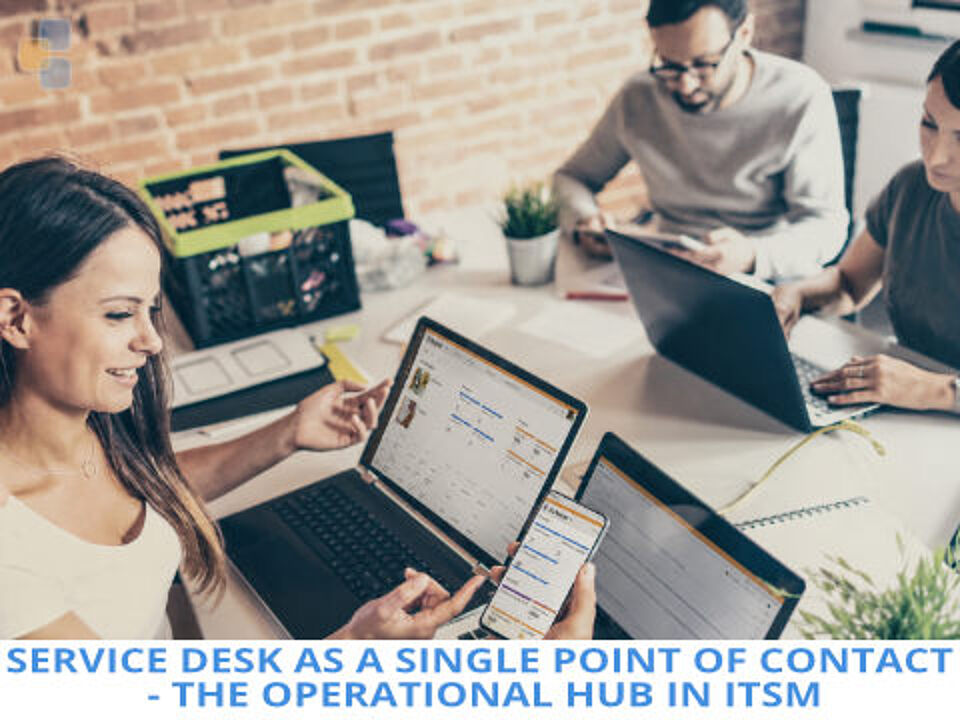
Roles and responsibilities in the SPoC model
A SPoC only works if responsibilities are clearly defined.
| Role | Typical responsibilities |
|---|---|
| Service Desk Agent | Receipt, documentation, classification, initial diagnosis and communication |
| First-Level Support | Handling standardised and frequently occurring issues |
| Second-Level Support | Handling specialised technical or subject-matter-related processes |
| Service Desk Manager | Management of workload, quality, escalations and key performance indicators |
| Service Owner | Responsibility for the quality, performance and further development of an IT service |
| Process Owner | Responsibility for the design and effectiveness of an ITSM process |
| Major Incident Manager | Coordination of business-critical incidents |
| Knowledge Manager | Development, quality and utilisation of the knowledge base |
| Department or External Service Provider | Handling defined specialist or technical tasks |
It is important that transferring a ticket does not result in a loss of responsibility. Every process must have a traceable status, a designated person responsible for handling it and a defined next step at all times.
Which metrics indicate the effectiveness of the SPoC?
An SPoC should not only be achievable but also demonstrably effective. Metrics help identify quality, utilization, and opportunities for improvement.
First Contact Resolution Rate
The First Contact Resolution Rate shows what percentage of issues are resolved during the first contact.
A high rate can indicate a good knowledge base, clear processes, and sufficient expertise within the service desk.
Calculation: Suitable tickets resolved on first contact / total number of suitable tickets × 100
Response Time
Response time measures how quickly qualified handling begins after a request is received.
An automatic acknowledgment of receipt alone does not constitute a substantive response.
Resolution Time
Resolution time shows how long a case takes from receipt to complete resolution.
This should be broken down by priority, service, category, and ticket type.
SLA Compliance Rate
The SLA compliance rate shows what percentage of tickets were processed or resolved within the agreed-upon timeframes.
Calculation: Tickets processed within the agreed service level / all SLA-relevant tickets × 100
Escalation Rate
The escalation rate shows how often tickets are escalated to other teams.
A very high rate may indicate a lack of expertise, unclear responsibilities, or overly broad classification.
Reopening Rate
The reopening rate shows how many tickets that have already been closed are reopened.
A high rate may indicate incomplete resolutions, unclear communication, or premature closures.
Number of Overdue Tickets
Overdue tickets indicate an immediate need for action. They should be analyzed by cause, responsible team, priority, and affected service.
User Satisfaction
A brief evaluation after ticket closure provides insight into how users perceive responsiveness, communication, and the resolution.
Self-Service Rate
The self-service rate shows what percentage of issues is resolved via a portal, standardized forms, knowledge articles, or automated processes.
Knowledge usage
The usage and effectiveness of knowledge articles should also be considered:
- How often are articles accessed?
- Which articles help prevent tickets from being created?
- Which solutions are used by the service desk?
- Which content is outdated or incomplete?
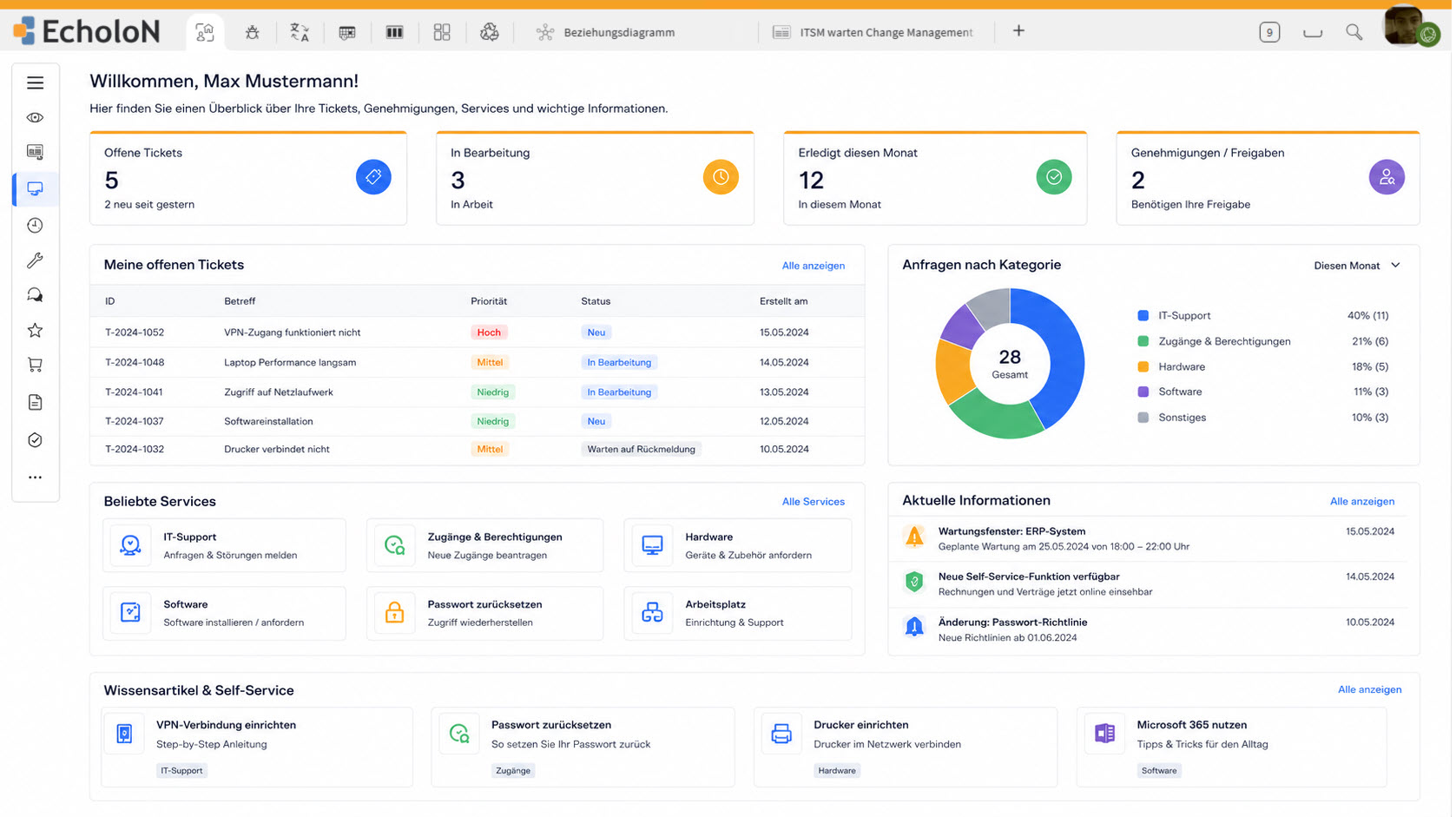
Example of an SPoC Dashboard
A dashboard for the SPoC and Service Desk should combine operational and qualitative metrics.
Useful elements include:
- Open tickets by status
- Tickets by priority
- Ticket volume by time period
- Tickets by intake channel
- Tickets by service and category
- Cases at risk of SLA violation
- Overdue tickets
- Average response time
- Average resolution time
- First Contact Resolution Rate
- Escalation Rate
- Reopening Rate
- User Satisfaction
- Support Team Workload
- Most Frequent Issues and Service Requests
A dashboard should not merely display numbers. It must clearly highlight where action is needed. This includes, for example, rising ticket volumes, recurring issues, overburdened teams, or service levels at risk.
Practical example: Outage of a business-critical IT service
A user reports that they cannot access the ERP system.
The SPoC first records the following:
- Affected users
- Location
- Affected service
- Error message
- Time of occurrence
- Potential impact
- Measures already taken
The Service Desk then checks whether similar reports have already been filed.
If only a single user is affected, a standard incident can be opened, and a standardized diagnosis can be performed initially.
If multiple departments or locations are affected, the business impact increases. The priority is adjusted accordingly. Depending on the scope, the major incident process may be initiated.
In this case, the SPoC does more than just log the incident. They also coordinate communication, inform affected users about the status, and document workarounds or solutions.
Once resolved, the data can be analyzed for problem management if the issue has recurred or if its root cause has not yet been permanently resolved.
Implementing a SPoC in ITSM: A Practical Approach
The implementation of a SPoC should not begin with a new email address. First, processes, roles and responsibilities must be clarified.
-
1. Analysing types of enquiries
First, we examine which issues arise on a regular basis.
These include, for example:
- Incidents
- Service requests
- Authorisation requests
- Information requests
- Requests for changes
- Enquiries regarding existing tickets
- Notifications from external systems
Result: defined case and process types.
-
2. Specify input channels
Companies must decide which channels are to be offered as standard and how these are to be integrated from a technical perspective.
Result: a standardised channel strategy.
-
3. Defining roles and responsibilities
The following must be clearly defined:
- Who handles enquiries?
- Who classifies and prioritises them?
- Which issues does first-level support resolve?
- When are enquiries escalated?
- Who monitors escalations?
- Who communicates with the user?
Result: a transparent model of accountability.
-
4. Setting up services and categories
Enquiries should not simply be categorised under general technical headings. A service-oriented structure provides better opportunities for analysis.
Result: a catalogue of services and categories.
-
5. Setting priorities and escalation rules
Impact and urgency must be assessed according to standardised criteria.
Result: a priority matrix with defined escalation paths.
-
6. Define service levels
Response, processing and resolution times are set for different services and transaction types.
Result: measurable service targets.
-
7. Configuring ITSM workflows
The defined rules are mapped within an ITSM solution.
These include:
- Forms
- Status models
- Mandatory fields
- Assignment rules
- Approvals
- Escalations
- Notifications
- Automations
- Reports
Result: a technically executable ITSM process.
-
8. Integrating knowledge and self-service
Frequently asked questions and standardised services should be made available via knowledge articles, service catalogues and self-service.
Result: Reduced workload for the service desk and a more user-centred approach.
-
9. Training users and support teams
Users need to know how to use the SPoC and what information is required to ensure cases are processed quickly.
Support teams need to understand how classification, prioritisation, escalation and documentation are carried out.
Result: a consistently applied process.
-
10. Analysing key performance indicators and improving processes
Following implementation, ticket data, service levels, escalations and user feedback are regularly analysed.
Result: continuous improvement based on reliable data.
EcholoN enables you to integrate intake channels, roles, priorities, SLAs, escalations and workflows into a single, centralised ITSM solution.
Common mistakes in SPoC implementation – and how to avoid them
A SPoC does not automatically provide added value. Implementation often fails due to organizational gaps.
The SPoC is perceived merely as an email address
While a shared mailbox consolidates messages, it does not yet create a manageable ITSM process.
Better: Automatically convert emails into structured cases and link them to categories, priorities, responsibilities, and deadlines.
Direct communication bypasses the process
Users continue to contact individual IT staff members. As a result, tickets, metrics, and transparent processing statuses are missing.
Better: Establish clear communication rules and consistently document direct inquiries.
Categories are unclear or too broad
Too many categories make selection difficult. Too few categories prevent meaningful classification.
Better: Develop categories based on actual services and request types, and review them regularly.
Priorities are assigned subjectively
If every request is classified as urgent, prioritization loses its effectiveness.
Better: Assess impact and urgency according to defined criteria.
Tickets are forwarded without information
Downstream teams have to ask the user for information again.
Better: Define required information and handoff criteria.
Users do not receive status updates
Even technically correct handling is perceived negatively if communication is lacking.
Better: Combine automated and manual status updates.
Recurring issues are not analyzed
Identical incidents are repeatedly resolved individually without investigating the root cause.
Better: Link ticket data to problem management and knowledge management.
SLAs are defined but not monitored
Agreed-upon times remain ineffective if no alerts or escalations are triggered.
Better: Technically implement thresholds, notifications, and escalation rules.
EcholoN as a Platform for SPoC, Service Desk, and ITSM Processes
A SPoC requires a common data and process foundation. If phone calls, emails, portal transactions, and direct reports are managed separately, the single point of contact remains organizationally incomplete.
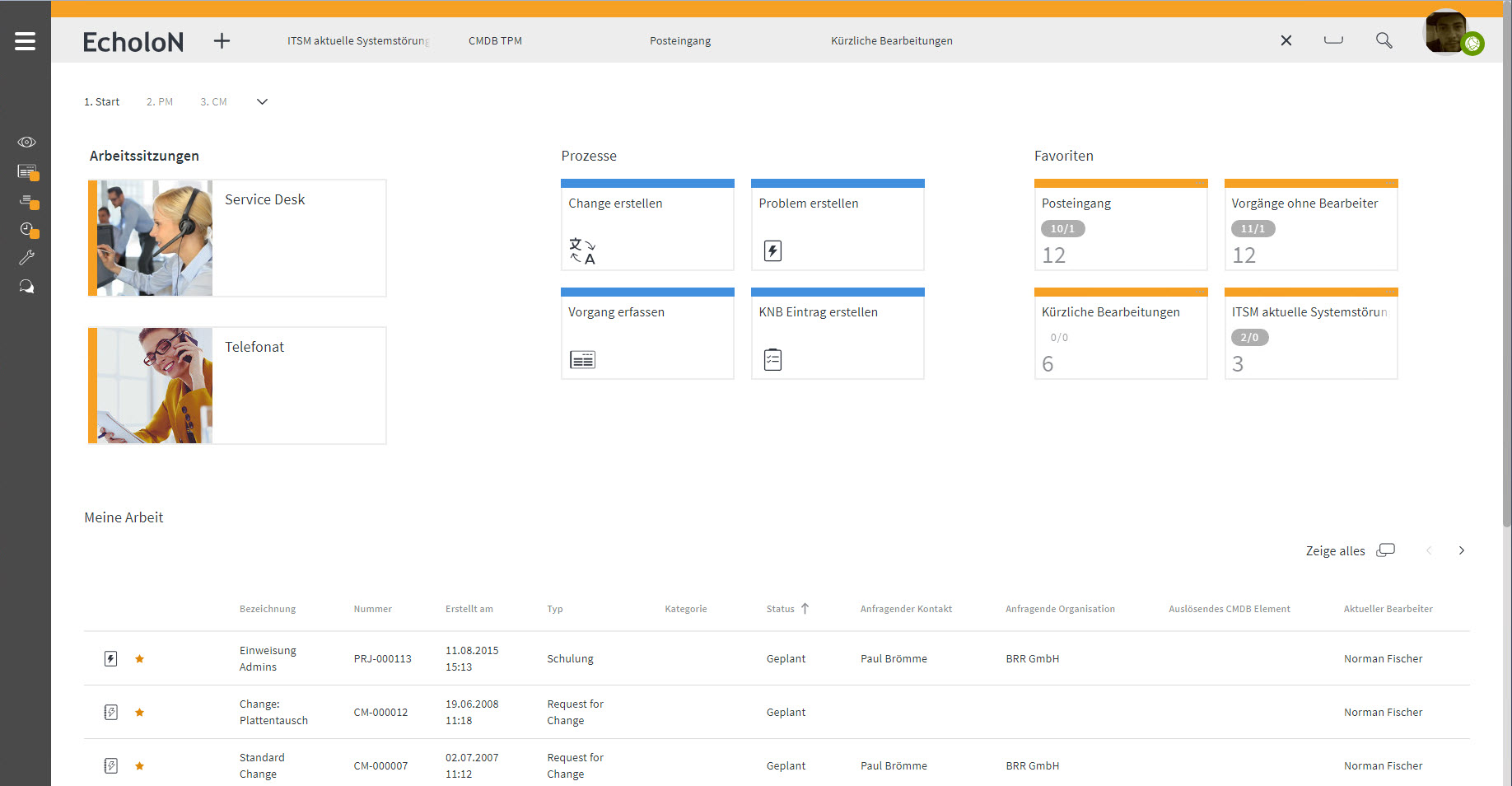
EcholoN helps companies consolidate different intake channels and service processes onto a single platform.
Requests can be centrally recorded, assigned to the relevant services, classified, and prioritized according to defined rules. Responsibilities, service levels, escalations, and processing statuses remain traceable throughout the entire process.
Possible features include:
- Centralized ticket and case recording
- Service and category catalogs
- Assignment to customers, organizations, and users
- Assignment to IT services and configuration items
- Prioritization based on impact and urgency
- Automatic assignment rules
- SLA monitoring
- Functional and hierarchical escalations
- Tasks and approval workflows
- Status communication
- Knowledge management
- Self-service
- Reporting and dashboards
- Integration with other systems and departments
As a result, the Service Desk becomes not just a point of contact, but a controllable operational unit within IT Service Management.
The integration with knowledge management, self-service, configuration management, workflows, and other enterprise service management processes enables the reuse of information and the gradual improvement of processes.
For more information, see:
Conclusion: A SPoC makes ITSM processes transparent and manageable
A SPoC in IT service management provides a standardized point of contact for IT services without burdening users with internal responsibilities.
However, its value does not stem solely from a central point of contact. The underlying processes are crucial: structured data collection, accurate classification, transparent prioritization, clear responsibilities, monitored service levels, targeted escalations, and reliable communication.
In practice, the service desk often assumes this role. It resolves issues directly or coordinates their handling by downstream teams. At the same time, it provides the data foundation for reporting, knowledge management, problem management, and continuous service improvements.
For companies, this means:
- fewer unstructured direct inquiries
- clearer responsibilities
- better data quality
- more transparent processing statuses
- more reliable service levels
- faster and traceable solutions
- greater control over the IT organization
With a suitable ITSM platform, a central point of contact becomes an end-to-end service process.
An effective SPoC requires more than just a central point of contact. Structured processes, clear responsibilities, automated escalations, monitored service levels and transparent communication are crucial.
With EcholoN, organisations can map out their service desk, ticket management, self-service, knowledge management and other ITSM processes on a single platform.
Would you like to explore how a SPoC could be implemented or improved within your IT organisation?
FAQ: Frequently Asked Questions About the SPoC in IT Service Management
What is an SPoC in IT Service Management?
An SPoC in IT Service Management is the single point of contact for IT inquiries, incidents, and service requests. It receives issues, documents them, classifies them, and routes them to the appropriate ITSM process.
Is the Service Desk always the SPoC?
In many companies, the Service Desk assumes the role of the SPoC. However, SPoC fundamentally describes an organizational principle. Other central service units can also take on this function.
Does SPoC mean that only one point of contact is allowed?
No. An SPoC can be reached through multiple channels such as a portal, email, phone, or chat. The key is that all cases are centrally documented and processed according to standardized procedures.
How does the SPoC distinguish between incidents and service requests?
An incident describes an unplanned disruption or limitation of an IT service. A service request is a standardized request for a service, information, or deployment.
Does the SPoC have to resolve every ticket themselves?
No. The SPoC can resolve tickets directly or escalate them to specialized support teams. However, they ensure that the process is fully documented, correctly assigned, and handled in a traceable manner.
What information should the SPoC record in the event of a disruption?
Important information includes the affected service, the affected users, the time of occurrence, the error message, the business impact, and any measures already taken.
What metrics are relevant for a SPoC?
Key metrics include the first-contact resolution rate, response time, resolution time, SLA compliance rate, escalation rate, reopening rate, number of overdue tickets, and user satisfaction.
How does ITSM software support a SPoC?
ITSM software consolidates incoming channels, documents tickets, supports classification and prioritization, manages responsibilities, monitors service levels, and enables escalations, reporting, knowledge management, and self-service.
Is an SPoC a single point of failure?
No. A single point of contact is a central organizational point of contact. It should not depend on a single person or a single unsecured system. Rules for delegation, multiple intake channels, and technical redundancy prevent the SPoC from becoming a single point of failure.
How do you implement an SPoC in ITSM?
To implement an SPoC in IT Service Management, companies first analyze existing request types, contact channels, and responsibilities. Next, central intake channels, roles, prioritization rules, service levels, and escalation paths are defined and mapped within the ITSM system. Employees are trained, users are informed about the new contact channels, and operations are launched in a controlled manner. Metrics such as first-call resolution rate, response time, escalation rate, and user satisfaction then indicate where the SPoC needs further improvement.