

Eine Helpdesk Software ist eine zentrale Anwendung zur Organisation und Bearbeitung von Supportanfragen. Sie erfasst Anliegen als nachvollziehbare Tickets oder Vorgänge, ordnet Zuständigkeiten zu und unterstützt Supportteams dabei, Anfragen zu klassifizieren, zu priorisieren, zu bearbeiten, bei Bedarf zu eskalieren und dokumentiert abzuschließen.
Moderne Helpdesk-Software geht damit über eine gemeinsame Ticketliste hinaus. Sie verbindet die Bearbeitung von Anfragen mit Kommunikation, Wissen, Service Levels, Self-Service, Automatisierung und Auswertung.
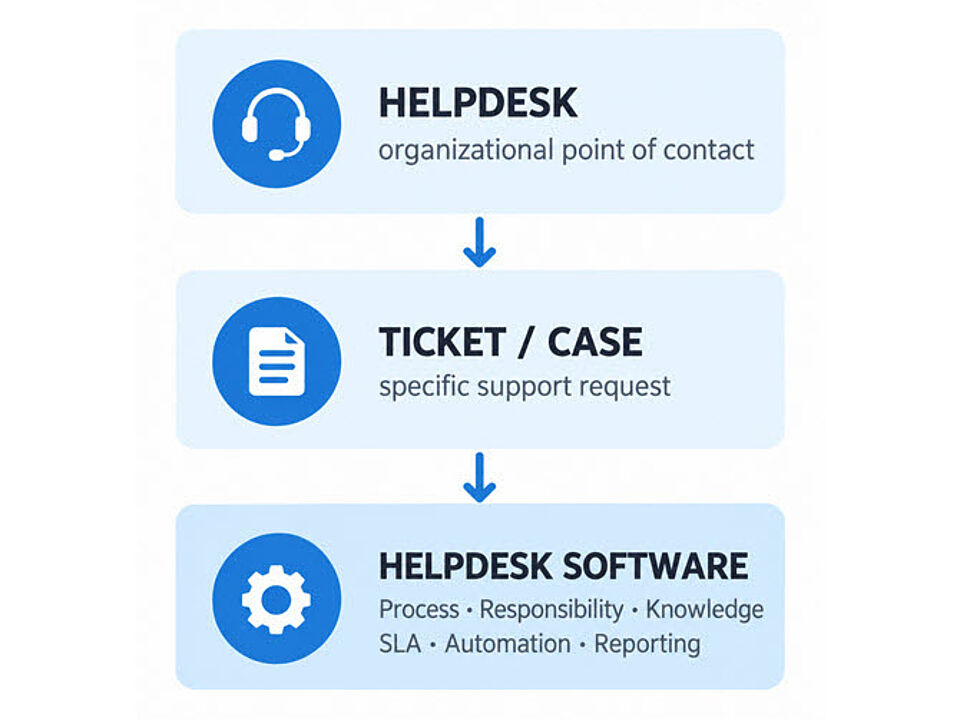
Kurz erklärt: Der Helpdesk ist die organisatorische Anlaufstelle für Support. Die Helpdesk-Software stellt die technische und prozessuale Grundlage bereit, mit der dieser Support strukturiert organisiert und gesteuert werden kann.
What is a help desk?
A help desk is a central point of contact for employees, customers, or other users who need assistance with a question, issue, or service-related concern.
The types of issues handled there depend on the specific company. In an internal IT department, for example, problems with applications, user accounts, permissions, or devices may be addressed. In technical customer support, the focus may be on products, systems, or software. In customer service, inquiries, complaints, or other service-related issues may be handled.
The fundamental task is similar regardless of the area of application: A request should not depend on whether the person making the request happens to know the right contact or whether a message ends up in the correct inbox.
The help desk provides a defined point of access to support and organizes the subsequent handling of the request.
Three levels should be distinguished:
The help desk describes the organizational function.
The ticket or case represents a specific request.
The help desk software supports the information, processes, and parties involved that are necessary for handling the request.
What are the benefits of helpdesk software?
Helpdesk software offers a variety of benefits that help companies to make their customer service more efficient and effective. Here are some of the most important benefits of helpdesk software:
Efficient resource management
With helpdesk software, businesses can manage their resources efficiently. The software makes it possible to optimise the workload of customer service staff and ensure that they can focus on the important tasks. Through efficient resource management, companies can improve their customer service performance.
Improved team communication
Helpdesk software promotes communication and collaboration within the customer service team. The software enables staff to communicate about tickets and requests, share information and collaborate effectively. Improved team communication leads to faster and more coordinated solutions to customer queries.
-
1. A request is logged as a case
Requests are received by Support through the designated channels. The request is converted into a ticket or case with a unique identifier.
This provides a common point of reference for all further processing.
-
2. The case is provided with the necessary context
A message text alone is often insufficient for structured processing.
Categories, affected products or services, the person making the request, organizations, priorities, and other information help classify the case.
Which details are actually required should depend on the specific support process.
-
3. Responsibility is assigned
The case is assigned to a person, group, or other responsible party.
This assignment can be done manually or supported by rules and existing information.
It is crucial that it remains clear who is responsible for the next step in the process.
-
4. The process remains traceable
Communication, follow-up questions, status changes, tasks, and other steps remain linked to the case.
This ensures that even when the case is handed off to other employees or teams, it is clear what has already been done and what information is available.
-
5. Deadlines and escalations are taken into account
If response or processing targets have been agreed upon, they can be systematically monitored.
An escalation does not necessarily mean that something has already gone wrong. Used correctly, it highlights at-risk processes early on and triggers defined follow-up actions.
-
6. Closed-case information remains usable
The potential value of the recorded information does not end with the resolution of a request.
What tasks does a help desk handle?
- A help desk does more than just receive inquiries. It manages the process from the initial request to the resolution.
This includes, in particular, logging and triaging an inquiry, determining or identifying the appropriate point of contact, coordinating the handling of the issue, and communicating with the person who submitted the inquiry.
How these tasks are distributed within a company can vary greatly.
First-Level Support
- First-level support is often the first point of technical contact.
Inquiries are received there, assessed, and—provided the necessary information, expertise, and permissions are available—resolved directly.
An effective first-level support team therefore requires not only staff but also clear processes and accessible solution knowledge.
Second-Level Support
- Second-Level Support typically handles cases that require additional expertise, special permissions, or further investigation.
This may involve, for example, specialists from IT, engineering, product management, or other departments.
Third-Level Support
- Third-Level Support addresses highly specialized or complex issues.
Depending on the organization, internal experts, development teams, manufacturers, suppliers, or external service providers may be involved.
First, second, and third levels are thus support tiers within a possible organizational model. They are not different types of helpdesks.
Nor is a three-tier support model a prerequisite for professional support. What matters most is that responsibilities and handoffs align with the actual organization.
What features does help desk software really need?
A list of features that’s as long as possible isn’t a reliable indicator of quality.
The crucial question is rather: Which features are actually needed for your specific support model?
Basic Features
For a structured help desk, central ticket tracking, clear responsibilities, traceable statuses, documented communication, and a history of the handling process are typically essential.
Without these fundamentals, an application remains functionally little more than a shared inbox.
Features Depending on the Support Model
Additional requirements arise from the organization itself.
Service levels and escalations become relevant when binding response or resolution targets are in place.
A knowledge base is useful when documented solutions are to be systematically reused.
Self-service becomes valuable when users are expected to retrieve information on their own, log incidents in a structured manner, or track their status.
Automation is particularly well-suited for sufficiently well-defined, regularly recurring processes.
Integrations become important as soon as information from CRM, ERP, monitoring, or other applications is required for processing.
Features for Increasing Organizational Complexity
With multiple teams, companies, locations, customer groups, or services, the demands on roles, permissions, data structures, workflow control, and reporting increase.
At this point, at the very latest, the question “Can the software manage tickets?” is no longer sufficient for making an informed selection.
What becomes relevant is whether different processes can be mapped in a controlled manner within a common structure and further developed later on.
What problems should help desk software solve?
A sensible selection process does not begin with product features, but with the problems actually observed in the existing support system.
| Observations in Support | Possible Structural Cause | Approach for a Help Desk Solution |
|---|---|---|
| Requests get lost | No controlled, centralized intake | Clear case tracking |
| Users frequently ask about the processing status | Status is not transparent | Status model, notifications, self-service |
| Tickets regularly end up with the wrong team | Categories or responsibilities are unclear | Structured logging and routing |
| The same questions are answered over and over again | Knowledge is not systematically maintained and utilized | Knowledge management and self-service |
| Critical issues are identified too late | Deadlines are monitored manually or inconsistently | Service levels, follow-ups, and escalations |
| Information is lost during handoffs | Processing is person-based rather than case-based | Shared case history and documentation |
| Discussions about support performance are based on individual opinions | A shared database is lacking | Reporting and consistent metrics |
This perspective prevents software features from becoming an end in themselves.
A feature only provides concrete value when it resolves an actual problem, improves a process, or enables a necessary control.
Ticket System, Help Desk, Service Desk, and ITSM: What’s the Difference?
These terms are not used entirely consistently in the market. Rigid, universally applicable definitions would therefore be misleading.
As a guide, we can distinguish typical areas of focus:
| Term | Typical Area of Focus |
|---|---|
| Ticket System | Structured recording, assignment, and tracking of requests and cases |
| Help Desk-Software | Organizing operational support for these requests |
| Service Desk | More closely linking support to defined services and advanced service processes |
| IT Service Management | Integrated planning, management, and improvement of IT services and multiple ITSM processes |
A ticket system can thus be a component of a help desk solution. A help desk, in turn, can be part of a more comprehensive service management structure.
The specific term used to describe a particular solution is less important than the actual processes and functions implemented.
For a more detailed classification, see the article The Service Trio: Ticket System, Help Desk Software, and Service Desk.
You can also find information on technical implementation on the solution pages for the EcholoN Ticket System and the EcholoN Service Desk Software.
Where is help desk software used?
Help desk software is often associated with IT support, but its use is not limited to that.
Internal IT Support
- Employees report issues with applications, devices, user accounts, permissions, or other IT-related matters.
- A centralized help desk provides a defined point of access to support and enables traceable case handling.
Technical Customer and Product Support
- Manufacturers, software providers, and technical service providers can systematically record questions and issues regarding products or services and forward them to the appropriate specialists.
Customer Service and After-Sales
- Complaints, inquiries, and other service requests can also be organized and documented as traceable cases.
Other Internal Service Areas
- The basic principle of request, responsibility, processing, and workflow can also be applied to other areas of the organization.
- When services from different departments are provided on a common organizational and technical foundation, the use case increasingly moves toward Enterprise Service Management.
What are the benefits of help desk software?
The benefit of help desk software goes beyond simply replacing emails with tickets.
First, it creates transparency: The status, responsibility, and processing history of a case are easily traceable.
It establishes accountability: Cases are assigned responsibilities and can be processed according to defined rules.
It supports the reuse of knowledge: Documented solutions do not always need to be researched anew for similar cases.
It lays the foundation for automation: Only when workflows are sufficiently structured can recurring steps be effectively supported by technology.
And it enables measurability: Consistently recorded cases provide a data foundation for workload, processing times, and process quality.
However, these benefits do not arise automatically simply by implementing software.
Poor or unclear processes do not automatically become good processes through digitization.
Knowledge Base and Self-Service: Why Knowledge Must Be Organized
Over time, a support team resolves numerous similar or recurring issues.
However, a closed ticket does not automatically result in a good knowledge article.
A ticket initially documents an individual case. For it to become reusable knowledge, the information must be understandable, technically accurate, discoverable, and suitable for the intended audience.
That is why knowledge management requires clear responsibilities.
Who is authorized to create a knowledge article? Who reviews it? How is it determined when information is outdated? Which content is restricted to support staff, and which is suitable for users or customers?
A knowledge base therefore derives its value not solely from the number of stored articles, but from its quality, structure, and maintenance.
A self-service offering expands on this principle. Users can search for approved information themselves and—depending on the solution used—digitally submit standardized requests or track the status of existing cases.
We cover this topic in more detail in the article What Is Self-Service? Best Practices and Use Cases. The practical software implementation is described on the page for the EcholoN Self-Service Portal.
Automation in the Help Desk: Clarify the Process First, Then Automate
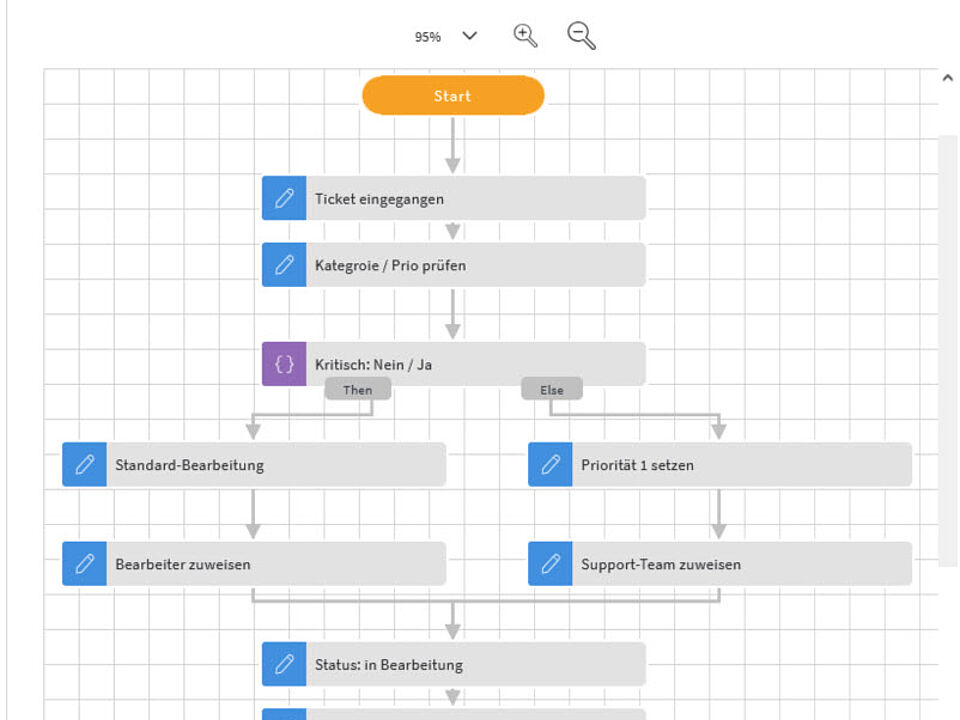
Automation can significantly simplify recurring workflows.
Typical examples include task assignments, notifications, deadlines, follow-ups, or standardized follow-up tasks.
However, automation becomes problematic when it merely executes an unclear process more quickly.
For example, if the criteria for categorizing a task are not clearly defined, an automatic forwarding based on that category does not solve the underlying problem. It merely automates an uncertain decision.
Before automating a process, three questions should therefore be clarified:
What triggers the process step?
What information is needed to make the decision?
What should happen in the event of an exception?
Automation is therefore not an end in itself. It is the technical implementation of sufficiently clearly defined rules and workflows.
Which metrics are useful for a help desk?
Metrics are helpful when they answer a specific technical question.
They become problematic when individual values are used as a general assessment of quality without context.
| Metrics | What They Indicate | Common Misinterpretations |
|---|---|---|
Ticket volume | Number of incoming cases over a period of time | More tickets do not automatically mean poorer support; the number of users, new services, or improved accessibility can also affect the volume |
| Initial response time | Time until the first qualified response | A quick, standard response does not automatically equate to helpful support |
| Resolution time | Time between case creation and closure | A low resolution time says little about quality if cases are closed prematurely |
| Backlog | Number of open cases | The raw number ignores the age, priority, and complexity of the cases |
| First Contact Resolution | Percentage of issues resolved on the first contact | A high rate is not an end in itself if complex cases actually require specialized knowledge |
| SLA Compliance | Percentage of cases meeting defined service targets | Meeting an SLA does not automatically mean the user is satisfied with the solution |
| Reopenings | how often closed cases are reopened | This metric alone does not explain whether the cause is an incomplete resolution, new information, or other circumstances |
| Satisfaction scores | feedback from surveyed users | The result depends, among other things, on who responds, when the survey is conducted, and how the question is phrased |
The most important rule is therefore:
Key metrics should not be viewed in isolation.
A decrease in average resolution time can be positive. However, if reopenings or escalations increase at the same time, this trend must be evaluated differently.
Average values can also be skewed by individual extreme cases. Depending on the question at hand, a supplementary analysis of the median, distribution, or age structure may therefore be significantly more informative.
The selection of a metric should also begin with a clear question:
What decision do we want to make better with this information?
Common Mistakes in Help Desk Processes
Not every problem in the help desk is a software issue. Many difficulties arise simply from unclear organizational rules.
- Unclear Responsibilities: If it is not defined who is responsible for certain types of requests, even an automated assignment system cannot make a reliable decision. Organizational responsibilities must be clarified first.
- Too many categories: A highly detailed category tree may seem structured at first, but it can make data entry more difficult. Categories should serve a specific purpose—such as routing, reporting, or process control.
- Too many escalation levels: An escalation should have a defined consequence. If every process triggers numerous reminders, warnings, and hierarchical levels, it creates additional communication without necessarily improving processing.
- Automation of undefined processes: A workflow can reliably execute rules. It cannot replace the need to decide in advance which rules make business sense.
- Self-service without maintained knowledge: A portal alone does not reduce support work. If information is incomplete, hard to find, or outdated, it merely changes the way support is accessed.
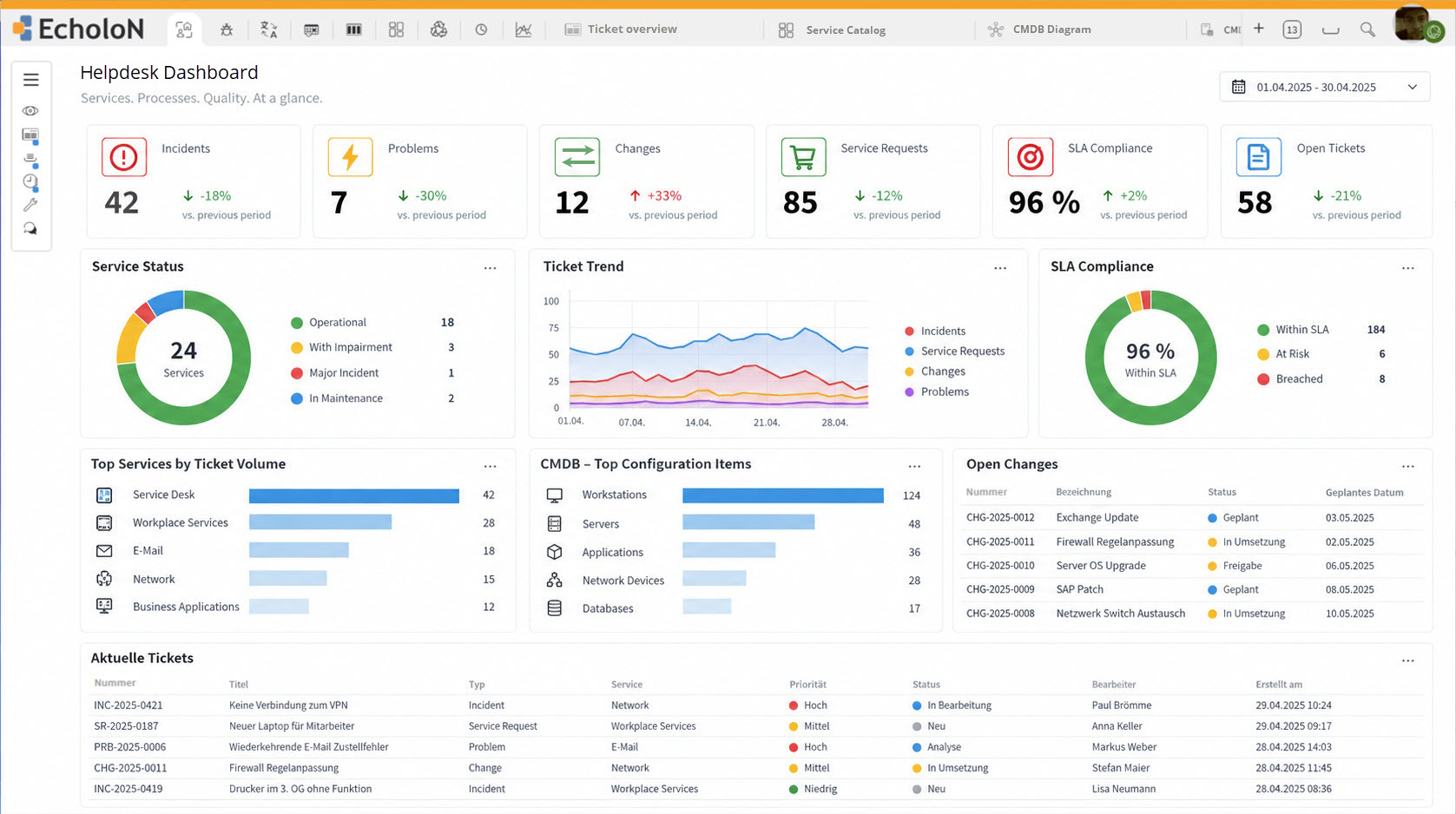
- Metrics without decision-making relevance: A dashboard can display a great many values. However, the relevant metrics are those from which a business assessment or a specific action can be derived.
Professional help desk support therefore arises from the interplay of organization, processes, knowledge, employees, and software.
What should you look for when choosing help desk software?
The selection process should not begin with a list of vendors or a feature comparison that is as comprehensive as possible.
The starting point should be your own support model.
-
1. Identify Target Audiences
First, it’s important to determine who uses the help desk.
Internal employees have different requirements regarding authentication, portals, and processes than external customers, resellers, or service partners.
-
2. Examine Real-World Support Cases
Instead of immediately creating an abstract list of requirements, you should examine typical cases from day-to-day operations.
What are the five to ten types of requests that occur regularly? What information is needed? Who handles them? What exceptions occur? Where are there currently wait times or follow-up questions?
These real-world scenarios are much better suited for a software evaluation later on than a general list of features.
-
3. Jointly Assess Volume and Complexity
The number of incoming tickets alone is not a sufficient selection criterion.
Other relevant factors include, for example, the number of teams involved, different customers or organizations, service goals, handoffs, integrations, and the variability of processes.
-
4. Prioritize requirements
Not every desired feature carries the same weight.
A useful classification is:
Must-have: Without this requirement, a critical process cannot be implemented effectively.
Desirable: The feature offers a clear benefit but is not a mandatory prerequisite for launch.
Nice-to-have: The feature would be useful but does not determine the solution’s fundamental suitability.
This prioritization prevents rarely used special features from being given the same weight as core processes.
-
5. Evaluate Complete Workflows Rather Than Individual Features
A product demo should not merely show that a specific feature is available.
A complete, real-world support case is more revealing:
How is the request logged? What information is available? How is the request assigned? What happens in the event of an exception? How does a handoff work? What does the requester see? How is the process closed and evaluated?
This reveals how well the individual features actually work together.
-
6. Consider administration and adaptability
Support processes do not remain unchanged forever.
New teams, customers, products, services, or organizational requirements change workflows.
Therefore, it should be clarified which adjustments may be necessary later, who is authorized to make them, and what effort is involved.
-
7. Consider integrations early on
A help desk solution rarely operates in complete isolation.
If information from CRM, ERP, monitoring, user management, or other applications is needed during processing, the issue of integration should be clarified before selecting a product.
-
8. Plan for Knowledge and Data Migration
When replacing existing systems, the question arises as to which existing data actually needs to be migrated.
Not every historical case has the same long-term value.
Active tickets, relevant solution knowledge, master data, and information required for reporting or compliance purposes should therefore be carefully evaluated, rather than migrating all legacy data without review.
-
9. Review the operating model and responsibilities
The operating model influences technical and organizational responsibilities.
Therefore, your own requirements for infrastructure, administration, security, data protection, availability, data storage, and integration must be evaluated.
-
10. Plan for Future Development Realistically
A solution should not be selected solely for today’s minimum needs nor for hypothetical requirements.
A realistic development perspective makes more sense:
What additional teams, processes, or services are actually foreseeable? Will these need to be implemented later within the same solution? Or will a clearly defined help desk application suffice in the long term?
KnowledgeChecklist for Selecting Help Desk Software
The following checklist summarizes the most important points for evaluating software:
| Area | Question for Evaluation |
|---|---|
| Target Audience | Who submits requests, and who handles them? |
| Intake | Through which channels do support requests come in? |
| Volume and Complexity | How many cases are generated, and how complex is their resolution? |
| Responsibility | How are tickets assigned to teams or specialists? |
| Prioritization | What criteria are used to identify important or critical cases? |
| Service Goals | What response or resolution times must be taken into account? |
| Exceptions | How are special cases, hand-offs, and escalations handled? |
| Knowledge | How are existing solutions maintained and reused? |
| Self-Service | Which issues can users resolve on their own or initiate digitally? |
| Automation | Which recurring steps are sufficiently defined from a business perspective? |
| Integrations | Which existing systems and data are required for processing? |
| Reporting | Which decisions should be supported by key performance indicators? |
| Administration | Who will be able to modify processes, roles, and structures later on? |
| Operations | What technical, organizational, and regulatory requirements exist? |
| Future Development | What realistic expansions can be expected in the coming years? |
Such a checklist is no substitute for an individual evaluation. However, it prevents a decision from being based solely on product names, marketing claims, or the number of available features.
Conclusion: Help desk software does more than just manage tickets
Help desk software creates a common foundation for the structured handling of support requests.
Its value does not stem solely from ticketing. The key lies in the interplay of controlled data entry, clear responsibilities, traceable processing, knowledge, rules, and actionable information.
The software should never be viewed in isolation from the support organization. Unclear responsibilities, inappropriate categories, poorly defined escalations, or unmaintained knowledge are not automatically resolved by a new application.
Anyone selecting a help desk solution should therefore first understand how their own support should function, what problems actually exist today, and what requirements are realistic for future development.
Only then can one meaningfully assess which software best supports this organization.
Implementing Help Desk Software with EcholoN
If you’re looking to go beyond the basics and digitally map out a specific help desk process, you’ll find more information on our solutions page about the EcholoN Help Desk Software for IT Support and Customer Service.
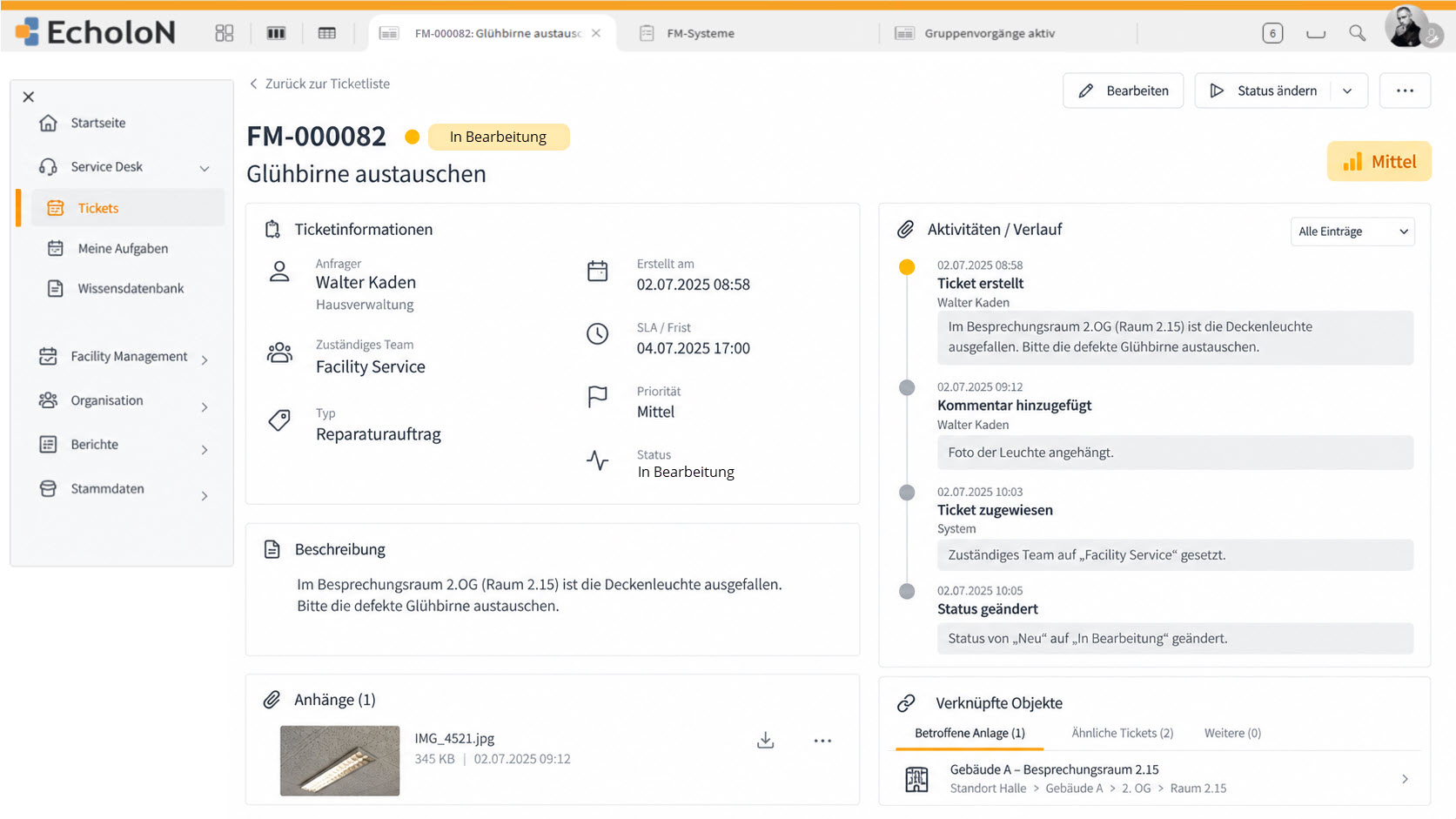
EcholoN combines ticket management, knowledge base, self-service, workflows, integrations, and other support functions on a single software platform.
Frequently Asked Questions About Help Desk Software
What is help desk software, explained simply?
Help desk software is an application designed to centrally organize support requests. It records issues as tickets or cases and assists with assigning responsibility, processing, communication, documentation, and analysis.
Is a help desk the same thing as a ticketing system?
Not necessarily. A ticket system typically focuses on the structured recording and tracking of tickets. A help desk also addresses the organization of operational support surrounding these requests. However, the terms are not used entirely consistently in the market.
Are First, Second, and Third Levels different types of help desks?
No. First, Second, and Third Levels refer to possible support tiers within an organization. They describe different areas of responsibility or levels of specialization and are not distinct types of helpdesks.
When is helpdesk software worthwhile?
Helpdesk software becomes particularly relevant when multiple people or teams handle requests, responsibilities and statuses must be transparent, deadlines need to be monitored, or knowledge management, self-service, automation, and reporting are required. The decisive factor here is not only the number but also the complexity of the processes.
What is most important when selecting help desk software?
The starting point should be the actual support processes. Companies should identify target groups, typical inquiries, responsibilities, volume and complexity, service goals, knowledge, integrations, administration, and future requirements—and then test complete, real-world support workflows with the respective software.