
Author: Sandra Effenberger
created on: 18.12.2025, last change: 07.01.2026
Table of content
Why modern contract management is critical for businesses today
Compliance as a basis: What clean contract management must achieve
From document to asset: The decisive change in perspective
How EcholoN integrates contracts into the asset ecosystem
Business value: Transparency, efficiency, cost certainty
Frequently asked questions (FAQ) – Contract management software – CLM
Contracts are the backbone of business relationships. They govern customer projects, supplier agreements and employment relationships. In many medium-sized companies, however, these documents are still piled up in filing cabinets, scattered across various folder structures or kept in Excel lists. It is easy to lose track of notice periods, extensions and important clauses. In addition, contracts contain legal relationships, costs and business-critical information. They must be stored securely, easy to find and documented in a traceable manner.
Modern contract management software solves these problems by digitally recording and structuring contracts and linking them to reminder and analysis functions. EcholoN goes one step further: the system treats contracts not only as documents, but as assets that can be managed like hardware, software or licences. The following guide explains why this approach makes sense, which compliance requirements need to be taken into account, and how you can use EcholoN to manage your contracts efficiently, transparently, and in an audit-proof manner.
Why modern contract management is critical for businesses today
Risks of traditional contract management
Without structured software, managing hundreds of contracts can quickly become a burden. Without a centralised system, deadlines are forgotten, contracts disappear into email inboxes and Excel files, or are accidentally renewed. This has concrete consequences:
- Financial risks: Missed cancellation deadlines can lead to automatic renewals with higher costs. Failure to meet service levels or forgotten renewal dates result in contractual penalties.
- Legal uncertainties: Companies that cannot access their obligations at any time are operating in a grey area. A lack of evidence of contract changes or responsibilities increases the risk in audits and legal proceedings.
- Time-consuming: Teams spend hours searching for contracts or manually entering them into calendars. A digital process saves time and prevents errors.
Digital contract management as a solution
Modern contract management software digitally maps the entire contract lifecycle. At its core is a central contract database in which all documents are stored in a structured manner. Important basic functions include quickly finding contracts, monitoring termination and renewal deadlines, and tools for creation and editing. Modern solutions offer digital signatures, approval workflows and reporting functions. They reduce manual effort, minimise errors and create transparency regarding costs, revenues and responsibilities.
Contract lifecycle management
A modern contract management software system with AI support helps companies and organisations to manage contracts digitally, digitise them and create them automatically. The software provides an overview of all contracts in the dashboard, so that contracts and deadlines remain in view. Through the direct integration of signature providers – DocuSign & Co. – users can sign contracts digitally or sign them directly in digital form to make processes smooth and uncomplicated.
EcholoN integrates upstream and downstream systems, allows archiving and management of contracts in a contract file, searching and extracting contract data and contract information, as well as contract review and analysis of contract content with text modules and contract templates. Such CLM solutions are intelligent, offer flexibility and freely configurable functions for individual requirements, minimise risks, provide valuable insights for informed decisions, support the legal department and comply with regulations such as DORA, the Digital Operational Resilience Act.
Compliance as a basis: what clean contract management must achieve
Retention and documentation requirements
Contract management has an essential governance function. According to the German Commercial Code and the German Fiscal Code, business-related documents must generally be retained for ten years.
In addition, there are industry-specific regulations, data protection laws such as the GDPR and certification requirements (ISO 9001, ISO 27001). Documents must be archived in an unchangeable, complete and gap-free manner, retrievable at any time and provided with a traceable history.
An audit-proof archive ensures that every change is logged without gaps and that previous versions remain accessible. It relies on tamper-proof storage structures, versioning, audit trails and finely graded rights concepts.
Compliance in contract law
Compliance encompasses consistent adherence to laws, official regulations and internal guidelines. The aim is to prevent illegal or careless misconduct; violations can lead to heavy fines and lasting damage to a company's image. Contract managers must take numerous regulations into account – from the General Data Protection Regulation to antitrust and anti-corruption law to industry-specific standards. For this reason, many contracts contain compliance clauses that specify audits and sanctions.
In practice, specialised teams check whether clauses comply with current laws and company standards as early as the drafting stage. Approvals are systematically documented so that it remains traceable how and why a contract was concluded. Digital contract management systems facilitate this work with automated verification mechanisms, tamper protection and complete documentation. Regular risk analyses and internal audits help to identify weaknesses.
From document to asset: the crucial change in perspective
From document to asset: the crucial change in perspective
Why contracts are considered assets
In traditional systems, contracts are viewed as static files. This way of thinking falls short. Contracts define rights, obligations and economic conditions; their structured availability supports decision-making processes, risk management and operational procedures.
EcholoN considers contracts to be assets – similar to hardware, software or licences. This perspective offers several advantages:
- Holistic life cycle: A contract has a life cycle that begins with its conclusion, continues through adjustments and renewals, and ends with its termination. As an asset, this cycle can be planned, controlled and evaluated in the same way as an IT asset.
- Cost and benefit perspective: Contracts contain costs (e.g. licence fees) and service levels. Assigning them to assets enables budget planning and shows which assets are financed by which contract.
- Risk assessment: Linked contracts show which obligations are tied to specific assets – for example, minimum terms, renewal clauses or SLAs. This allows risks to be identified and controlled at an early stage.
What data a contract asset contains
Setting up a contract management archive begins with capturing information according to contract type. For each contract, you should maintain at least the following data:
- Internal information: Contract owner, department, cost centre.
- Supplier information: Company name, contact person, contact address.
- Status: Whether the contract is active, under negotiation, approved or terminated.
- Date information: Start, termination and end dates, as well as renewal or withdrawal options.
- Asset reference: The contract must be linked to the associated asset in the asset repository.
Additional data is required for special contract types. An activity-based maintenance contract contains information about individual activities, their frequency and the budget per activity. Service contracts require information about service levels, start times, service windows and methods for performance measurement. Linking this data to assets enables comprehensive analysis and serves as a basis for maintenance and investment decisions.
Three starting points for recording your contracts
Planon suggests three key steps for recording contracts as assets:
- Link contracts to the asset repository. This supports reactive and planned maintenance processes and enables better analysis.
- Implement alerts and notifications in your process or contract system to assist with contract terminations or renewals.
- Link all digital or scanned contract documents to the relevant contract to ensure a central source of data.
These recommendations fit perfectly with the EcholoN approach, in which contracts become part of the asset structure.

How EcholoN integrates contracts into the asset ecosystem
As an enterprise service management suite, EcholoN is designed to automate processes and connect various corporate data sources. For contract management, EcholoN offers functions that go far beyond simple filing:
Central contract register
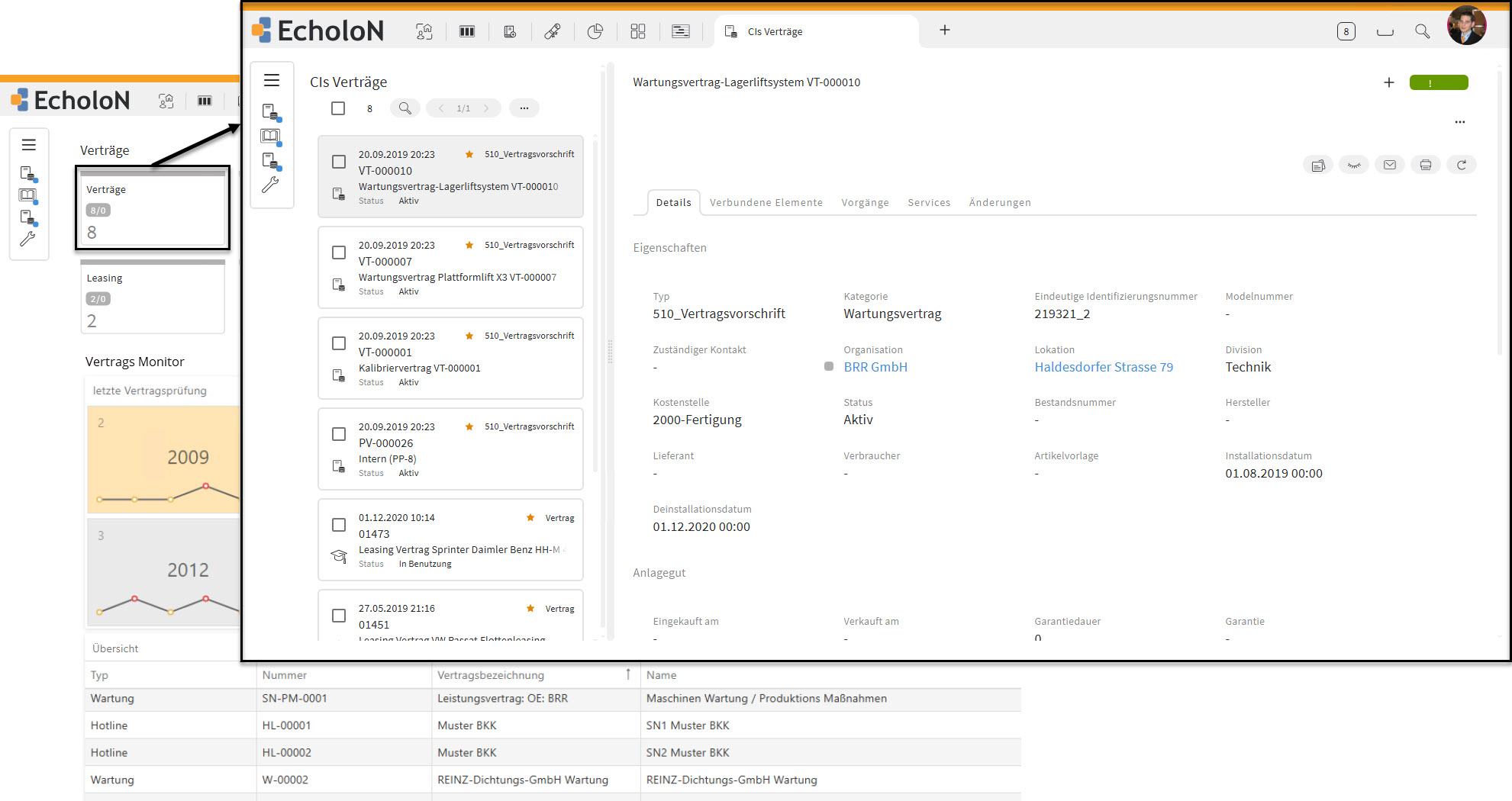
EcholoN provides a central contract register in which all contracts are recorded in a structured manner. Metadata such as contract type, partner, term, cost centre or responsible persons are maintained via freely configurable fields. Each contract can be linked to physical or digital assets via the asset reference. This allows you to know, for example, which licence agreement belongs to which software or which maintenance contracts apply to a particular machine.
Automated deadline and reminder management
Deadline management is one of the most important tasks in digital contract management. In EcholoN, you can store termination or renewal dates directly in the contract.
The system monitors this data, sends individual notifications and escalates if necessary. For example, rules can be set up to send reminders to the responsible persons 30 days before expiry. This means you are always well informed and never miss a deadline.
Linking contracts to assets
As described in the section ‘From document to asset’, the link to assets is central. EcholoN uses its asset and configuration management database (CMDB) to link contracts to equipment, software licences or service relationships. You can see not only which hardware is covered by a maintenance contract, but also which SLAs and costs are linked to specific services. This gives you a complete 360° view of your service landscape.
Role and authorisation concepts
The software supports differentiated roles and access rights. Those responsible can determine who is allowed to view, edit or approve contracts. In combination with audit trails and versioning, this ensures governance-compliant processes and meets internal and external compliance requirements.
Audit-proof documentation
EcholoN stores contract documents in an unalterable and complete form. Every change is logged with a timestamp and user. Tamper-proof storage, cryptographic security and detailed versioning ensure that the documents remain legally valid in the long term. Once the legally prescribed retention periods have expired, documents can be deleted automatically in accordance with GDPR.
Uniform workflows and approval processes
The EcholoN workflow engine enables standardised approval processes. New contracts go through defined review stages, compliance checks and approvals. Documented approvals ensure traceability. Integration with other EcholoN modules (e.g. incident or change management) allows contract processes to be embedded in cross-functional service workflows.
Transparency regarding costs, obligations, SLAs and risks
Dashboards and reporting functions give you an overview of current contracts, upcoming termination windows, costs and revenues at all times. Analyses show which contracts are about to expire, which assets are associated with high costs and which SLAs are frequently violated. This allows you to decide at an early stage whether to renew, renegotiate or terminate contracts.
Business value: transparency, efficiency, cost certainty
Recording contracts as assets in EcholoN creates tangible added value:
- Time savings and efficiency: Automated processes, reminders and centralised data reduce administrative effort. Teams spend less time searching and maintaining Excel files and can concentrate on core tasks.
- Reduction of errors and risks: Clear structures, automatic reminders and versioning minimise the risk of forgotten terminations or misplaced documents. Compliance risks are reduced through audit-proof storage and audit trails.
- Transparency and control: Dashboards provide an overview of all contracts. Those responsible can see at a glance which costs are associated with contracts and who is responsible.
- Strategic decision-making basis: By linking contracts to assets and services, they become predictable corporate assets. They serve as a basis for budget planning, risk assessment and contract negotiations.
Governance and audit compliance: Documentation that passes audits
Many companies fail audits or certifications because they have not documented contracts in an audit-compliant manner. EcholoN supports documentation that convinces auditors:
- Complete history: Every change to a contract is logged in a traceable manner. You can see at any time who made which changes and when.
- Tamper protection: Cryptographic hashing and digital signatures prevent documents from being changed without notice.
- GDPR-compliant deletion: Contracts can be automatically deleted after the retention periods have expired. The deletion process itself is documented.
- Fine-tuned rights assignment: Role and rights concepts ensure that only authorised persons have access.
Conclusion: Establish contract management as a strategic business process
Contracts are more than just documents – they are assets with rights, obligations, costs and risks. Professional contract management transforms distributed files and Excel lists into a centrally controlled, traceable and evaluable information base. EcholoN connects contracts with your asset landscape, providing a clear view of obligations, budgets and risks.
Companies benefit from greater efficiency, cost certainty and legal certainty.
Would you like to know how EcholoN can be integrated into your existing IT landscape? Find out more about our IT service management solution or discover the ticket system, the service desk or our field service management. We are happy to provide individual advice and a demo of our contract management functions – please contact us!
Frequently asked questions (FAQ) – Contract management software – CLM
What is contract management software?
Contract management software is a digital platform that supports the entire contract lifecycle – from creation and approval to termination. Its core functions include a central contract database, deadline and reminder functions, digital signatures, approval workflows and reporting. Modern solutions such as EcholoN also link contracts to assets, thereby supporting asset management.
Why should contracts be considered assets?
Contracts define rights, obligations, costs and SLAs. When treated as assets, their terms, budgets and risks can be managed in the same way as IT assets. The structured availability of this information supports decision-making processes, risk management and operational procedures. In addition, linking to the asset database provides a holistic view of services and costs.
How does EcholoN help with compliance contract management?
EcholoN helps companies comply with legal and internal retention and documentation requirements. The platform stores contracts in an audit-proof manner, logs every change and offers finely graded access rights. Automatic workflows ensure that approvals are documented and compliance checks are carried out.
What data should be recorded when entering a contract?
For each contract asset, internal information (contract owner, department, cost centre), supplier data, status, relevant dates and the asset reference should be recorded. Depending on the type of contract, additional data such as activities, budgets or service levels must be documented.
How does EcholoN ensure audit-proof documentation?
The software relies on tamper-proof storage structures, cryptographic security and versioning. Every change is recorded with a timestamp and user in the audit trail. Once the statutory retention periods have expired, contracts can be deleted automatically and logged.
Can EcholoN link contracts to other service processes?
Yes. Integration with the EcholoN workflow engine allows contracts to be seamlessly embedded in incident, problem or change management processes. For example, changes to an asset or service can automatically check whether a contract is affected.
What are the advantages of automated deadline and reminder management?
Automatic deadline management reduces manual effort and prevents termination or renewal deadlines from being overlooked. Individually configurable notifications provide timely information about upcoming decisions. This allows you to maintain control over your contract landscape and avoid unwanted renewals or contractual penalties.
Also interesting:
- CMDB - Configuration Management Database Complete Solution
- Overview of Configuration Management in IT Infrastructure
- IT Asset Management – Example & Advantages
- Blog article: Service Level Management
- Blog article: What is Enterprise Asset Management - EAM?
- Blog article: What does Service Asset mean?
- Blog article: Risk management reimagined